Table of Contents
Comunidad de Propietarios: What Mallorca Property Buyers Need to Know
The comunidad de propietarios is one of the most important concepts in Spanish property ownership, and one of the least understood by foreign buyers until they are already committed to a purchase. Every apartment, every townhouse in a development, every villa on an urbanisation with shared facilities — swimming pools, access roads, gardens, lifts — belongs to a comunidad de propietarios. Membership is automatic and mandatory from the moment you complete. There is no opting out, no choosing not to engage, and no ignoring the obligations that come with it. Understanding what the comunidad de propietarios is, what it can require of you, and what you should check before buying is essential preparation for anyone purchasing a Mallorca property that is not a completely standalone building on private land.
What Is a Comunidad de Propietarios?
A comunidad de propietarios is the legal entity formed automatically by all owners of individually-owned properties within a building or development that shares common elements. It is created by the Ley de Propiedad Horizontal — the Horizontal Property Law — first enacted in 1960 and substantially reformed in 1999, 2013, 2021 and most recently in 2022-2024. The law is the framework within which every comunidad in Spain operates, regardless of whether it is a two-apartment building in the old town of Palma or a large golf-course urbanisation in Calvia with hundreds of villas.
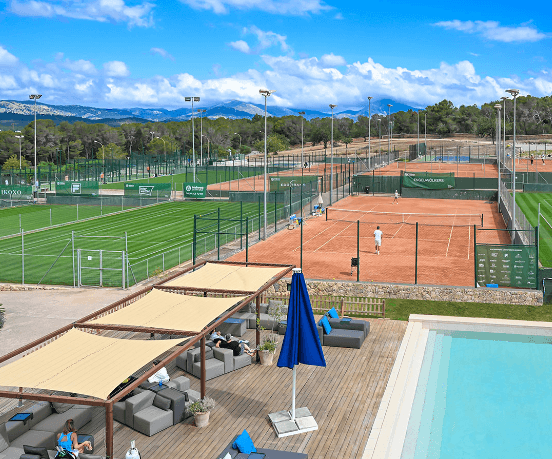
The shared elements — elementos comunes — can range from a staircase and a front door in a small apartment block to swimming pools, sports facilities, gardens, access roads, street lighting, security systems and concierge services in a larger development. Every owner holds full private ownership of their individual unit plus a proportional share of these common elements. That proportional share — the coeficiente de participacion — is fixed in the building's foundational deeds (the Escritura de Division Horizontal) and determines both your financial contribution to community costs and your voting weight in community decisions.
Community Fees: What You Pay and How It Is Calculated
Community fees — cuotas de comunidad — are the regular financial contributions each owner makes to fund the upkeep and management of the shared elements. They cover ongoing operational costs: cleaning of common areas, lift maintenance, pool maintenance, gardening, electricity for communal lighting, building insurance, and the administrator's fee where one is engaged. They do not cover repairs or improvements to private units.
The amount you pay depends on two factors: your coeficiente de participacion (your proportional share of the common elements, expressed as a percentage) and the total budget approved by the community at its annual general meeting. A larger apartment or a villa with a private garden within the development typically carries a higher coefficient — and therefore a higher fee — than a studio flat in the same building.
Community fees in Mallorca vary considerably by development type and facilities offered:
| Development Type | Typical Monthly Fee Range |
|---|---|
| Small apartment block, minimal facilities | 50 – 150 euros per month |
| Mid-sized development with pool and gardens | 150 – 400 euros per month |
| Large urbanisation with extensive facilities | 400 – 800 euros per month |
| High-end development with concierge and security | 800 – 2,000+ euros per month |
These are ordinary fees covering the annual operating budget. Extraordinary fees — cuotas extraordinarias — are levied separately when major unplanned or capital works arise: a roof replacement, facade repainting, lift modernisation, or pool resurfacing. These can represent significant additional costs, and they are voted on and approved by the community's general meeting rather than being discretionary.
How the Comunidad Is Governed
Every comunidad de propietarios operates through a governance structure defined by the Horizontal Property Law:
The President (Presidente) is the legal representative of the community, elected by the owners at the annual general meeting. Holding the position is mandatory under Spanish law when elected — owners cannot simply decline without a valid legal reason such as serious health conditions. The term is one year, renewable by re-election. In small communities without a professional administrator, the president also handles much of the day-to-day management. This is the role that surprises many foreign owners when they discover they can be elected — or even selected by rota — whether they want it or not.
The Administrator (Administrador de Fincas) is a professional property manager, typically a qualified member of the Colegio de Administradores de Fincas Rusticas y Urbanas. Most comunidades of any significant size engage a professional administrator to handle financial management — collecting fees, preparing budgets, paying service suppliers — as well as administrative tasks such as maintaining meeting minutes and managing contracts. The administrator reports to the community, not the other way round.
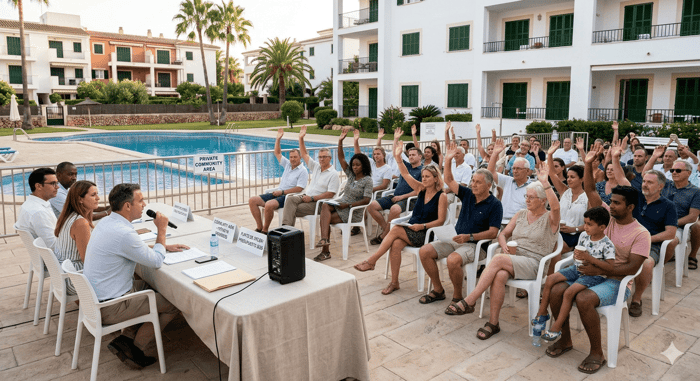
The General Meeting (Junta de Propietarios) is the governing assembly of all owners, meeting at least once a year (the AGM) and additionally when called for specific matters. The AGM approves the annual budget, elects officers, approves accounts, votes on proposed works and considers any matters raised by owners. Voting weight is proportional to participation coefficients. Owners who cannot attend can grant proxy votes to another owner or to the administrator.
Voting: What Decisions Require What Majority
The Horizontal Property Law sets different voting thresholds for different types of decision:
| Decision Type | Required Majority |
|---|---|
| Ordinary management decisions (budget approval, routine works) | Simple majority of those present and represented |
| New services or improvements not required by law | 3/5 majority of owners and coefficients |
| Banning or restricting tourist rentals in the building | 3/5 majority of owners and coefficients |
| Imposing a surcharge on tourist rental properties (up to 20%) | 3/5 majority of owners and coefficients |
| Amendments to the community statutes | Unanimous agreement of all owners |
| Changes to participation coefficients | Unanimous agreement of all owners |
The 3/5 majority threshold for tourist rental restrictions is significant for any owner who is renting or plans to rent their property on a short-term basis. A 2024 Supreme Court ruling confirmed that communities can vote to ban tourist rentals by a 3/5 majority and can also impose a community fee surcharge of up to 20% on properties operating as tourist rentals. Before purchasing a property with the intention of short-term letting, verifying the current community statutes and any recent meeting decisions on this matter is essential due diligence.
Your Obligations as an Owner
As a member of a comunidad de propietarios, Spanish law imposes several specific obligations:
Pay fees on time. Community fees are not optional. Owners who fall into arrears lose their voting rights at meetings until the debt is cleared. The community can pursue unpaid fees through the courts — a rapid legal debt recovery process is available specifically for community fee debts — and can ultimately place an embargo on the property. The debt also transfers to the buyer on sale, making unpaid fees discoverable and problematic at the notary.
Contribute to the reserve fund. Spanish law requires that every comunidad maintain a reserve fund equivalent to at least 5% of the annual operating budget. This is built from regular owner contributions and provides a buffer for unexpected capital expenditure.
Allow access for essential works. Owners must permit workmen access to their private unit when works are necessary for the maintenance of the building or the installation of new services. Where damage to a private unit results from communal works, the community is obliged to pay compensation.
Comply with community rules. The statutes and internal regulations of the community govern the use of private units and common areas — quiet hours, use of the pool, rubbish disposal, parking, pets, renovation works and other matters. Owners are responsible for ensuring their tenants also comply. Persistent breach can result in court action by the community president, including in serious cases an injunction preventing the offending owner from accessing their property for up to two years.
What to Check Before You Buy
Before committing to any Mallorca property that belongs to a comunidad de propietarios, your Spanish lawyer should obtain and review:
The seller's community fee debt certificate. The seller is legally obliged to provide a certificate from the administrator confirming that all community fees are paid up to date at the time of signing. Any outstanding debt transfers to the buyer under Spanish law.
The last three years of meeting minutes. These reveal any planned extraordinary works, disputes within the community, ongoing legal proceedings, or decisions affecting your intended use of the property — including any votes on tourist rental restrictions.
The annual budget and reserve fund balance. A community with a healthy reserve fund is better positioned to absorb unexpected costs without levying large extraordinary fees. A community with a depleted reserve and known major works pending is a different proposition.
The community statutes. Particularly relevant for buyer intending to let the property, operate a business from it, or carry out significant modifications. The statutes define what is and is not permitted.
Any pending or ongoing litigation. Communities can be parties to legal proceedings — against service contractors, against individual owners, or in disputes with the local authority. Pending litigation can affect property values and individual owners' financial exposure.
The Practical Reality of Comunidad Life
For the vast majority of foreign property owners in Mallorca, the comunidad de propietarios is a background fact of ownership that requires little active engagement beyond paying the fees and occasionally reading meeting minutes sent by the administrator. Most well-run communities with professional administrators operate smoothly, maintain the shared areas well and cause their members no difficulty.
The issues arise when they do arise — an unexpected extraordinary fee for a significant piece of work, a neighbourly dispute about noise or use of the pool, or a vote on tourist rentals that affects your letting plans. Having taken the time to understand the system before buying, and having chosen a property with a well-managed, financially sound community behind it, resolves the vast majority of potential complications before they occur. This is not a reason to avoid communal properties — the best-presented and most appealing residential properties in Mallorca are almost always in well-run communities — but it is a strong argument for thorough due diligence at the point of purchase.