Table of Contents
- The Moratorium: Why New Licences Are Restricted
- The Three Types of ETV Licence
- Property Requirements That Must Be Met
- The DRIAT: The Application Document
- What the ETV Number Means in Practice
- Zoning: Where Tourist Rentals Are Permitted
- Buying a Property With an Existing ETV Licence
- The Rental Income Opportunity
How to Get a Tourist Rental Licence (ETV) in Mallorca: The Complete Guide for 2026
If you own a property in Mallorca and are considering renting it out to holidaymakers, the first thing you need to understand is that short-term tourist rentals — anything under 30 days — are only legal with a specific licence. That licence is called an ETV, short for Estancia Turística en Vivienda, and without one, advertising your property on platforms such as Airbnb or Booking.com is illegal and can result in fines that start at 5,000 euros and reach beyond 50,000 euros in serious cases.
The ETV system is one of the most important things to understand before buying an investment property in Mallorca, because the current regulatory landscape has made the situation considerably more complex — and considerably more valuable for those who already hold a licence — than it was just a few years ago.
The Moratorium: Why New Licences Are Restricted
Since 2022, the Balearic government has imposed a moratorium on the issue of new ETV licences across the islands. The moratorium reflects a deliberate policy decision to limit the expansion of tourist accommodation in residential areas, to protect housing availability for local residents and to manage the island's tourist carrying capacity. The Consell de Mallorca was required to review the situation and publish new zoning and quota requirements, a process which has moved slowly. As of 2026, the moratorium remains in effect for most property types and areas.
The practical consequence is significant. Anyone who buys a property in Mallorca today and does not already have a valid ETV licence attached to it cannot obtain a new short-term tourist rental licence in most areas. The only legal route into the short-term rental market is to buy a property that already holds a valid licence. Properties with existing ETV licences are consequently more valuable than comparable unlicensed properties — a premium that independent agents typically estimate at 15 to 25 percent.
The Three Types of ETV Licence
There are three categories of tourist rental licence in Mallorca, each designed for different property types and situations.
The standard ETV applies to single-family detached homes — villas, fincas and standalone houses. This is the most straightforward category. An ETV for a detached property is issued on an indefinite basis, meaning it does not expire and does not require periodic renewal. There is no requirement to obtain the approval of neighbouring property owners. The property can be rented to tourists throughout the entire year.
The ETVPL applies to properties within multi-family buildings — apartments and terraced or semi-detached houses. This category is subject to considerably more restrictions. The licence is issued for five-year renewable periods. The community of owners of the building must have approved the use of apartments within the building for tourist rental by a majority vote, and this approval must be documented and presented as part of the application. Many communities of owners in Mallorca have voted specifically to prohibit tourist rentals in their buildings, which means that obtaining an ETVPL in those buildings is not possible regardless of other factors. The cost of an ETVPL licence is 875 euros per plaza — per authorised guest place.
The ETV60 is a special category for owners who use the property as their primary registered residence — their empadronamiento address — but wish to rent it out to tourists for limited periods. Under the ETV60 licence, a property can be rented to tourists for a maximum of 60 days per year, and at least 30 of those days must fall within July or August. The licence is valid for five years and renewable. The cost is approximately 292 euros in total for the two-month annual rental window. The ETV60 is relevant primarily for residents who want to generate income from their home during the period they are away on holiday or travelling.
Property Requirements That Must Be Met
Regardless of which licence type applies, any property seeking an ETV must meet a set of minimum conditions. The property must be at least five years old as a private residence. It cannot be a property under official protection or subject to a regulated capped price. It cannot be located on protected rustic land. It must not have received a serious or very serious sanction in connection with tourist rental activity. It cannot be rented by individual rooms — only the whole property can be let to a single party. The maximum permitted is six bedrooms and twelve beds, with at least one bathroom for every three beds.
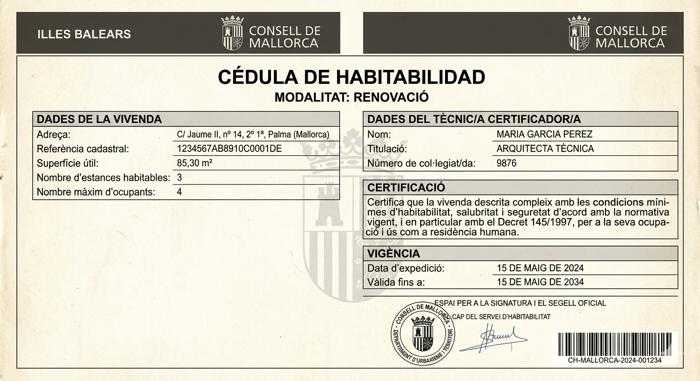
The property must also hold a valid cédula de habitabilidad — the certificate of habitable occupancy — and a current energy performance certificate at the required rating for the age of the building. Both certificates have a ten-year validity period and must be current at the time of application. This is a detail that catches some buyers out when purchasing an older property: if either certificate has lapsed, it must be renewed before the ETV application can proceed.
The DRIAT: The Application Document
To begin operating as a tourist rental, the owner must submit a DRIAT — a Declaración Responsable de Inicio de Actividad Turística, or Responsible Declaration for the Commencement of Tourist Activity — to the tourism department of the Consell de Mallorca. The DRIAT is not a conventional application that is reviewed and approved over time; once it is correctly submitted, the activity is automatically authorised to begin. If there are errors or missing documents, a ten-day correction window applies under Law 30/1992.
Following the submission of the DRIAT, the Tourism Department will conduct an inspection of the property to verify that the information provided is accurate and that the property meets all applicable requirements. If false or incorrect information is discovered, the licence will be suspended and the registration cancelled from the Tourism Registry.
What the ETV Number Means in Practice
Every ETV licence carries a registration number in the format ETV/xxxx/xxxx. This number must appear in all advertising for the property — on Airbnb, on Booking.com, in any print or digital marketing material, and on the rental agreement provided to guests at the start of their stay. Advertising a tourist property without displaying the licence number is itself an infringement and can result in fines. Platforms such as Airbnb now filter for this number and may remove listings that cannot demonstrate a valid registration.
Owners with an ETV licence also have ongoing obligations. They must register with the Guardia Civil or Policía Nacional to submit weekly reports of guest details — name, passport or identity document number, dates of stay — shortly after each arrival. This is a standard security requirement across all tourist accommodation in Spain. They must provide tourist services including regular cleaning, bed linen and towels. They must maintain civil liability insurance covering the property during tourist occupancy. And they must register for tourist tax purposes and collect and remit the Ecotasa — Mallorca's tourist tax — from each guest for each night of their stay.
Zoning: Where Tourist Rentals Are Permitted
The permit to hold an ETV licence depends not only on the property itself but on where it is located. Each municipality in Mallorca has its own urban zoning plan — zonificación — which divides the territory into zones where tourist rentals are permitted and zones where they are restricted or prohibited. Areas classified as saturated tourist zones have the strictest controls. Playa de Palma, for example, historically restricted apartments from operating as tourist rentals at all and now permits villa-type properties in specific circumstances for a maximum of 60 days per year.
Before purchasing any property with the intention of using it as a tourist rental, the zoning classification of that specific property must be verified. This is not something that can be assumed from the property type or from its location in a tourist area — it requires specific confirmation from the relevant municipal planning department or from a lawyer familiar with the local zoning scheme. Imperial Properties works with trusted legal specialists who can verify this as part of the due diligence process.
Buying a Property With an Existing ETV Licence
Given the moratorium on new licences, the most reliable route into the Mallorca tourist rental market in 2026 is to buy a property that already holds a valid ETV. When a property is sold, the ETV licence transfers with it, provided the new owner continues to meet all the conditions under which the licence was granted and notifies the relevant authorities of the change of ownership.
Before completing any purchase of a property marketed as having an ETV licence, several things must be verified. The licence must be confirmed as active and in good standing in the Tourism Registry — not suspended or under sanction. The authorised number of plazas must match the physical capacity of the property. The cédula de habitabilidad and energy certificate must be current. And the community of owners, if applicable, must not have subsequently voted to withdraw permission for tourist rentals. All of this requires proper legal due diligence.
The Rental Income Opportunity
Mallorca's tourist rental market generates strong returns for properties in the right locations with the right licences. During the peak months of July and August, demand consistently exceeds supply, with weekly rental rates for licensed villas and apartments commanding premiums that reflect both the scarcity of licensed stock and the island's enduring appeal as a premium Mediterranean destination. Properties in the southwest — in the areas of Calvià, Santa Ponsa, Puerto Portals, Andratx and Bendinat — and in and around Palma itself attract consistent international demand across the longer spring and autumn shoulder seasons as well as in peak summer.
The team at Imperial Properties is well placed to advise on which available properties carry valid ETV licences and what the income potential of those properties looks like in practice. For buyers who want to understand this market fully before making a decision, we can arrange conversations with specialist rental management companies and legal advisers as part of the property viewing process. Visit www.imperial-properties.com or contact our team directly.