Table of Contents
Building Your Own Home in Mallorca: Planning Permission, Land Categories and What Buyers Need to Know
The idea of building your own home in Mallorca rather than buying one ready-made is more common than the property market coverage suggests. A significant proportion of the most distinctive properties in the southwest were built by their owners — designed for a specific plot, a specific orientation, a specific way of living — rather than selected from a developer's catalogue.
The process is not simple and it is not fast. But it is well-established, it is navigable with the right professional support, and for buyers with clear ideas about what they want and the patience to see the process through, it produces results that the resale market cannot replicate.
This guide covers what you need to know before you start: land categories, planning permission, the key steps, the professionals involved, and the realistic timescales.
Thinking about buying or selling in Mallorca?
Understanding Land Categories in Mallorca
Before buying a plot with the intention of building, the most important thing to establish is the land classification. In Mallorca, all land falls into one of three primary categories, and these determine entirely what can be built and under what conditions.
Suelo Urbano — Urban land. This is land with existing infrastructure: roads, mains water, drainage, electricity. Building on urban land is the most straightforward scenario. The rules are set by the local municipality (in the southwest, the Ajuntament de Calvià) and are well-established. Most plots for sale in Santa Ponsa, Nova Santa Ponsa, Portals Nous and similar residential areas fall into this category.
Suelo Urbanizable — Land that has been designated for future development but has not yet been fully serviced with infrastructure. Building here is possible in principle but depends on the development plan being active and the infrastructure being in place or guaranteed. This category carries more risk and requires more due diligence before purchase.
Suelo Rústico — Rural or agricultural land. This is the most restrictive category and covers the majority of Mallorca's interior, including much of the Calvià countryside behind the coastal strip. Building restrictions on rústico land are strict: in most cases, new residential construction is not permitted unless there is already a legal building on the land, the plot exceeds minimum size thresholds set by the Territorial Plan of Mallorca, and specific conditions are met. Extensions and renovations of existing legally registered buildings are generally permitted with the right licences.
The distinction between these categories is not always obvious from looking at a plot. An experienced local architect or lawyer should verify the classification of any land you are considering before you make an offer.
The Planning Permission Process
Building in Mallorca requires a licencia de obra mayor — a major construction permit — for any new building, structural extension, demolition or swimming pool construction. The process follows a defined sequence of steps.
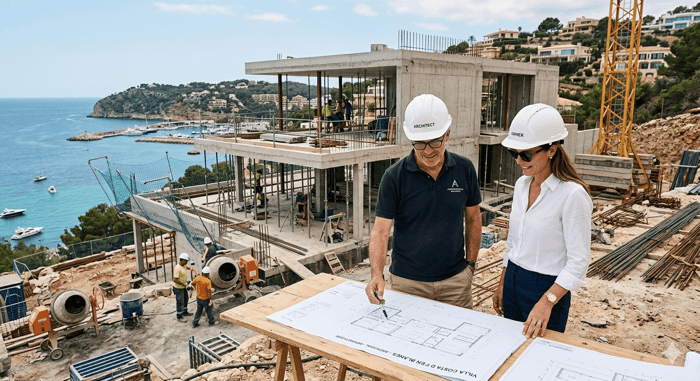
Step 1: Hire a licensed architect. In Spain, all planning applications for major construction works must be submitted by a licensed architect (arquitecto). The architect draws up the approval plan — the Proyecto Básico — which sets out the design, structural approach, materials and compliance with local planning regulations. The Proyecto Básico must then be stamped (visado) by the Colegio de Arquitectos de Mallorca, the professional architects' association in Palma, before it can be submitted to the town hall.
Step 2: Submit the application. The Proyecto Básico and a completed building application form (Solicitud de Obras) are submitted to the Servicio Técnico del Ajuntament — the town hall planning department. In Calvià, this is the Ajuntament de Calvià in the village of Calvià. The planning department checks the application against local and regional regulations including fire safety, accessibility, design standards and environmental impact.
Step 3: Consell Balear involvement for rural land. For properties on rústico land, the Consell de Mallorca (the regional island authority) must also approve the project. The town hall cannot issue the final building permit until it has received a positive decision from the Consell. This adds time to the process and introduces a second layer of regulatory review.
Step 4: The building permit. Once approved, the architect prepares the full working drawings (Proyecto de Ejecución). The town hall then issues the Licencia de Obras — the building permit — and construction can begin. Before work starts, an aparejador (technical architect and project manager, also called arquitecto técnico) and the construction company must be formally notified to the building authority.
Realistic Timescales
Processing times in Mallorca are variable and depend significantly on the complexity of the project, the land category and the workload of the local planning department. For straightforward urban plots, processing times of three to six months are typical. For rural properties involving the Consell Balear, the process commonly takes twelve months or more, and in some cases significantly longer if changes are requested during the review.
This means that buying a plot and expecting to be in a completed house within two years is optimistic. A more realistic planning horizon for a self-build in Mallorca is three to four years from plot purchase to occupation certificate — allowing for planning, construction and any delays. Buyers who approach the process with patience and professional support navigate it successfully; those who underestimate the timescales encounter frustration.
The Cost Structure
Beyond the plot purchase price and construction costs, a self-build in Mallorca involves a specific set of fees and taxes. The two main municipal charges are the ICIO (Impuesto sobre Construcciones, Instalaciones y Obras) — the construction tax, typically 3–4% of the estimated construction cost — and the planning licence fee, typically 1–2% of construction cost. These fees are payable to the town hall and are not refundable even if the permit is ultimately not granted.
Architect fees are typically calculated as a percentage of construction cost and vary according to the complexity of the project. The aparejador charges separately. VAT (IVA) at 21% applies to construction services and materials. A 10-year structural insurance policy (seguro decenal) is mandatory for new builds and must be arranged before construction begins.
What to Check Before Buying a Plot
Before committing to any plot purchase with building intent, the following checks are essential. First, confirm the land classification with a local architect or lawyer — not just from the seller's representations. Second, obtain a nota simple from the Land Registry (Registro de la Propiedad) to confirm ownership, surface area and any charges or encumbrances. Third, check the catastro (cadastral register) to confirm the official plot boundaries and area, which may differ from the nota simple. Fourth, verify there are no urban planning charges or contributions outstanding (cargas urbanísticas) that would transfer to the new owner. Fifth, confirm that the plot has or can obtain connections to mains services — water, electricity, drainage — or establish what the cost of doing so would be.
For plots on rústico land, additionally verify whether there is an existing legal building registered in both the Land Registry and the catastro, what the minimum plot size requirements are under the Territorial Plan of Mallorca, and whether any prior planning applications have been made and what their outcome was.
Working with the Right Professionals
A self-build in Mallorca involves a team: a local architect who knows the Calvià planning department and its requirements; an aparejador to oversee construction quality and safety; a Spanish property lawyer (abogado) to handle the plot purchase, review the planning documentation and protect your interests; and a qualified builder (constructor) with experience in the southwest's specific construction conditions.
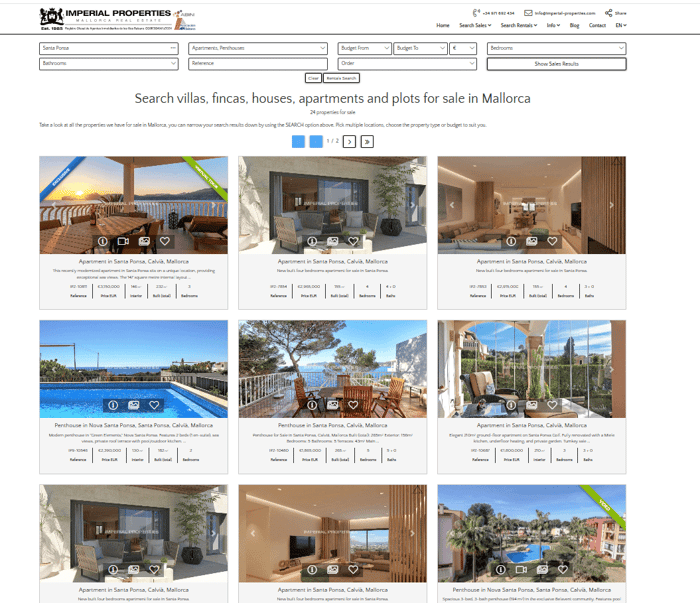
Imperial Properties has been operating in Santa Ponsa and the Calvià municipality since 1985 and can provide introductions to trusted professionals in each of these categories. If you are considering a plot purchase with building intent, talking to the team before you buy is the sensible first step. Browse available plots and properties at imperial-properties.com or contact us directly on +34 971 692 434.