Table of Contents
The Correfoc: Inside Calvià's Night of Fire for Festes de Sant Jaume
On Saturday 18 July 2026, the streets of Calvià Vila fill with devils, drums and sparks for Nit de Foc — the correfoc that's become the signature event of the village's Festes de Sant Jaume. It's one of the most striking traditions on the island's festival calendar, and one of the least understood by anyone who hasn't seen it up close, so here's what it actually is, where it comes from, and how Calvià does it.
What a Correfoc Actually Is
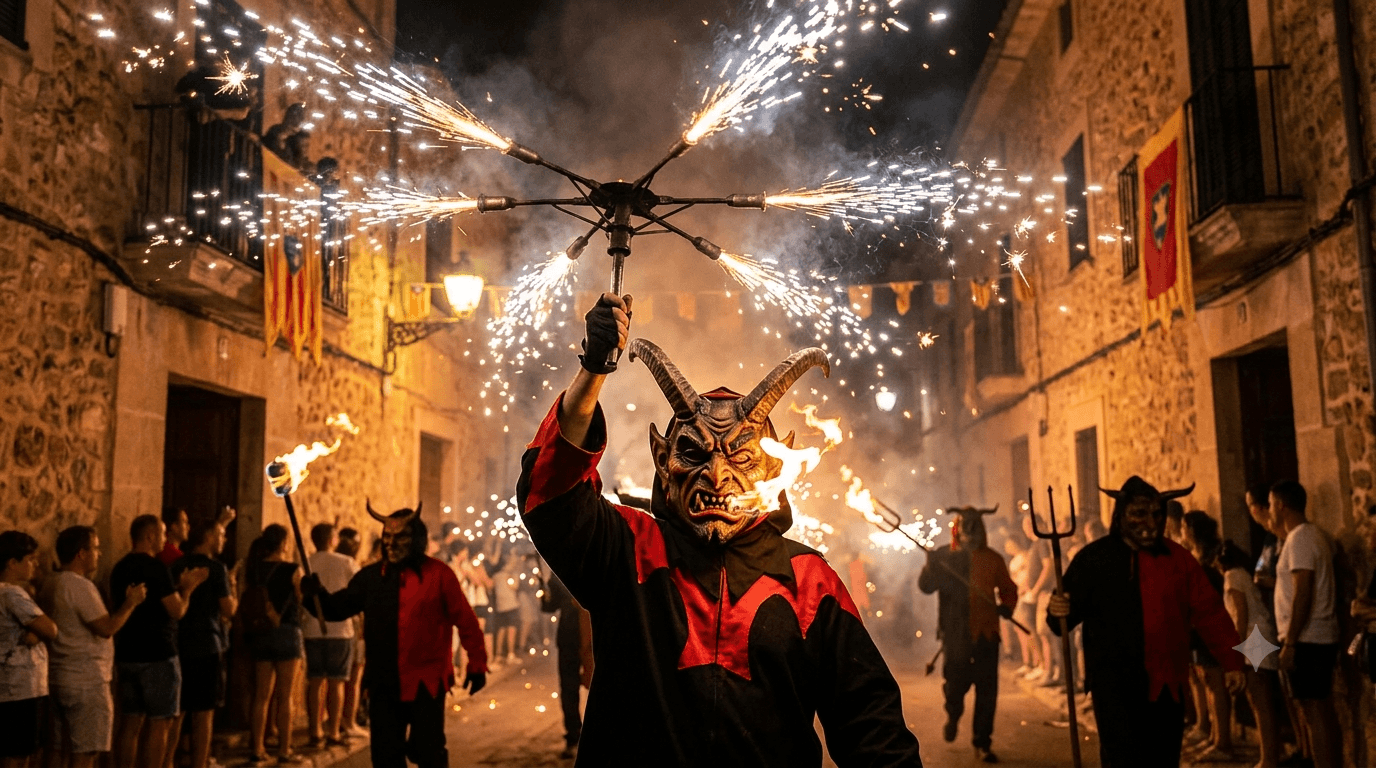
Correfoc translates roughly as "fire-run." A group dressed as devils — dimonis in Catalan — parade through the streets carrying pitchforks and handheld fireworks that throw off sparks as they walk, run and dance. Drummers (a batucada or tabalada) keep the pace, and in many towns a beast or dragon figure joins the procession.
What sets a correfoc apart from a normal parade is that the audience doesn't just watch from the side. People dress in old clothes with a hat or scarf for protection and step into the procession itself, dancing and running under the shower of sparks alongside the devils rather than staying back on the pavement. It's participatory by design — the crowd becomes part of the spectacle, not just spectators of it.
Where the Tradition Comes From
The roots go back to the Ball de Diables — the Dance of Devils — documented as far back as the 12th century across the old Crown of Aragon, which covered Catalonia, Valencia, the Balearics and parts of what's now southern France. Most historians trace it to medieval street theatre: short comic or moral plays performed during Corpus Christi processions, where devils appeared as caricatured, mischievous figures acting out a battle between good and evil.
Thinking about buying or selling in Mallorca?
That older dance tradition survived for centuries in various forms, but it was suppressed during the Franco dictatorship, when this kind of popular, non-religious street celebration was heavily restricted. It resurfaced with force after Spain's return to democracy: the modern correfoc format, with its heavier use of pyrotechnics and its now-familiar name, is generally dated to 1979 in Barcelona, part of a broader wave of towns reclaiming traditional street festivals that had been dormant for decades. From there it spread through Catalonia, Valencia and the Balearics over the following two decades, with each region developing its own local style. The Balearic version tends to be more theatrical than the Catalan mainland's, with devils wearing masks and performances that lean into staged drama rather than pure pyrotechnic spectacle.
How Calvià's Nit de Foc Works
Calvià's own tradition is younger than the dance itself but has deep local roots by now. The first Nit de Foc was held in 1990 to mark the inauguration of the new town hall, and from 1991 it was folded permanently into the Festes de Sant Jaume programme, where it's remained the headline event ever since.
The village now has its own colla — Dimonis de Calvià Vila — with a beast figure of its own called Llorençot, and since 2024 a second figure, El Cavallet del Dimoni, a devilish sea-horse tied to a local folk legend rooted in Santa Ponça bay. Locals describe the group's style as short but intense: an opening section with torches, low-intensity pyrotechnics and close interaction with the crowd, building through a middle section with carretillas (spark-throwing devices) and fire beasts, and closing with all the devils lighting up together at once.
The Route and Watching Safely
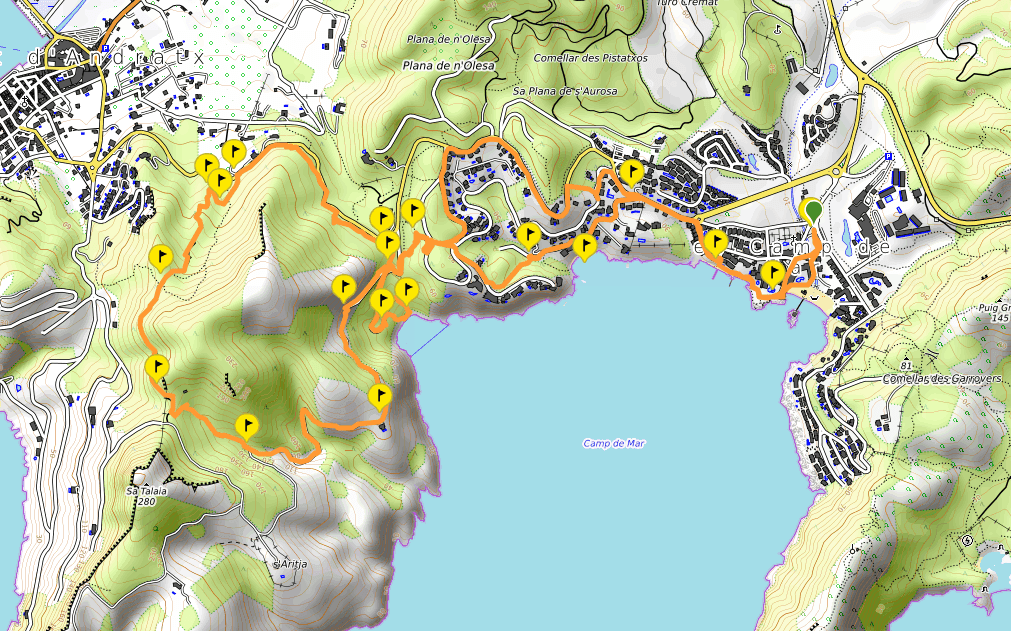
This year's Nit de Foc runs from Plaça de l'Església, along Carrer Costeta de la Música and Carrer Major, through Plaça de la Vila, along Carrer Ca'n Vich and Carrer Batle Bujosa Sans, finishing at the municipal car park by the Ajuntament, where the music and celebrations continue into the early hours.
The Ajuntament's own guidance is simple: don't step into the route itself and don't handle any pyrotechnic material. Beyond that, the usual correfoc etiquette applies across the Balearics and Catalonia — wear old, close-fitting cotton clothing rather than anything synthetic, cover your head, and if you want to get close to the devils, follow the organisers' instructions rather than the crowd's. One thing experienced correfoc-goers know: never throw water at the devils themselves, however hot the night gets — wet gunpowder doesn't just fizzle out, it can go off unpredictably.
Living Where the Tradition Happens
Calvià Vila itself is a quieter, more traditional corner of the municipality than its coastal resort towns, and nights like this are part of why. A festival like Nit de Foc only works with a village-scale centre — narrow streets, a central square, a community that turns out for it year after year — and that same character is exactly what draws buyers to the inland parts of Calvià looking for something more rooted than a purely coastal address.
If a base near the historic heart of Calvià interests you beyond festival season, get in touch — we know this area well and can talk through what's currently available.