Table of Contents
- The Law Behind the Requirement
- Who Does It Affect — and Who Is Exempt
- What Type of Property Triggers the Requirement
- The 15 Percent Cap — Why Some Applications Are Refused
- The Application Process — Step by Step
- Processing Time — The Two-Route System
- Protecting Your Purchase Contract — The Military Authorisation Condition Clause
- Cost and Practical Starting Points
- FAQs
Military Certificate Spain Property: The Complete Guide for Non-EU Buyers in Mallorca
The military certificate for property purchase in Spain is one of the most misunderstood requirements in the entire Mallorcan buying process — and that misunderstanding costs buyers both time and money. Non-EU buyers who discover the requirement after finding a rural property they love, having already paid a reservation deposit and begun due diligence, face a difficult choice: wait 5 to 7 months for authorisation, renegotiate the contract timeline, or lose their deposit and start again. None of these outcomes is necessary if the requirement is understood and planned for from the outset. This guide explains exactly what the military authorisation is, which buyers and which properties it affects, what the application process involves, how long it takes, and — critically — how to structure your purchase contract to protect your deposit if approval takes longer than expected or is refused.
The Law Behind the Requirement
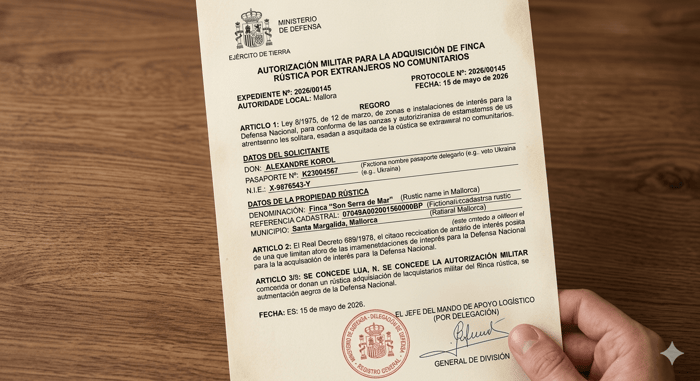
The military authorisation requirement for property purchases in Spain traces directly to Law 8/1975 on Areas and Installations of Interest for National Defence, subsequently developed by Royal Decree 689/1978. The law was enacted in the final years of the Franco regime as a mechanism to prevent foreign nationals from acquiring land in areas considered strategically significant for Spain's military defence — the logic being that the concentration of foreign ownership in coastal, island and border zones represented a national security risk. Spain joined the EU in 1986, and from that point EU citizens were exempted from the requirement under the principle of free movement of capital. Non-EU nationals, however, have been subject to the authorisation requirement continuously since 1978.
The law remains fully in force in 2026. Despite decades of lobbying from property industry groups, the Balearic Islands College of Property Registrars and various chambers of commerce for its abolition or significant reform, no government has enacted the legislative changes required to remove it. The Spanish Ministry of Defence administers the authorisation process and has, in recent years, granted partial exemptions in certain mainland municipalities — most notably in parts of the Alicante province — but the Balearic Islands continue to be subject to the full requirement. Any non-EU buyer considering rural property in Mallorca, Menorca, Ibiza or Formentera in 2026 must factor the military authorisation into their purchase plan.
Who Does It Affect — and Who Is Exempt
The military authorisation requirement applies to nationals of countries outside the European Union who wish to purchase rural land in designated zones. The current list of affected buyer nationalities is extensive and includes British nationals (since 1 January 2021, when Brexit removed their EU exemption), American citizens, Canadians, Australians, Gulf nationals, Chinese buyers, Indians, Turks, Latin American buyers and all other non-EU nationalities. The common thread is simply the absence of EU or EEA membership.
The nationalities currently exempt from the requirement are:
- All EU member state nationals — German, French, Dutch, Swedish, Danish, Belgian, Irish, Italian, Spanish and all other EU citizens require no military authorisation for any property purchase in Spain.
- Swiss nationals — Switzerland has a bilateral agreement with Spain that exempts Swiss citizens from the military authorisation requirement.
- Norwegian nationals — Norway similarly has a bilateral exemption agreement in place, meaning Norwegian buyers are not subject to the requirement despite not being EU members.
- Icelandic nationals — Iceland is also exempt through its EEA status and bilateral arrangements.
All other non-EU nationalities — including British nationals post-Brexit — require the military authorisation before completing a rural land purchase in Mallorca or the wider Balearic Islands. It is worth noting that the requirement applies regardless of whether the non-EU buyer is resident in Spain. A British national with Spanish residency, a US citizen with a Spanish long-term visa, and a Gulf national who has never visited Spain before are all subject to the same military authorisation requirement if they wish to purchase rural property in the Balearics.
The requirement also applies to Spanish limited liability companies (Sociedades Limitadas) and other corporate vehicles when more than 50 percent of their shares are held by non-EU nationals. Buyers considering purchasing through a corporate structure should verify the military authorisation implications of that structure with their Spanish lawyer before proceeding.
What Type of Property Triggers the Requirement
This is the single most important practical point in understanding the military authorisation, and it is the one most frequently misunderstood by buyers and, occasionally, by agents unfamiliar with the specific Balearic application of the law. The military authorisation requirement in Mallorca applies exclusively to purchases of rural land — formally classified as suelo rústico (rustic land) or suelo no urbanizable (non-developable land) in Spanish planning terminology. It does not apply to urban property.
The following categories of property are not affected by the military authorisation requirement in Mallorca:
- Apartments and penthouses of any size or value in any location
- Villas and houses within established urbanisations or residential zones
- Townhouses in villages and town centres
- Urban plots and building plots within urban planning zones
- New-build properties in approved urban development zones
- Properties in Palma, in coastal resort areas such as Santa Ponsa, Portals Nous, Palmanova, Peguera and similar urbanised zones
The following categories of property do require military authorisation for non-EU buyers:
- Fincas and rural farmhouses with rural land classification
- Agricultural land, orchards, olive groves and vineyards
- Country estates on rural plots
- Rural plots and building plots on rustic land
- Any property where the land classification is suelo rústico, regardless of whether a house is built on it
The classification that matters is the land classification — not the property type, value or appearance. A well-restored luxury finca with a pool, modern kitchen and every contemporary comfort, if it sits on a plot classified as suelo rústico, requires military authorisation for a non-EU buyer regardless of how urban its character may feel. The nota simple from the Land Registry and the cadastral certificate will confirm the land classification of any specific property, and this should be one of the first checks a non-EU buyer's lawyer makes when evaluating any rural property.
It is also important to note that the military authorisation requirement is not limited to purchases. It also applies to mortgage applications on rural land and to construction or extension works on rural properties. A non-EU buyer who purchases rural land with a plan to build a house will need military authorisation twice: once for the land purchase and again before beginning construction.
The 15 Percent Cap — Why Some Applications Are Refused
Law 8/1975 contains a provision that deserves specific attention because it creates a risk that many buyers are entirely unaware of until their application reaches the Ministry of Defence. The law establishes that within each municipality, no more than 15 percent of the total rural land area can be held in foreign (non-Spanish) ownership. This cap applies across all foreign nationalities combined, not per nationality.
In practice, this means that in Balearic municipalities where there has been strong historical demand for rural properties from non-EU buyers, the 15 percent threshold may already have been reached. If it has, new applications for military authorisation in that municipality will be refused — not because of anything specific to the applicant, but simply because the municipal cap has been exceeded. The Ministry of Defence maintains records of foreign rural land ownership by municipality and applies the cap when processing applications.
For buyers, this creates a risk that cannot be fully mitigated through preparation. Before investing significant time and legal fees in the authorisation process for a rural property in a specific municipality, it is worth asking your Spanish lawyer to make enquiries about the current state of foreign ownership within that municipality. While this information is not always readily available, experienced Balearic property lawyers often have a working knowledge of which municipalities are approaching or have reached the cap.
The Application Process — Step by Step
The military authorisation application is submitted to the Spanish Ministry of Defence and must be linked to a specific property and a specific buyer. There is no generic or advance military authorisation — the permit is property-specific and person-specific. This means the buyer must have identified the exact property they wish to purchase before beginning the authorisation process. It is not possible to obtain a permit in anticipation of finding a suitable property.
Buyer documentation:
- Certified criminal record certificate from the buyer's country of nationality and country of residence, apostilled in accordance with the Hague Convention. For UK buyers this is obtained from the Disclosure and Barring Service (DBS). For US buyers, from the FBI or the relevant state authority. The criminal record certificate must typically be no more than 3 months old at the point of submission.
- Photocopy of the buyer's valid passport — all pages, not just the data page
- Copy of the buyer's Spanish NIE number
- Copy of the Spanish residence card if the buyer holds one
Property documentation:
- A detailed floor plan of the property at a scale of no less than 1:500
- A location map of the property identifying its position within the municipality
- Measurements of the distance from the property to the nearest coastline and to the nearest military installation
- The nota simple from the Land Registry confirming ownership, surface area and land classification
- The cadastral reference and cadastral certificate
Processing Time — The Two-Route System
Route 1 — Plots of less than 2,000 square metres: Processed by the Ministry of Defence regional office in Barcelona. Current processing times run approximately 4 weeks from complete application submission.
Route 2 — Plots of 2,000 square metres or more: Processed directly by the central Ministry of Defence in Madrid. Processing typically takes 5 to 7 months, extending to 7 to 9 months or beyond in recent years due to higher application volumes following Brexit.
Protecting Your Purchase Contract — The Military Authorisation Condition Clause
Any non-EU buyer purchasing rural property in Mallorca must ensure that their Contrato de Arras includes a specific military authorisation condition clause — a clause that makes the completion of the purchase expressly conditional upon the granting of military authorisation and that gives both parties a realistic timeline for this process. Without this clause, the buyer risks losing their deposit if the authorisation takes longer than the standard arras completion deadline. The clause should extend the completion deadline to 6 to 9 months from application submission and provide for full deposit recovery if authorisation is ultimately refused.
Cost and Practical Starting Points
The military authorisation itself carries no direct government fee. Total professional costs typically run between 1,500 and 3,500 euros — modest relative to the purchase price of most rural properties but important to budget for explicitly. The single most important action is to instruct a qualified Spanish property lawyer with Balearic Islands experience before making any offer or paying any deposit, and to ensure that no arras contract for a rural property is signed without the military authorisation condition clause in place.
Have a question about buying property in Mallorca?
The military certificate process has specific timelines and risks that are genuinely important to plan for. Our team has guided non-EU buyers through rural property purchases in Mallorca for over 40 years — we are happy to talk through your situation, with no obligation and no pressure.
Call or WhatsApp us: +34 971 692 434 | Chat on WhatsApp
Email: help@imperial-properties.com
Read our complete guide to the Contrato de Arras in Spain
Read our guide to mortgages for non-residents in Mallorca
See all our properties for sale in Mallorca