Table of Contents
- The Cathedral: Start Here, Always
- The Royal Palace of La Almudaina
- The Arab Baths: The Most Unexpected Room in Palma
- The Hidden Courtyards of the Old Town
- Bellver Castle: The View the Old Town Cannot Give You
- Eating and Drinking in Palma Old Town
- The Passeig del Born: The Centre of Gravity
- Practical Notes for Visiting Palma Old Town
- FAQs
Palma Old Town: The Definitive Walking Guide
Palma Old Town is one of the great historic city centres of the Mediterranean — and it is consistently underestimated by people who assume the island is primarily about beaches and boats. The old town of Palma de Mallorca packs more than two thousand years of layered history into a compact, walkable area of limestone lanes, grand Renaissance courtyards, Moorish bath houses, Gothic churches and some of the best food and drink on the island. This guide covers Palma Old Town properly: what to see, in what order, what to eat, where to drink, and the corners that most people miss entirely.
The Cathedral: Start Here, Always
Every visit to Palma Old Town begins at La Seu, the Cathedral of Santa Maria of Palma. Built on the site of a former mosque after the Christian reconquest of the island in 1229, it took three centuries to complete and the result is one of the most extraordinary Gothic structures in Europe. The nave is 44 metres high — one of the tallest Gothic naves in existence — and the Rose Window on the east facade contains 1,236 individual pieces of stained glass spread across a diameter of 11.5 metres.
What most people do not know before they enter is that the interior was partially redesigned by Antoni Gaudi between 1904 and 1914, at the invitation of Bishop Campins. Gaudi repositioned the choir from the centre of the nave to the apse, flooding the interior with light, and added the extraordinary wrought iron baldachin — a canopy suspended above the main altar — that remains one of his least-discussed works. Enter through the south portal, walk the full length of the nave, and allow at least an hour. The museum wing is well worth the additional entrance fee.
The approach along the waterfront promenade — the Parc de la Mar, with its reflection pool and the city walls rising behind — is one of the great urban vistas on the island. Come in the morning, when the light hits the south facade directly and the tourist coaches have not yet arrived.
The Royal Palace of La Almudaina
Directly adjacent to the Cathedral, the Royal Palace of La Almudaina sits on the site of an Arab alcazar, remnants of which are incorporated into the current Gothic structure. The palace has been the official residence of Spanish monarchs in Mallorca since the 13th century. Note that at the time of writing the palace is temporarily closed for renovation works; the official Patrimonio Nacional website carries current reopening information and a waiting list for email notification. The exterior and the view of it from the Cathedral esplanade remain accessible and are impressive in their own right — the juxtaposition of Moorish and Gothic architecture that defines Palma Old Town is visible from the street.
The Arab Baths: The Most Unexpected Room in Palma
The Arab Baths on Carrer de Can Serra are one of the best-preserved examples of Moorish civil architecture in Spain and are almost absurdly small given their historical significance. Built in the 10th or 11th century, the hammam consists of a single domed room supported by 12 columns, each one different — recycled, it is believed, from the Roman buildings that preceded the Moorish occupation of the site. The combination of the domed ceiling with its star-shaped oculi, the dim light and the complete silence inside makes this one of the most affecting spaces in Palma Old Town.
It is easy to walk past — the entrance on Carrer de Can Serra is unassuming — and it is rarely busy. Go in the early afternoon when most visitors are at lunch. Admission is modest and the visit takes twenty minutes. Full details including opening hours are available through visitpalma.com, the official Palma tourism portal.
The Hidden Courtyards of the Old Town
The defining architectural feature of Palma Old Town that most first-time visitors never discover is the patios — the great aristocratic courtyards concealed behind the street facades of the noble houses along Carrer de l'Almudaina, Carrer de Can Savella and the streets around the Convent of Sant Francesc. Many of these palaces were built in the 15th, 16th and 17th centuries by Mallorca's landed nobility, and the courtyards follow a distinctive local form: grand stone staircases rising to open loggias, potted citrus trees, stone cisterns and a particular quality of silence that makes the noise of the street outside feel very far away.
The most accessible include the Palau del Marquès de Palmer on Carrer de l'Almudaina, the courtyards visible from the street along Carrer de Can Savella, and the cloister of the Convent de Sant Francesc on Placa de Sant Francesc, which is open to visitors and contains the tomb of Ramon Llull, Mallorca's most significant medieval philosopher. Full visiting information for the Convent is available through visitpalma.com. The best approach is simply to walk slowly through the streets of Palma Old Town and push open any door that is ajar — the city is remarkably open in this respect, and the rewards are considerable.
Bellver Castle: The View the Old Town Cannot Give You
Bellver Castle sits on a wooded hill three kilometres west of Palma Old Town and provides the perspective on the city that no street-level view can. Built in the early 14th century for King Jaume II, it is one of very few circular Gothic castles in Europe — a remarkable piece of medieval military architecture with a detached circular tower connected to the main body by an elevated arch. The castle houses the City History Museum of Palma and the views from the battlements across the Bay of Palma are exceptional, particularly in the late afternoon when the light is on the water.
The walk up through the pine woods from the road below takes about twenty minutes and is worth doing rather than driving to the top. The castle is open daily except Mondays; current opening hours and admission prices are published on the official Bellver Castle website. Combined with a visit to Palma Old Town, Bellver makes a full and highly satisfying day.
Eating and Drinking in Palma Old Town
The food and drink landscape of Palma Old Town has changed substantially over the last decade and now includes some of the most serious cooking on the island alongside the neighbourhood bars and market stalls that have been here for generations.
Mercat de l'Olivar on Placa de l'Olivar is the central market of Palma and the best single place to understand what the island produces: fish from the morning catch, local vegetables, cheeses, sobrassada, ensaimadas and the full range of Mallorcan pantry staples. The market bars serve breakfast and lunch to a crowd that is predominantly local. Go on a weekday morning.
Pa amb oli — bread rubbed with tomato and olive oil, topped with whatever the kitchen has to offer — is the defining snack of Palma Old Town. The version at Celler Pagos on Carrer de la Fabrica, one of the oldest wine cellars in the city, remains a benchmark. Order the local Binissalem red alongside it.
For coffee, the terrace of the Grand Cafe Cappuccino on Carrer de Sant Miquel is a long-established Palma institution with a good view of the street life. For something more local, the bars around the Placa Major and along Carrer dels Apuntadors serve a crowd that mixes residents with visitors in roughly equal measure — a reliable indicator of quality in any city.
For evening dining, the streets between the Cathedral and the Passeig del Born concentrate the highest density of serious restaurants in Palma Old Town. Booking ahead is advisable from May onwards, when the island's summer rhythm is fully established.
The Passeig del Born: The Centre of Gravity
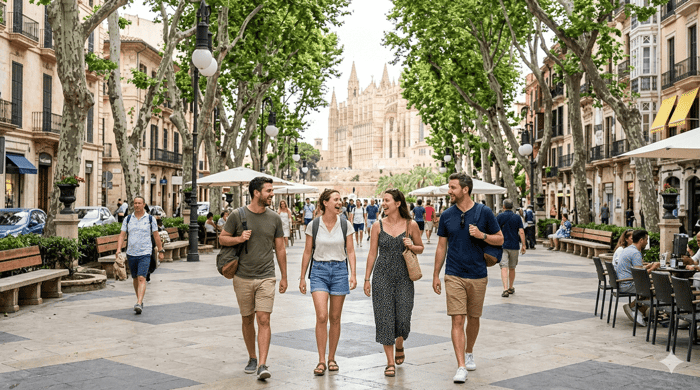
The Passeig del Born is the grand promenade that runs through the heart of Palma Old Town, lined with plane trees and flanked by some of the city's most elegant 19th-century architecture. It was built on the course of a seasonal stream — the Sant Miquel torrent — that was covered over in the 18th century, and its current form owes much to a programme of urban improvement in the late 19th century. Today it serves as the primary axis of the old town, connecting the waterfront to the commercial streets further north.
The Born is at its best in the early evening, when Palma's residents use it in the way that Mallorcan city life has always dictated: slowly, on foot, in groups, with no particular destination in mind. Sit on one of the benches under the plane trees with a coffee from one of the flanking cafes and watch the city conduct itself. It is a reliable pleasure at any time of year.
Practical Notes for Visiting Palma Old Town
Palma Old Town is best explored on foot — the streets are largely pedestrianised and the area is compact enough that a full day covers the main sites and leaves time to get genuinely lost in between. Parking is difficult and largely unnecessary; the old town is within walking distance of the main waterfront and well served by bus from the surrounding areas.
The Cathedral and Bellver Castle both require an entrance fee and have set opening hours that vary by season. Current times and prices for all Palma Old Town attractions are published at visitpalma.com, the official tourism portal for Palma. Most of the street-level architecture, the courtyards and the Passeig del Born are free.
May and early June are among the best months to visit Palma Old Town. The weather is warm without the intensity of July and August, the city is busy but not overwhelmed, and the light in the late afternoon — falling across the Cathedral's south facade and the limestone of the old town streets — is as good as it gets anywhere in the Mediterranean.