Table of Contents
Buying Property in Mallorca as an American: What US Buyers Need to Know in 2026
American buyers are a growing presence in the Mallorca market. The island has attracted Northern European buyers for decades, but US enquiries have increased steadily since 2022, driven by a combination of favourable dollar-euro dynamics, lifestyle appeal, and a growing awareness of Spain as a serious long-term base rather than just a holiday destination.
The good news is straightforward: there are no nationality-based restrictions on Americans buying property in Spain. You do not need residency. You do not need special permission. What you do need is a clear understanding of several specific areas where the American buying experience differs meaningfully from that of a European buyer — and where getting the detail wrong costs real money and time.
The Golden Visa Is Gone
Spain's Golden Visa programme, which granted residency in exchange for a property investment of at least €500,000, ended in April 2025. If you have seen it mentioned in older guides, it is no longer available. Buying property in Mallorca today does not provide any route to Spanish residency.
This is a significant change for American buyers who were considering the purchase partly as a pathway to a European base. It does not affect your ability to buy — but it changes the conversation around what comes next if you want to spend extended time on the island.
Thinking about buying or selling in Mallorca?
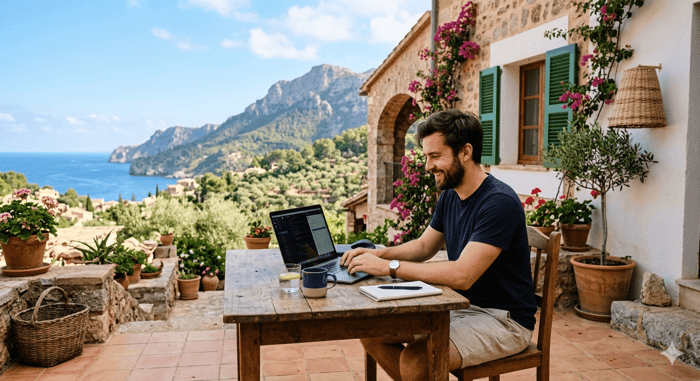
The alternatives that remain open are the Non-Lucrative Visa (for those who can demonstrate sufficient passive income and do not intend to work in Spain), and the Digital Nomad Visa, introduced in 2023 under Spain's Startup Act. The Digital Nomad Visa is designed for remote workers employed by non-Spanish companies. The income requirement in 2026 sits at around €2,850 per month for a single applicant, rising with dependants. It offers an initial residence permit for up to three years, renewable for two more, and a pathway to permanent residency after five years of legal residence.
The NIE and the Buying Process
Every property purchase in Spain requires a NIE — the Número de Identificación de Extranjero, your Spanish tax identification number. Without it you cannot sign contracts, pay taxes, or open a Spanish bank account. American buyers need to factor this into their timeline. The NIE can be obtained in person at a Spanish consulate in the US, or in Spain itself. Processing times vary, but allowing several weeks is sensible, particularly if you are applying from the US.
The overall purchase timeline in Spain typically runs two to three months from offer accepted to keys in hand, sometimes slightly longer depending on the property's legal situation — for example, if a military permit is required (more on this below) or if there are inheritance or coastal concession matters to resolve.
Opening a Spanish bank account is a practical requirement, not just a bureaucratic one. Transfer fees and mortgage payments flow through it, and Spain's anti-money laundering regulations require buyers to document the origin of purchase funds. Large wire transfers from US accounts attract scrutiny, so preparing this paperwork in advance — bank statements, proof of income source, any investment account documentation — saves delays later.
FATCA and What It Means for Your Mortgage
This is where the American buyer experience diverges most noticeably from that of a British or German buyer. The Foreign Account Tax Compliance Act (FATCA) requires foreign financial institutions — including Spanish banks — to report account information about US persons to the IRS. This creates an administrative compliance burden that some smaller Spanish banks prefer to avoid. In practice, they decline US clients not out of any legal restriction, but because the paperwork is simply not worth it for them.
The major banks are different. BBVA, Bankinter, Sabadell, Santander, and CaixaBank's HolaBank service all lend to US citizens once the FATCA compliance box is ticked. What this means for you as a buyer is additional documentation: Form W-9, IRS tax transcripts, and a signed foreign tax compliance declaration are now standard requirements. Budget for underwriting taking a week or two longer than it would for a European applicant, and expect a marginal increase in the interest rate spread to cover the bank's extra compliance cost.
Non-resident buyers in Spain generally receive mortgages at 60 to 70 percent loan-to-value, meaning a deposit of 30 to 40 percent plus purchase costs. Purchase costs — transfer tax, notary, registry, and legal fees — typically add 10 to 12 percent on top of the purchase price. Fixed-rate terms of 15 to 25 years are standard, with rates tied to the Euribor plus a bank spread of around 1.0 to 2.0 percent.
The US Tax Layer
Unlike most nationalities, US citizens are taxed on their worldwide income regardless of where they live. Buying a property in Mallorca adds a compliance layer that does not affect British, German, or Scandinavian buyers in the same way.
The key obligations are:
FBAR (FinCEN Form 114): Required if the aggregate value of your foreign financial accounts — including your Spanish bank account — exceeds $10,000 at any point during the calendar year. This is reported separately to the IRS, not as part of your tax return.
Form 8938 (FATCA reporting): Required if your foreign financial assets exceed certain thresholds. For single filers living in the US, the threshold is $50,000 at year-end or $75,000 at any point during the year. Thresholds are higher for married couples and for Americans living abroad.
Rental income: Any rental income from the property must be reported on your US tax return on Schedule E, regardless of the amount. Spain will also tax this income under the non-resident income tax framework, but the US-Spain double taxation treaty means you will generally receive a credit for taxes paid in Spain.
Spain's wealth tax: The Balearic Islands apply their own wealth tax rates on assets above €700,000. As a non-resident owner, this applies to your Spanish property net of any mortgage. Americans are not exempt, and it needs factoring into the annual cost of ownership.
None of this should discourage a purchase. But it does mean that an accountant familiar with both US and Spanish tax law is not optional — it is a practical necessity.
Does the Military Permit Apply to Americans?
Spain requires non-EU buyers purchasing certain rural properties — fincas, country estates, and properties in areas designated as militarily sensitive — to obtain a military authorisation before completing the purchase. This requirement exists under a 1975 law relating to areas of strategic national defence interest.
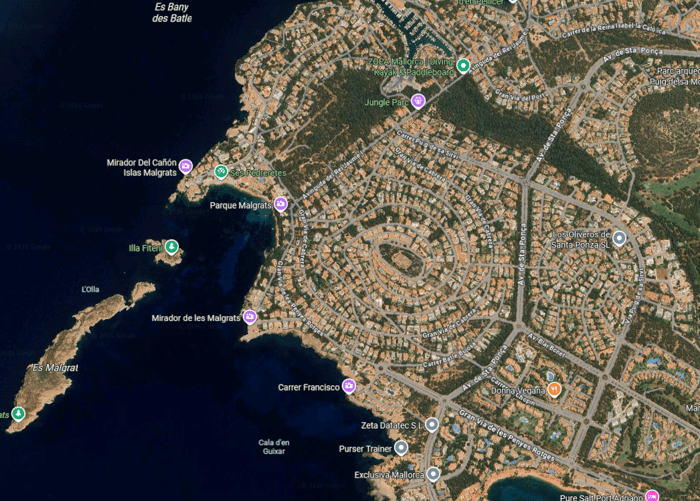
In the Balearic Islands, the requirement applies to non-EU nationals buying rural or agricultural land. Most urban apartments, townhouses, and standard villas in residential areas of Calvià — including Santa Ponsa, Nova Santa Ponsa, and the surrounding zones — are not affected. If you are considering a rural finca or a property with significant agricultural land, your lawyer will advise whether the permit is required. When it is, the process is straightforward and does not represent a major obstacle, but it adds several weeks to the timeline.
The Schengen Reality
Owning a property in Mallorca does not change your status as a non-EU visitor to Spain. Americans can spend up to 90 days in any 180-day period within the Schengen Area without a visa. If you want to spend more time than this — including living in your Mallorca property for extended stretches — you will need a visa or residence permit. The Digital Nomad Visa is the most practical route for working Americans. The Non-Lucrative Visa suits retirees or those with significant passive income who are not working.
ETIAS — the European Travel Information and Authorisation System, a pre-travel registration requirement for non-EU visitors to Schengen countries — has been further delayed and is now not expected to apply as a boarding condition until at least April 2027.
Why Mallorca, and Why Now
The fundamentals that attract American buyers are the same ones that have made Mallorca Europe's most consistently performing luxury property market over the past decade. The island-wide average price reached €7,370 per square metre in 2026, according to the independent Steinbeis Transfer Institute study published in March — a 9.8 percent year-on-year increase. In the southwest, where Imperial Properties operates, prices approach €10,000 per square metre for well-positioned properties.
Supply at the premium end is structurally constrained. New build is tightly regulated, and prime sea-view properties with pools represent only around 2 percent of total available stock. This is not a market that inflates and deflates with news cycles. It is driven by geography, planning restrictions, and a sustained international buyer base that shows no sign of contracting.
For American buyers who have done the research — understood the FATCA layer, found a bilingual lawyer, appointed a US-Spain tax adviser, and chosen a bank with a non-resident desk — the process is perfectly manageable. The key is treating it as a structured project rather than something to sort out as you go.
If you are at the early stages of exploring what is possible in southwest Mallorca, the Imperial Properties team has been working with international buyers since 1985. We can help you understand the market, the specific areas, and the practicalities before you commit to anything. Browse current listings across Mallorca or get in touch directly.