Table of Contents
Working Remotely from Mallorca: Connectivity, Visas and the Honest Reality
The number of people who have restructured their working lives around living in Mallorca permanently rather than visiting it occasionally has grown considerably since remote working became a standard arrangement across professional services, technology, finance and media. The island has always attracted buyers who wanted a second home with serious lifestyle credentials. What has changed is that a meaningful proportion of those buyers are now asking a different question: not whether Mallorca is a good place to own property, but whether it is a viable place to base a working life entirely. The honest answer is that for the right person, in the right situation, it is — but with specific conditions on connectivity, legal status and the texture of daily working life that are worth understanding before you commit.
The Connectivity Question
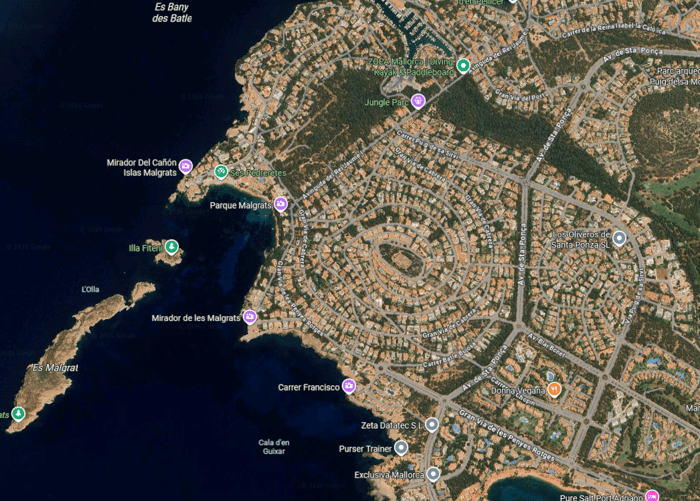
The first thing most people ask is about internet. The answer in the southwest of Mallorca in 2026 is better than many expect and better than the island's reputation for connectivity might suggest. The main residential areas — Santa Ponsa, Nova Santa Ponsa, Palmanova, Portals Nous, El Toro — have fibre optic broadband available through the major Spanish providers including Movistar, Orange and Digi, as well as local Balearic providers such as ConectaBalear, which describes itself as the local provider with the widest fibre coverage across the islands. Speeds in established urbanisations are generally sufficient for video calls, cloud-based working and file transfer without difficulty.
The picture is more variable in rural locations, elevated plots and the upper parts of some urbanisations where the fibre infrastructure has not yet reached every street. For those properties, providers such as ConectaBalear and Wannahop offer WiMAX wireless broadband as an alternative to fibre, reaching locations that cable cannot. The coverage is not the same as fibre but is workable for most professional remote working arrangements. Data from the Fair Internet Report shows Balearic Islands broadband speeds typically running between 88 and 430 Mbps — a wide range that reflects the difference between a well-connected villa in central Santa Ponsa and a rural finca at the end of a track in the interior.
The practical approach before committing to a property as a remote working base is to verify coverage at the specific address rather than assuming the area is covered. Providers' online coverage checkers are reasonably reliable, and it is worth confirming with neighbours and the local provider what speeds are genuinely achievable at that street, not just in the postcode.
Thinking about buying or selling in Mallorca?
The Legal Framework — EU Residents Versus Non-EU Residents
The legal situation for remote working in Mallorca depends almost entirely on your nationality and the nationality of the company you work for. For EU and EEA nationals the situation is straightforward — free movement means you have the right to live and work in Spain without a specific visa, and registering as a resident in Spain (empadronamiento) is a formality rather than a legal hurdle. EU nationals working remotely for non-Spanish employers are not doing anything that requires a special visa or permit. They need to consider their tax residency position — spending more than 183 days in Spain in a calendar year makes you a Spanish tax resident — but the right to be physically present and work is not in question.
For non-EU nationals, primarily British citizens post-Brexit and Americans, Canadians and Australians, the situation requires more attention. Spain introduced its Digital Nomad Visa in 2023 under the Startup Act (Ley de Startups), and it remains the primary legal pathway for non-EU remote workers in 2026. The visa is officially called the International Telework Visa and it allows non-EU citizens to live in Spain while working remotely for companies or clients based outside Spain. Freelancers may work for Spanish clients but that work cannot exceed 20 percent of total income.
The Spain Digital Nomad Visa — 2026 Requirements
The income threshold for the 2026 Digital Nomad Visa is 2,849 euros per month for a single applicant — set at 200 percent of Spain's minimum wage (SMI), which was updated in February 2026 to 1,221 euros per month under Royal Decree 126/2026. For applicants with dependents, the threshold rises: add 75 percent of the SMI for the first dependent and 25 percent for each additional one, meaning a couple with one child needs to demonstrate approximately 4,275 euros per month in stable remote income.
Beyond income, applicants must demonstrate a professional qualification (a university or postgraduate degree from a recognised institution) or at least three years of professional experience in their field. The company the applicant works for must have been in continuous operation for at least one year, and the applicant must have been employed by or contracting with that company for at least three months prior to application. A clean criminal record covering all countries of residence over the past two years is required.
Applications can be made either from within Spain — if you are already legally present on a Schengen tourist visa, for example — or at a Spanish consulate abroad. Applying from within Spain produces a three-year residence permit. The permit can be renewed for a further two years, and after five years of legal residency in Spain the holder can apply for long-term residency. After ten years, a Spanish citizenship application becomes possible.
The Digital Nomad Office (UGE-CE) tightened its review standards in early 2026, deploying a more experienced team and reducing benefit-of-the-doubt decisions on documentation. Compliant applications with consistent bank statements, properly certified employer documentation and complete paperwork are approved without difficulty. Applications relying on gross salary figures unsupported by matching bank statement evidence are not.
The Tax Position
Spending more than 183 days per year in Spain makes you a Spanish tax resident, at which point your worldwide income becomes taxable in Spain. For most remote workers relocating to Mallorca this is unavoidable and intended — you are moving here, after all. The Spanish income tax (IRPF) system has progressive rates that are comparable to most northern European countries, though the specific liability depends on total income level. Non-residents who spend less than 183 days per year pay a flat rate on Spanish-source income only.
The Beckham Law (Regimen Especial de Impatriados) is a provision that allows qualifying newly arrived tax residents to opt for a flat 24 percent tax rate on Spanish income for the first six years of residency, rather than the progressive IRPF rates. It is available to people relocating to Spain for work for the first time — the Digital Nomad Visa itself is one of the qualifying pathways. For high earners, the Beckham Law can represent a significant saving. It requires an application within six months of starting work in Spain and is worth discussing with a Spanish tax adviser before making decisions.
What Daily Working Life Looks Like
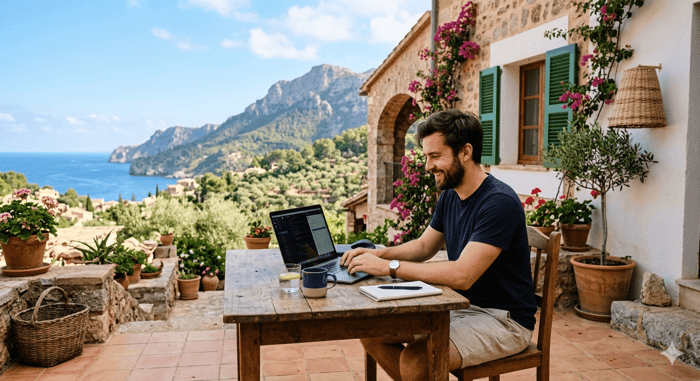
The practical texture of working remotely from southwest Mallorca depends more on discipline and the nature of the work than on the location itself. The conditions are good: the climate means you are not fighting the weather for eight months of the year, the quality of life outside working hours is high by any measure, and the absence of a commute is structurally different from being office-based even by the standards of other remote-work locations. What Mallorca is not is a buzzing technology hub with a dense ecosystem of co-working spaces, networking events and professional community — that ecosystem exists more in Palma than in the southwest, and in Palma it is modest by the standards of Barcelona or Madrid. If your work requires day-to-day in-person professional community, the island will not provide that in the way that a city does.
What it does provide is a working environment where the quality of life outside the screen is substantially better than most alternatives available at a comparable cost. The ability to swim at 7am, be at your desk by 9am, have lunch outside in January and spend the afternoon doing something other than commuting is a genuine structural change to daily life, not a holiday fantasy. The people who make it work long-term are those whose professional output is measured by what they produce rather than where they produce it, and who have made a deliberate decision about what they want their daily life to look like.
Connectivity Checklist Before You Buy
If you are evaluating a property in southwest Mallorca as a remote working base, the connectivity questions worth answering before exchange are: whether fibre reaches the specific street; what the maximum speed available at that address is from at least two providers; whether the property has a phone line and existing infrastructure or requires a new connection; and whether a backup mobile data connection would be viable at that location in case of outages. The answers to these questions take 30 minutes to establish with a phone call to the providers and a conversation with neighbours or the selling agent. They are worth establishing before you commit rather than after.
If you are considering a move to southwest Mallorca as a remote working base and want to understand the property options, we are happy to discuss what is available and what questions to ask about connectivity at specific properties.
See all our properties for sale in Mallorca
Read our guide to Spanish tax residency for Mallorca property owners
Read our guide to moving to Mallorca from the UK in 2026