Table of Contents
- Can You Actually Live Without a Car in Calvia?
- The Most Direct Route: Line 103 to Palma
- Line 104: The Slower Coastal Alternative
- Getting to and from Santa Ponsa
- Reaching Camp de Mar and Port d'Andratx
- Fares, Transfers and Paying On Board
- Getting Around Once You're in Palma
- What a Realistic Car-Free Week Looks Like
- Getting the Free Resident Travel Card
- FAQs
Can You Actually Live Without a Car in Calvia?
Going car-free in Calvia is more realistic than most people expect, provided you know which TIB bus lines actually serve the municipality and how often they run. This isn't a guide to the free resident transport card scheme in general — it's a practical, route-by-route look at what getting around Santa Ponsa, Palmanova, Portals Nous, Bendinat and the rest of the Calvia coast actually looks like day to day, for residents rather than holidaymakers passing through.
The Most Direct Route: Line 103 to Palma
For anyone in Santa Ponsa itself, Line 103 is the most logical way into Palma. Its route is short and direct — Santa Ponsa, Costa de la Calma, Galatzo and then Palma — without the long loop through Palmanova, Son Caliu and Magaluf that other lines take. The journey takes around 25 minutes, which makes it genuinely usable for a regular commute or an evening out rather than something you plan an afternoon around. A newer service, Line 103B, reinforces this corridor further by connecting Costa de la Calma directly to Santa Ponsa and Palma alongside the original 103, which has meant more departures overall on this stretch in recent seasons.
Line 104: The Slower Coastal Alternative
Line 104 is the workhorse for the rest of the Calvia coast, running from Palma through Cala Major, Portals Nous, Son Caliu, Palmanova and Magaluf. It takes longer than the 103 because it stops at every resort along the way, but in peak season it runs every 12 to 15 minutes in each direction, with departures continuing until around 1am. If you live in one of those coastal towns rather than central Santa Ponsa, this is the more useful line day to day. Outside the summer season, frequency drops on both lines, so it's worth checking the current timetable on the TIB website before relying on either for a fixed appointment.
Thinking about buying or selling in Mallorca?
Getting to and from Santa Ponsa
Beyond the 103 and 104, Line 107 also connects Santa Ponsa to Palma via Costa de la Calma and Palmanova, while Line 123 gives a more local hop between Santa Ponsa, El Toro, Son Ferrer, Magaluf and on to Cas Catala. Costa de la Calma's own connectivity was improved a few seasons back to roughly a 25-minute frequency, which matters if you live on that stretch rather than in central Santa Ponsa. For anyone heading inland, Line 107 continues on to Es Capdella and Calvia town, useful for appointments at the ayuntamiento or the health centre.
Reaching Camp de Mar and Port d'Andratx
If your daily life extends west into Andratx municipality, Line 107 and the seasonal Line 131 both run from Santa Ponsa through Peguera and Camp de Mar to Andratx and beyond — Line 131 continues on to Banyalbufar, opening up the Tramuntana side of the island as a day trip without a car. These routes run less frequently than the direct 103, so they suit planned trips rather than spontaneous ones.
Fares, Transfers and Paying On Board
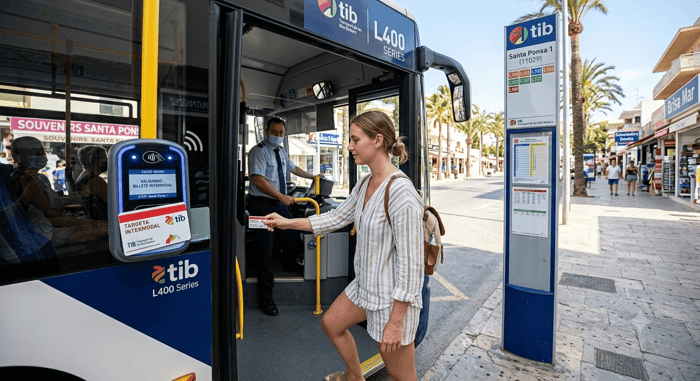
TIB fares work on a zonal system based on the number of "saltos" (hops) your journey covers. If you pay with a Tarjeta Unica, a bank card tapped directly on board, or an advance QR ticket bought through the TIB website, you're allowed up to two free transfers across three different lines within a single journey, so changing buses partway doesn't mean paying twice. The one option worth avoiding is the cash single ticket bought from the driver: it's the most expensive fare in the system, has to be paid in exact or near-exact banknotes of no more than €20, and only covers the one line you board — no transfers included. It also slows down boarding for everyone else on the bus, which is one reason most residents load a Tarjeta Unica with credit rather than paying cash.
Getting Around Once You're in Palma
Once you arrive at Palma's Estacio Intermodal or one of the stops along the seafront, the city's own EMT network takes over for reaching a specific address rather than just the centre. EMT is entirely separate from TIB — a different operator, different vehicles, blue rather than red — though your resident travel card generally covers both. EMT arrival times are tracked in real time using GPS, unlike TIB's published fixed timetables for interurban routes, so it's worth checking a live app for that last leg once you've made it in from the Calvia coast rather than working from a printed schedule.
What a Realistic Car-Free Week Looks Like
In practice, residents who go car-free in Calvia tend to combine three things: Line 103 for regular trips into Palma, Line 104 or one of the 107/123 group for local journeys along the coast, and walking or e-bikes for the last stretch between a bus stop and home, since Calvia's urbanisations are often set back from the main road. For the airport, the dedicated seasonal Aerotib line A11 runs directly from Camp de Mar through Peguera, Santa Ponsa, Magaluf, Palmanova and Portals Nous to the airport, without going via Palma centre — worth knowing if you're dropping off or collecting visitors. None of this replaces a car entirely for everyone — anyone needing to reach the more scattered rural properties inland, or travelling with young children and a lot of luggage, will still find a car useful occasionally — but for day-to-day errands, commuting into Palma and evenings out, the network covers the Calvia coast better than most people assume.
Getting the Free Resident Travel Card
All of this runs on the same free resident travel scheme available across Mallorca: register as a resident (empadronamiento), then collect a Targeta Intermodal or the newer Single Public Transport Card at any main bus or train station, including the TIB terminals along this coast. Once registered, TIB, SFM and EMT journeys are free rather than the standard cash fares of roughly €3 to €13.50 that visitors pay, which changes the calculation considerably if you're using the bus several times a week rather than occasionally. Between the two coastal lines, the Santa Ponsa local hops, the Andratx connections and the resident card itself, most day-to-day journeys along this stretch of coast turn out to be entirely coverable without a car — it's mainly a matter of learning which line to check first for a given trip.