Table of Contents
Fiestas de Sant Jaume in Calvià Village: Nine Days of Celebration, 16–25 July 2026
Every municipality in Mallorca has its own fiesta mayor — the annual celebration in honour of its patron saint, the stretch of days when the town is most purely itself. For Calvià, that's the Fiestas de Sant Jaume: officially confirmed by the Ajuntament de Calvià to run from Thursday 16 July through Saturday 25 July 2026, with 25 July — the feast day of Saint James the Apostle, patron saint of the municipality — as the culminating day.
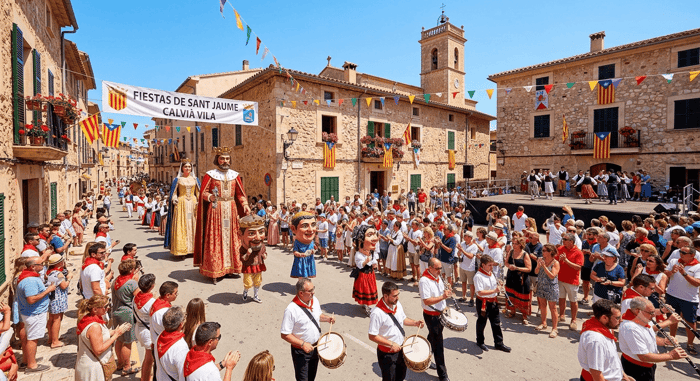
The Calvià Sant Jaume celebrations are not the kind of event that makes travel guides. They are not designed for visitors. They are the annual expression of a community that has been celebrating the same festival for centuries, with live music, a correfoc, children's activities and the particular atmosphere of a Mallorcan village when the streets fill and the usual pace of life is suspended for over a week.
For residents of Santa Ponsa, Peguera, Portals Nous and the surrounding southwest, the village of Calvià is just six kilometres inland. The Sant Jaume fiesta is one of those weeks worth making the short drive for, more than once if you can.
Thinking about buying or selling in Mallorca?
Who Is Sant Jaume?
Sant Jaume — Santiago in Castilian Spanish, Saint James in English — is one of the twelve apostles and one of the most venerated saints in the Spanish Catholic tradition. His feast day on 25 July is celebrated across Spain and the Spanish-speaking world, and 25 July is also the day when pilgrims arrive at the Cathedral of Santiago de Compostela in Galicia at the end of the Camino de Santiago.
In Mallorca, Sant Jaume is the patron saint of Calvià municipality and of several other towns and villages on the island including Alcúdia and Santanyí. Each celebrates around 25 July with its own distinct programme, but the character of the celebration — religious mass, civic events, music and correfoc — follows a consistent Mallorcan pattern that is one of the most reliable expressions of the island's cultural identity.
The Calvià Celebration: Nine Days, Not One Night
The Fiestas de Sant Jaume in Calvià village run as a full programme from 16 to 25 July 2026, organised by the Associació d'Amics i Veïns de Calvià Vila together with the Comissió de Festes. Across that stretch, the village works through a mix of children's activities, sports events, live music nights and traditional acts, building toward 25 July itself, when the day typically includes a morning mass at the Parròquia de Sant Joan Baptista — the 16th-century parish church at the centre of the village — followed by civic acts in the village square and an evening programme of live music.
The single most anticipated event of the whole nine days happens partway through, not on the final day: the correfoc, held as the Nit de Foc on Saturday 18 July. Read our full guide to the Calvià correfoc for its history, route and how to watch safely.
The correfoc — literally fire-running — is one of the most distinctive elements of Mallorcan and Catalan festival culture. Participants dressed as devils run through the streets carrying fireworks mounted on tridents (diables) while spectators crowd the route. Children and adults who want to participate bring protective clothing — long sleeves, scarves, hats — and run alongside the devils through the shower of sparks. Those who prefer to watch do so from the edges of the street.
The village of Calvià itself is the right setting for this kind of week. The historic centre — the church, the Plaça de la Vila, the traditional stone buildings on the surrounding streets — has a character that the coastal towns of the southwest cannot quite match. It is what Mallorcan village life looks like at its most intact.
Calvià Village: The Context
Calvià village is the historic capital of the Calvià municipality — the same municipality that includes Santa Ponsa, Peguera, Magaluf, Portals Nous and the rest of the southwest coast. The municipality is the wealthiest in Spain by average income per capita, but the village of Calvià itself retains a character that is entirely distinct from the coastal urbanisations: a working agricultural centre with roots going back to the Moorish and medieval periods, a traditional church, a village square, and a small population of year-round residents who use the village as the genuine hub of local life inland.
The Calvià village Monday market sets up each week near Bar Rosita. The Aromes Gastrobar beside the Municipal Park is a reliable stop for lunch or an evening meal. The church of Sant Joan Baptista dates to the 16th century and sits at the head of the Plaça de la Vila in a way that makes the square feel genuinely enclosed and settled, rather than created for tourism.
For residents of the coastal southwest who have not explored the village, the Sant Jaume week is one of the best occasions to make the six-kilometre drive inland and see the other side of the municipality they live in.
Practical Notes
Calvià village is approximately six kilometres from Santa Ponsa by car — around ten minutes on the road through the interior. Parking in the village centre on fiesta nights can be limited; arriving a little early and walking the last few minutes is the sensible approach.
The full day-by-day programme for the Calvià Sant Jaume 2026 celebrations (16–25 July) is published by the Ajuntament de Calvià in advance of the event. Check the municipal website at calvia.com or the Calvià social media channels for the confirmed timetable.
The Nit de Foc correfoc on 18 July typically runs from early evening into the night, finishing with a party at the municipal car park that continues toward dawn. The 25 July evening programme itself centres on live music and continues well after midnight.
The Fiesta and the Community
The Fiestas de Sant Jaume in Calvià are one of a sequence of summer patronal festivals that defines the social calendar in the municipality. The Nit de Sant Joan fires on 23 June, the Sant Jaume festivities from 16 to 25 July, the Festes de Santa Ponsa in late September — together these form the rhythm of a community year that is distinct from anything the coastal tourism season offers.
For buyers considering the southwest, the patronal festival calendar is part of the answer to a question that prospective residents often ask: what does community life actually look like here? The answer, in part, is a July week in Calvià village with a correfoc running through the streets of a 16th-century town. That is what this municipality looks like when it is being itself.
Imperial Properties has been part of the Calvià community since 1985. Browse current listings at imperial-properties.com or contact us on +34 971 692 434.