Table of Contents
The Ensaïmada: Mallorca's Most Famous Pastry and the PGI That Protects It
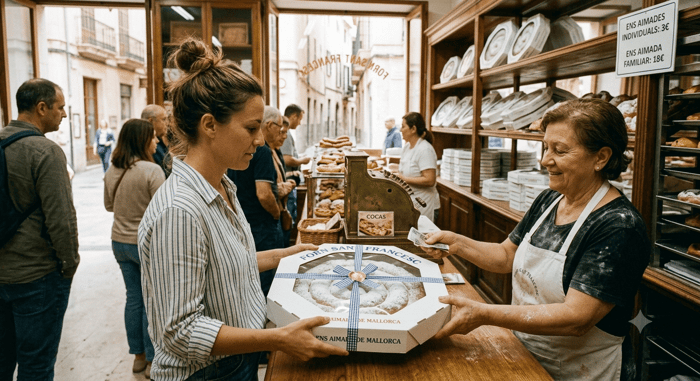
There is one thing that almost everyone who has ever spent time on Mallorca takes home: a large flat cardboard box, circular, about 40 centimetres across, carrying a spiralling coil of light, enriched pastry dusted with powdered sugar. The ensaïmada mallorquina is the island's most recognisable food product — more exported than sobrasada, more photographed than pa amb oli, and the one thing that reliably fills the overhead lockers of flights out of Palma airport from June to September.
It is also, as of 2003, a Protected Geographical Indication under EU law — which means the name ensaïmada mallorquina can only legally be used for a pastry produced on the island of Mallorca using a specific process and specific ingredients. Understanding what makes a genuine ensaïmada, who makes the best ones, and what the protection actually means is part of understanding one of the most culturally significant food traditions on the island.
Thinking about buying or selling in Mallorca?
What Is an Ensaïmada?
The ensaïmada is a leavened, enriched dough pastry, traditionally made from strong flour, water, eggs, sugar, sourdough culture and — critically — saïm, the Mallorcan word for lard (pork fat). The name itself comes from saïm: an ensaïmada is, literally, a pastry made with lard. This distinguishes it from many superficially similar pastries made with butter or vegetable fat.
The dough is mixed, fermented overnight with the sourdough culture, laminated with the saïm and then rolled into a long thin rope which is coiled into the characteristic flat spiral shape. The spiral is then proved for up to eight hours and baked at a moderate temperature until it is light, airy and barely golden. After cooling, it is dusted generously with icing sugar (sucre en pols). The result is a pastry that is simultaneously rich and light — denser than a brioche, lighter than a croissant, with a faint sweetness and a depth of flavour that comes from the long fermentation and the quality of the lard.
There are two formats: the plain ensaïmada (llisa) and filled versions (farcida). The most traditional filling is cabell d'àngel — candied pumpkin, pulled into thin threads by hand after slow cooking in sugar syrup, with an amber colour and an intensely sweet, slightly caramelised flavour. Other fillings include sobrasada (the island's paprika sausage), cream, chocolate or seasonal fruits, but the plain and the cabell d'àngel remain the most authentic.
The PGI: What It Means and Why It Matters
The Indicació Geogràfica Protegida (IGP) — Protected Geographical Indication in English — for the ensaïmada de Mallorca was registered with the European Union in 2003. The protection is overseen by the Consell Regulador de l'Ensaïmada de Mallorca, which sets the production standards and monitors compliance.
To carry the PGI designation, an ensaïmada must be produced on the island of Mallorca, must use saïm (lard) rather than butter or vegetable fat, must follow the traditional long-fermentation process using sourdough culture, and must meet the dimensional and weight specifications set by the Consell Regulador. The flour must be of a minimum protein content. The pastry must achieve the characteristic open, layered crumb structure that results from the lamination process.
This means that the ensaïmadas sold in bakeries and pastry shops across the Spanish mainland — in Madrid, Barcelona, Valencia — cannot legally carry the IGP designation. Some may be called ensaïmadas, but they are not ensaïmadas mallorquinas in the protected sense. The same applies to versions sold in other countries. Only those produced on Mallorca by registered producers following the specification can carry the official seal.
The History
The ensaïmada has been documented on Mallorca since at least the 17th century, with written references to the pastry in Mallorcan documents from 1651 onwards. Its origins are debated — some food historians connect the coil shape and the use of lard to Moorish pastry traditions from the period before the 1229 reconquest, while others point to purely Christian Mallorcan origins. What is clear is that by the 18th and 19th centuries, the ensaïmada was firmly established as the island's defining pastry and was already being carried off the island by visitors as a gift.
The large cardboard box — the caixa d'ensaïmada — became the standard transport packaging in the 20th century and is now itself an icon: the unmistakable flat circular box that identifies an ensaïmada from any angle and fills the departure lounge of Palma airport with a particular kind of sweet anticipation every summer Friday evening.
Where to Buy a Genuine Ensaïmada in the Southwest
Every bakery (forn) and pastry shop (pastisseria) in the southwest makes ensaïmadas. Quality varies significantly — the difference between a mass-produced version and one made with care, good lard and proper fermentation is immediately apparent in the texture and flavour.
In Santa Ponsa, the local forns along the commercial streets stock fresh ensaïmadas daily, typically baked overnight and available from early morning. The plain version (llisa) shows the quality of the dough most clearly — if the pastry is dense, heavy or uniformly pale without the characteristic layering, it has been rushed or made with substitute fats.
For the most serious versions, the Forn des Teatre on Plaça Weyler in Palma is one of the most celebrated producers on the island — established in 1700 and continuously operating since. The Can Joan de s'Aigo in Palma, operating since 1700, is another institution. For residents who want to source the best regularly without going into Palma, asking the forn directly which of their ensaïmadas are made with saïm rather than substitute fat is the right question.
How to Eat an Ensaïmada
There are no rules. In Mallorca, the ensaïmada is eaten at any time of day — for breakfast with café amb llet (coffee with milk), as a mid-morning snack, as a dessert, or as a gift to take to someone's house. It is always eaten at room temperature rather than warmed, which would collapse the delicate layering. It does not need butter, cream or any accompaniment — the pastry is rich enough on its own.
The plain version is typically finished in one sitting if you are two or three people. The large version (a kilo or more) is a sharing pastry that fills a table for a crowd. The cabell d'àngel filling adds a specific sweetness that is an acquired taste for those not used to intensely candied preparations, but one worth acquiring.
Fresh is everything. An ensaïmada at its best is the morning of baking. It remains perfectly good the following day. By day three, it has lost something irreplaceable. This is why residents buy them regularly rather than in advance, and why the Saturday market in Santa Ponsa — when local bakers sometimes bring fresh product — is worth checking for a good one.
The Ensaïmada and the Island
The ensaïmada is not just a pastry. It is the most portable expression of Mallorcan food identity — the one thing that travels off the island and carries the island's character with it. Understanding why it is made the way it is, what the lard contributes, what the fermentation does, and why the IGP matters is part of the broader project of understanding what makes Mallorcan food culture distinctive from the generic Mediterranean cooking that dominates tourist menus across the island.
It is also one of the simplest pleasures of living here: a fresh ensaïmada on a Saturday morning, with coffee, after the market.
Imperial Properties has been helping people make the move to the southwest since 1985. Browse current listings at imperial-properties.com or contact us on +34 971 692 434.