Table of Contents
Cost of Living in Mallorca vs London Munich Amsterdam and New York - A Real Numbers Guide 2026
One of the most persistent misconceptions about Mallorca is that it is an expensive place to live. The assumption tends to come from the price of a hotel room in August or the bill at a harbour restaurant in peak season, neither of which tells you anything useful about what it actually costs to live here as a resident. When measured against the cities where most of the island's international buyers and residents come from, the reality is materially different. Grocery staples cost a fraction of London or New York prices. Electricity is lower per unit than in Germany. Fuel is among the cheapest in the EU. Public transport within the island is free for registered residents. Flights to the mainland carry a 75 per cent government discount for qualifying residents. Annual property taxes and waste charges are modest by any northern European standard. This article puts real, verified numbers on the table.
Grocery prices are drawn from Numbeo's Palma de Mallorca data set updated April 2026, calibrated by 21 local contributors. Comparison city data is from the same Numbeo database. Utility costs are sourced from Endesa's published April 2026 tariff data and the European Commission Oil Bulletin dated 27 April 2026. Annual property cost data is sourced from published municipal tax records and independent legal guides.
Everyday Grocery Prices in Mallorca vs Other Cities
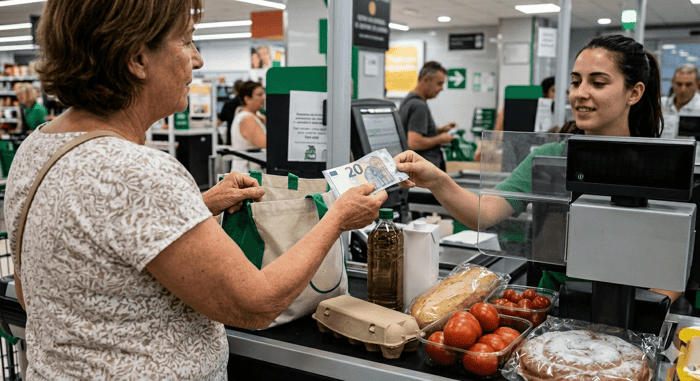
The prices below reflect what residents pay at Palma's main supermarkets — Mercadona, Lidl, Eroski and Carrefour — which serve the permanent population year-round at local rates. Grocery costs in Mallorca run 10 to 15 per cent below the Spanish mainland average, according to independent market data.
| Item | Mallorca (Palma) | London | Munich | Amsterdam | New York |
|---|---|---|---|---|---|
| Milk, 1 litre | €0.98 | €1.35 | €1.10 | €1.15 | €1.60 |
| Eggs, 12 free range | €2.80 | €4.20 | €3.50 | €3.80 | €5.20 |
| Bread, white loaf 500g | €1.10 | €2.10 | €1.60 | €1.80 | €3.20 |
| Chicken breast, 1kg | €6.50 | €9.80 | €8.20 | €8.50 | €12.50 |
| Rice, white, 1kg | €0.90 | €1.60 | €1.40 | €1.50 | €2.20 |
| Olive oil, 1 litre | €5.50 | €8.00 | €7.50 | €7.80 | €10.50 |
| Tomatoes, 1kg | €1.80 | €2.80 | €2.50 | €2.70 | €4.00 |
| Potatoes, 1kg | €0.90 | €1.40 | €1.20 | €1.30 | €1.80 |
| Bottle of local wine, 750ml | €4.50 | €8.00 | €5.50 | €6.50 | €12.00 |
| Beer, domestic, 500ml | €0.80 | €1.60 | €1.10 | €1.20 | €2.20 |
A weekly shop for two people at a Palma supermarket typically runs to €80 to €110. The equivalent shop in London would cost €145 to €190, in Munich €130 to €160, and in New York €180 to €240. The saving is consistent and meaningful, and it compounds over the course of a year.
Utilities in Mallorca vs Other Cities
Electricity in Mallorca is supplied through the national Spanish grid via Endesa, and priced at mainland Spanish rates with a slight island premium for distribution. As of April 2026, Endesa's fixed-rate residential tariff for Mallorca households is €0.1265 per kWh (their 24h Online Fixed Tariff), with the regulated PVPC variable rate averaging between €0.10 and €0.20 per kWh depending on the hour and day. Spanish VAT on electricity returned to the standard 21 per cent rate from January 2025, alongside a 5.11 per cent electricity excise tax.
| Utility | Mallorca (monthly avg) | London | Munich | Amsterdam | New York |
|---|---|---|---|---|---|
| Electricity (standard apartment) | €60–€100 | €130–€180 | €90–€140 | €100–€150 | €110–€160 |
| Electricity (3-4 bed villa, pool) | €150–€250 | n/a (no equivalent) | €200–€350 | €200–€300 | €250–€400 |
| Water (apartment, monthly) | €20–€40 | €35–€55 | €30–€50 | €30–€50 | €50–€80 |
| Internet, 100Mbps fibre | €30–€45 | €40–€65 | €35–€55 | €35–€55 | €55–€80 |
| Mobile phone, monthly plan | €15–€30 | €25–€45 | €20–€40 | €20–€40 | €40–€70 |
The combined monthly cost of electricity, water and internet for an apartment in Palma typically runs to €110 to €185. In London the equivalent is €205 to €300. Electricity on Mallorca is slightly higher per unit than mainland Spain due to the island distribution surcharge, but the absence of a central heating requirement for most of the year means annual electricity consumption is substantially lower than in northern European cities.
Fuel Prices in Mallorca
Spain's national average for unleaded 95 petrol was €1.504 per litre as of 27 April 2026, according to the European Commission Oil Bulletin, making it the fourth cheapest EU country for petrol. Mallorca carries a slight premium of 5 to 10 cents per litre above the mainland average due to island logistics and the distribution network. In practice, a litre of unleaded 95 at a Palma forecourt in April 2026 runs to approximately €1.55 to €1.70, with better prices at Lidl, Eroski and inland stations and higher prices at motorway services and tourist coastal zones. Diesel is approximately €1.73 per litre nationally, slightly higher on the island.
| Location | Petrol 95 (approx per litre, Apr 2026) |
|---|---|
| Mallorca (local stations, inland) | €1.55–€1.65 |
| Mallorca (coastal tourist areas) | €1.65–€1.78 |
| UK national average | €1.72 (approx £1.46) |
| Germany national average | €1.78 |
| Netherlands national average | €1.95 |
| USA national average | €0.90 (approx $0.97) |
Mallorca compares well against Germany, the UK and the Netherlands on fuel costs, and even against the EU average of €1.78 per litre. American drivers will find European fuel significantly more expensive, but for the European buyers who make up the majority of the island's international resident community, the cost is broadly competitive.
Transport for Residents - What It Actually Costs
One of the most significant practical financial advantages of being a registered resident in Mallorca is the cost of transport. The Balearic Government makes all public buses and local EMT (Empresa Municipal de Transports) city buses in Palma free of charge for all residents who are registered on the local padrón. This covers the TIB interurban bus network connecting towns across the island, and the EMT urban network within Palma. A non-resident visitor pays €2.00 for a single bus journey; a resident pays nothing.
For rail travel, the FGC narrow-gauge train line connecting Palma to Inca (and to Manacor via a branch) is also free for registered residents.
For flights between Mallorca and mainland Spain, registered residents of the Balearic Islands who hold a valid EU or EEA residence certificate are entitled to a 75 per cent government discount on the base fare of all domestic flights between Mallorca and any mainland Spanish airport, and on inter-island ferries. This discount, known as the descuento de residente, was introduced in 1997 and is funded by the Spanish Ministry of Transport. A €100 flight from Palma to Madrid costs a qualifying resident €25. The discount applies to an unlimited number of trips per year and is automatically applied at booking using the resident's NIE number.
The residency discount requires a certificado de viaje (residency travel certificate) from the local ayuntamiento, and is available to Spanish nationals, EU and EEA citizens, and Swiss nationals who can demonstrate qualifying residency status. Non-EU residents holding a TIE (long-term residence card) may also qualify.
Annual Property Costs - IBI and Basura
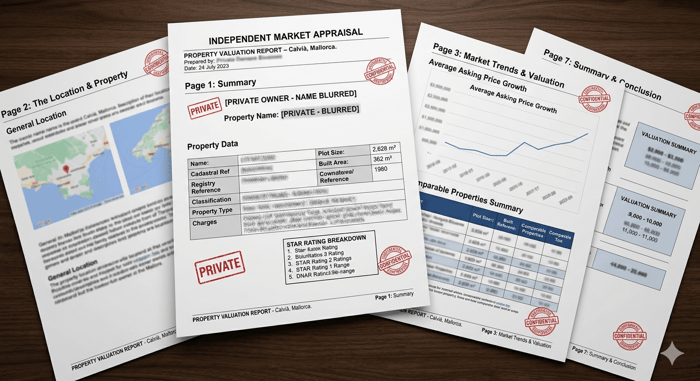
For property owners in Mallorca, the two main annual charges levied by the municipality are the IBI (Impuesto sobre Bienes Inmuebles, the property tax) and the Basura (waste collection charge). Both are calculated separately from the purchase price and are paid annually, typically in the summer months of July and August in Calvià and most southwest municipalities.
The IBI is calculated on the cadastral value of the property, which is set by the Land Registry and is typically 40 to 60 per cent lower than market value. The applicable rate varies by municipality: Palma applies around 0.9 per cent for urban properties; Calvià and Andratx typically apply rates between 0.4 and 0.7 per cent. In practice this means:
| Property (Market Value) | Typical Cadastral Value | Typical Annual IBI |
|---|---|---|
| Apartment €450,000 (Palma) | €150,000–€250,000 | €320–€800 |
| Villa €1,500,000 (Calvià) | €400,000–€600,000 | €2,000–€4,500 |
| Villa €3,000,000 (Andratx) | €700,000–€1,200,000 | €3,500–€8,000 |
The Basura (waste collection tax) is a separate annual charge, fixed by the municipality. For private residential properties in Palma it typically runs to €150 to €200 per year. In Calvià and Andratx the figure is similar. This is a flat charge unrelated to property value and represents a negligible annual cost by any comparative standard.
For comparison: annual council tax on a mid-range property in London runs to €2,000 to €3,000 per year at Band D rates, with no income-generating or wealth-based calculation involved. German Grundsteuer property tax on a comparable mid-range home runs to €500 to €2,000 annually depending on municipality. On a like-for-like basis, IBI in Mallorca is broadly comparable with Germany and considerably lower than the UK.
Home Insurance
Annual home insurance for a villa in Mallorca typically runs to €400 to €1,200 per year for a comprehensive policy covering buildings, contents, liability, pool and garden. For an apartment in Palma, annual premiums of €200 to €500 cover equivalent risks. Major providers operating in Mallorca include Mapfre, Axa, Generali and Zurich, all of which issue policies in English, German and French for international clients. These figures are significantly lower than equivalent comprehensive home insurance policies in the UK, where annual premiums for detached houses average €1,500 to €2,500.
Eating Out and Daily Life
A meal at an inexpensive restaurant in Palma costs approximately €15 per person. A three-course dinner for two at a mid-range restaurant, without drinks, averages €60. A cappuccino in a Palma café costs around €2.75. The three-course menu del día lunch available at most restaurants Monday to Friday costs €12 to €18 including a drink, bread and dessert — a genuinely excellent deal that has no equivalent in London, Munich or New York at any comparable quality level. A pint of draft beer in a Palma bar costs €3 to €5.
The Overall Picture
A single person living in a rented apartment in Palma, excluding rent, spends approximately €833 per month on groceries, utilities, transport and daily life, according to Numbeo's April 2026 data. The equivalent monthly spend in London is approximately €1,200, in Munich €1,050, and in New York €1,400. When the free public transport, the resident flight discount and the lower annual property running costs are factored in, the financial case for Mallorca as a primary or extended-stay residence is compelling on its own merits — quite separate from the lifestyle, climate and property value arguments that typically drive the conversation.
At Imperial Properties, we are happy to provide prospective buyers with detailed running cost estimates for specific properties and areas based on current market data. Understanding the full annual cost of ownership is part of the service we provide to every buyer we work with.