Table of Contents
The Real House Prices in Calvià's Coastal Belt (Postcode 07181): What Spain's Notarial Data Shows
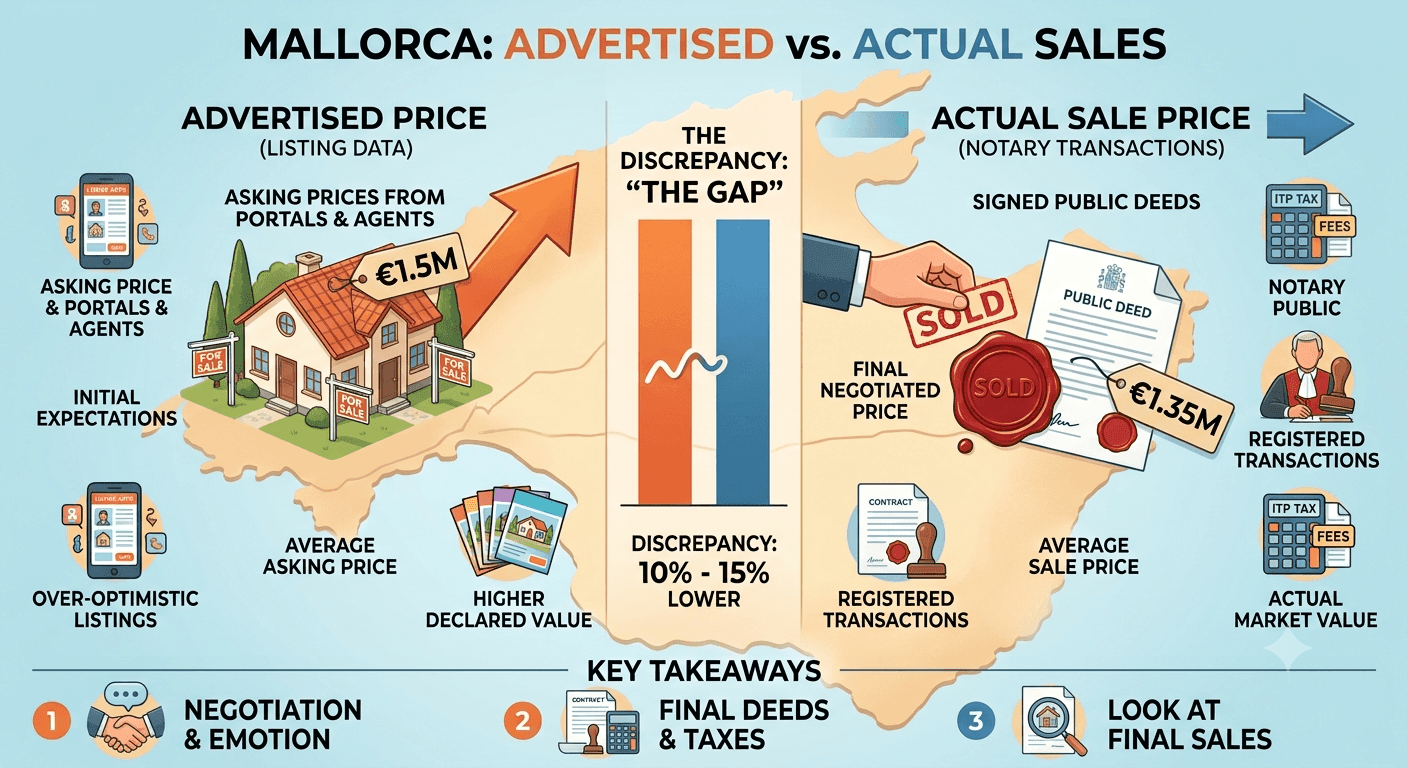
Most of what gets published about property prices in Mallorca comes from listing portals — asking prices, set by sellers, before any negotiation happens. The data from the Consejo General del Notariado is different: it's built from actual notarial deeds, the price recorded in front of a notary at the moment a sale legally completes. For postcode 07181 — the stretch of Calvià coastline running from Bendinat and Illetes through Portals Nous, Sol de Mallorca and Palmanova to Magaluf — that data tells a more grounded story than any asking-price index can.
The Headline Figures
Between May 2025 and April 2026, notaries recorded 112 house sales in postcode 07181. The average transacted price was €9,269 per m², on an average house size of 296 m², producing an average sale price of €2,739,305. This figure covers houses only — apartments are excluded — and includes both new-build and resale transactions.
That average masks real month-to-month volatility, and it's worth being upfront about why: with only 7 to 13 house sales recorded most months, a handful of unusually large or unusually modest deals can swing the monthly figure sharply.
Thinking about buying or selling in Mallorca?
January 2026 recorded an average of €14,358/m², while April 2026 dropped to €2,930/m² — not because the market moved that fast, but because the specific houses that closed in each of those months were very different in scale and value. The 12-month average is the more reliable figure to work from than any single month.
A Market That's Cooling, Not Stalling
The year-on-year price change for 2025 was +3.68% — a marked slowdown from the +20.85% jump recorded in 2024, though still positive. Zooming out, the notarial data shows the median price per m² for houses in this postcode has more than doubled over the past decade: from €2,353/m² in 2014 to €5,000/m² in 2025. The trajectory hasn't been a straight line — 2023 actually saw a small annual dip of -2.6% — but the decade-long direction is clearly upward.
Who's Buying
The buyer profile here is distinctly international: 62.75% of buyers were foreign, against 37.25% national buyers. Among foreign buyers specifically, Germans are by far the largest group, accounting for 39.02% of all foreign purchases, followed at a distance by the British (17.68%), Swedes (6.71%), Italians (3.96%) and Austrians (3.35%).
One nuance worth noting: the German buyer share is overwhelmingly non-resident — 31.4% of all buyers, versus just 7.62% resident — consistent with second-home buying rather than relocation. Italians show the opposite pattern, skewing slightly more toward resident buyers. Corporate buyers accounted for 16.67% of purchases, a meaningful minority typical of the upper end of the Mallorca market.
The median age of buyers in 2025 was 50, and buyers aged 41–60 made up over half of all purchases — 52.76% combined. Buyers under 31 remain a small share, at just 8.94%.
New Build Is Scarce
Only 10.64% of sales were new-build; 89.36% were resale. That split reflects what most residents of this stretch of coast already know: Bendinat, Illetes, Portals Nous and Palmanova are largely built out, with resale stock — not new development — driving most transactions.
What This Means for the Area
For a stretch of coastline that includes some of the southwest's most established addresses, notarial data confirms what asking-price indices tend to overstate or understate in different directions: prices here remain firmly international-buyer-driven, resale-dominated, and still rising — just at a noticeably steadier pace than the sharp jump seen in 2024.
If you're considering buying along this stretch of coast, browse our current listings across Mallorca or get in touch — we can talk through what these figures mean for a specific property or area.