Table of Contents
- January — Sant Sebastia: Palma's Winter Festival
- January — Sant Antoni: Bonfires in Every Village
- February — Carnival
- March/April — Semana Santa: Holy Week
- June — Sant Joan and the Nit de Foc
- July and August — The Patron Saint Festivals
- September — The Festes del Rei en Jaume: Santa Ponsa's Own Festival
- September/October — The Grape Harvest Festivals
- October — Palma Marathon
- December and January — Christmas and the Three Kings
- FAQs
Mallorca's Cultural Calendar: Fiestas, Folklore and the Events That Make the Island Come Alive
Mallorca's cultural calendar is one of the things that most residents discover slowly, in fragments — a neighbour mentions a fiesta in the village, the road through Palma is unexpectedly closed, a smell of woodsmoke drifts in from the square on a January evening. The island has a rich and continuous calendar of fiestas, religious festivals, folk traditions and civic celebrations that runs through every month of the year, and most of it is almost completely invisible to anyone who hasn't lived here long enough to know where to look. This is not the tourist version of Mallorca — the flamenco dinner show and the pirate boat excursion. This is the island celebrating itself, in the way it has been doing for centuries, and for residents of the southwest there are events within the Calvia municipality and across the island that reward attention and participation in equal measure. What follows is a month-by-month guide to the festivals and events that genuinely matter.
January — Sant Sebastia: Palma's Winter Festival
The Festes de Sant Sebastia, held in Palma in the third week of January, is the largest and most spectacular winter festival in the Balearic Islands. It celebrates the patron saint of Palma on 20 January and has grown over the decades into a week-long programme of outdoor concerts, bonfires, traditional folk events and the legendary correfoc — the fire run — in which groups of devils and dragons run through the streets trailing fire and fireworks in a spectacle that is simultaneously terrifying and magnificent. The main bonfires are lit across the city's squares on the evening of 19 January, and the Plaza Mayor and Passeig del Born fill with tens of thousands of people eating, drinking and watching music late into the night. The official concerts — held across multiple stages in Palma's squares — cover a range from contemporary Catalan and Spanish artists to traditional Mallorcan folk music. Sant Sebastia is free, open to everyone and unmissable. For residents in the southwest, the drive to Palma on the evening of 19 or 20 January and back late is a standard part of the island calendar.
January — Sant Antoni: Bonfires in Every Village
Sant Antoni de Viana is celebrated on 17 January throughout Mallorca, but it is in the island's rural towns — Sa Pobla, Muro, Manacor — that the celebration reaches its fullest expression. The night of Sant Antoni involves enormous bonfires (foguerons) in the streets, the blessing of animals by the parish priest, traditional dimonis (devil figures) processing through the town, and the ximbombada — improvised sung poetry performed in the street to the rhythm of the ximbomba, a friction drum specific to Mallorca. It is one of the most genuinely Mallorcan experiences available on the island and worth the drive to Sa Pobla or Muro for anyone who wants to understand the culture of the interior.
February — Carnival
Carnival in Mallorca runs in the week before Lent and is celebrated in most towns with parades, fancy dress and the ritual burial of the sardine on Ash Wednesday — a symbolic farewell to the excesses of carnival season that is taken with great seriousness and great comedy in equal measure. The Palma carnival parade is the largest, with decorated floats, costume competitions and street parties, but the smaller town carnivals — particularly in Sineu and Felanitx — have a more intimate character that rewards the journey. The Almond Blossom Fair in Llucmajor in February is a less raucous but equally Mallorcan occasion, celebrating the spectacle of the almond trees in full white flower across the interior of the island.
March/April — Semana Santa: Holy Week
Semana Santa — Holy Week — is the most important religious observance in the Mallorcan calendar and produces some of the most visually extraordinary street processions in Spain. The processions take place each evening from Palm Sunday to Good Friday, with penitents in traditional robes carrying elaborate floats bearing religious figures through the streets behind bands playing the slow, mournful music of the season. In Palma, the Good Friday procession along the seafront and through the old town is one of the most impressive religious processions in the western Mediterranean. In the smaller towns — Sineu, Pollenca, Felanitx — the scale is more intimate but the atmosphere is equally intense. Semana Santa in Mallorca is not a tourist event; it is a genuine expression of Mallorcan religious culture that dates to the medieval period and has barely changed in form.
June — Sant Joan and the Nit de Foc
The eve of Sant Joan on 23 June — the summer solstice — is one of the most celebrated nights in the Mallorcan year. In Palma, the Nit de Foc (Night of Fire) involves a spectacular fireworks display over the city and beach bonfires along the seafront, with crowds gathering on the beaches to leap over fires at midnight in a tradition that predates Christianity and is shared across the Mediterranean from Portugal to Greece. In the southwest, the beaches at Santa Ponsa and Peguera are traditionally the gathering points for the local Nit de Foc celebrations — bonfires on the beach, music and the collective sense that summer has officially arrived. The same night, Sant Joan is celebrated across the island with the same fire tradition, and the sky across Mallorca is lit from multiple directions as dusk falls.
July and August — The Patron Saint Festivals
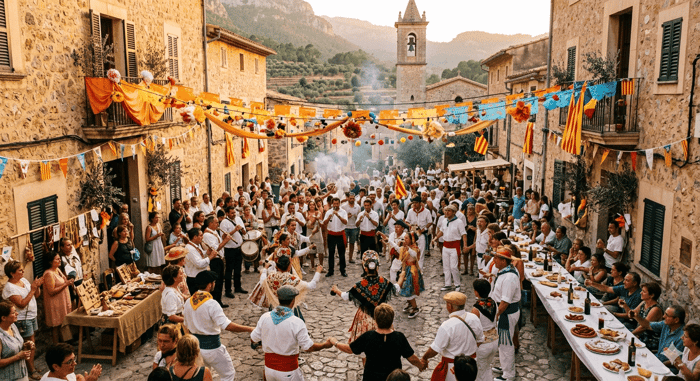
Every town and village in Mallorca celebrates its patron saint during the summer months, and the southwest is no exception. Calvia town celebrates the Festes de Sant Jaume in the third week of July, with a programme of concerts, traditional dancing (ball de bot), sports events, a correfoc and the communal meals in the square that are the social heart of every Mallorcan town festival. Es Capdella, Galilea and Puigpunyent each have their own smaller patron saint celebrations through July and August — quieter, more intimate than the coast, and the better for it. The combined sense of an island that pauses from its tourist function to celebrate itself is one of the best things about summer in the Mallorcan interior.
September — The Festes del Rei en Jaume: Santa Ponsa's Own Festival
The Festes del Rei en Jaume is the festival that matters most to residents of Santa Ponsa specifically, and it is genuinely one of the best events in the Calvia cultural calendar. Held at the beginning of September, it commemorates the landing of King Jaume I of Aragon at Cala Sa Caleta — the cove now occupied by the Club Nautico Santa Ponsa — on 12 September 1229, the event that began the Christian reconquest of Mallorca from the Moors. The festival runs for two weeks and includes an extraordinary and genuinely spectacular re-enactment of the landing and battle between Moorish and Christian forces, performed on and around the beach with hundreds of participants in period costume, horseback riders, cannon fire and the full theatrical treatment that the Calvia municipality has developed over decades into something well beyond a typical historical pageant. Alongside the re-enactment, the festival programme includes a medieval market, concerts, a giants' parade, DJ sessions, a correfoc, exhibitions and the communal meals and dancing that give every Mallorcan festival its social foundation. For residents of Santa Ponsa, the Festes del Rei en Jaume is the event to be present for.
September/October — The Grape Harvest Festivals
The Sa Vermar grape harvest festival in Binissalem, held in late September, is one of the most enjoyable mass-participation events in the Mallorcan calendar. Binissalem is the centre of the DO Binissalem wine designation — the principal wine-producing zone on the island — and the harvest festival involves a grape-treading contest, a giant communal paella in the town square, music, a giants' parade and the infamous grape fight in which the entire square turns into a purple-stained collective spectacle. Wearing white is traditional and strongly recommended. The drive from Santa Ponsa to Binissalem takes approximately 35 minutes, making this an easy day trip that sits firmly in the category of things every Mallorca resident should do at least once.
October — Palma Marathon
The Palma Marathon, held in mid-October, is an internationally registered event that attracts runners from across Europe and has grown into one of the more significant sporting events in the Balearic Islands calendar. The route runs through the streets of Palma and along the seafront, finishing near the cathedral. For non-runners, the marathon weekend brings a particular atmosphere to Palma — the city fills with visiting athletes and their families, the restaurants are full on the Saturday evening, and the Sunday morning seafront is worth watching from a cafe regardless of whether you have a race number. The October timing also coincides with the island at its most pleasant for outdoor activities — warm, clear and significantly less crowded than summer.
December and January — Christmas and the Three Kings
Christmas in Mallorca follows the Spanish pattern in which the most important celebration is not Christmas Day but the Epiphany on 6 January — the arrival of the Three Kings (Reis Mags), who bring gifts to children in the Spanish tradition rather than Santa Claus. On the evening of 5 January, every town in Mallorca holds a Cavalcada dels Reis — a parade in which the Three Kings arrive by boat or on horseback, process through the town on elaborately decorated floats and throw sweets to the children lining the streets. The Palma Cavalcada, with its harbour arrival and procession through the old town, is the grandest, but the Santa Ponsa and Calvia versions are warm and genuinely lovely for families. Christmas Day itself is primarily a family meal occasion, and the island in the two weeks between Christmas and Epiphany has a particular unhurried and pleasant atmosphere that long-term residents consistently describe as one of the best times of the year to be here.
See all our properties for sale in Mallorca