Table of Contents
Owning a Dog in Mallorca: The Complete Guide for Residents and Relocating Pet Owners
Owning a dog in Mallorca is, for many residents, one of the more enjoyable aspects of island life. The climate, the outdoor lifestyle, the walking culture and the genuine tolerance toward dogs in public spaces that characterises much of southern European society make Mallorca a good place to be a dog owner. The island is not without its rules and practical considerations, and bringing a dog from the UK, Germany, Scandinavia or the United States requires paperwork that rewards early attention. But the process is clear and well-documented, and once your dog is established on the island the day-to-day reality of dog ownership in southwest Mallorca is genuinely pleasant. This guide covers everything: the documentation required to bring a dog to Mallorca, registration with Spanish authorities, what the beach rules actually are in Calvia, the best veterinary practices near Santa Ponsa and the practical points that make life easier with a dog on the island.
Bringing Your Dog to Mallorca — The Entry Requirements
Spain follows EU pet travel regulations for the entry of dogs, cats and ferrets. The core requirements that apply to any dog entering Spain from any country are consistent: a valid ISO 11784/11785 compliant 15-digit microchip implanted before or at the time of the rabies vaccination, a valid rabies vaccination administered after the microchip and at least 21 days before travel, and appropriate travel documentation. Dogs must be at least 15 weeks old to travel internationally.
For dogs travelling from EU countries including Germany, France, the Netherlands and the Scandinavian EU members, an EU Pet Passport issued by an authorised vet in the home country covers all entry requirements. The passport records the microchip number, vaccination history and the issuing vet's details and is the standard document for all intra-EU pet movement.
For dogs travelling from the United Kingdom, the situation changed in April 2026 when GOV.UK guidance clarified that Great Britain residents — England, Wales and Scotland — should no longer rely on EU pet passports for travel into the EU. British residents now require an Animal Health Certificate (AHC) issued by an official veterinarian in the UK, valid for travel for a specific period. Northern Ireland residents retain EU pet passport access. The AHC must be obtained shortly before travel and is not a permanent document — it differs from the EU pet passport in being journey-specific rather than a lifelong record. British dog owners relocating to Mallorca should arrange their AHC through their UK vet well in advance of travel and confirm the specific requirements with the ferry company or airline, as carriers have their own pet transport policies.
For dogs travelling from the United States, Canada and other non-EU countries, an official veterinary health certificate endorsed by the relevant national authority is required. High-risk countries for rabies may additionally require a rabies antibody titre test conducted at least three months before entry, which significantly lengthens the planning timeline — owners relocating from these countries should begin the process at least four months before the intended travel date.
Spain does not require tapeworm treatment for dogs entering the country. There is no quarantine requirement for dogs arriving with correct documentation. Dogs arriving with incorrect or incomplete documentation may be refused entry or detained at the owner's cost, which underscores the importance of verifying requirements and having documentation checked by your home vet before travel.
Registering Your Dog in Spain
Once your dog is in Mallorca, Spanish law requires registration with the Ajuntament de Calvia's municipal animal registry (censo municipal de animales) within a defined period of arrival. The census records your dog's microchip number, breed, name and the owner's details, and serves as the official proof of ownership and responsibility in Spain. Registration is typically done through your local vet, who submits the registration to the municipality on your behalf. Failure to register is technically a fineable offence, though enforcement is variable.
Additionally, if your dog's microchip is recorded on a non-Spanish registry — the UK's Petlog, for example — it is worth registering the chip on REIAC, the Spanish national animal identification registry, which all Spanish vets can access and which will be the first database checked if your dog is ever lost or found on the island.
Spain has a PPP (Perros Potencialmente Peligrosos) classification for certain breeds deemed potentially dangerous: Pit Bull Terrier, Rottweiler, American Staffordshire Terrier, Fila Brasileiro, Dogo Argentino, Tosa Inu, Akita Inu and crosses thereof. Owners of PPP breeds must obtain a special licence, hold civil liability insurance of at least 120,000 euros, use a muzzle in public and keep the dog on a lead of no more than two metres. This is worth knowing before buying a property with a dog of one of these breeds, as the licence must be transferred with the ownership responsibility.
Beaches, Parks and Public Spaces in Calvia
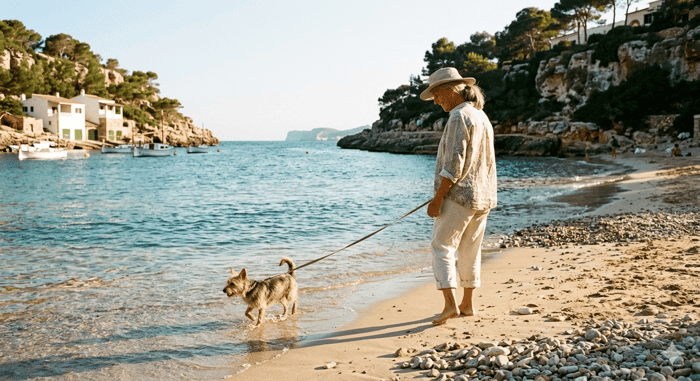
The beach rules for dogs in the Calvia municipality are clearly defined and worth understanding before summer arrives. The main beaches in Santa Ponsa, Palmanova, Portals Nous and Peguera prohibit dogs during the summer season, which the Ajuntament de Calvia defines as running from 1 June to 30 September. Outside this period — from 1 October to 31 May — dogs are permitted on most Calvia beaches provided they are kept on a lead and any waste is cleared immediately. This out-of-season window makes morning beach walks with a dog in May, October and November one of the better aspects of the Calvia year-round lifestyle.
The designated dog-friendly beach closest to Santa Ponsa during the summer season is at Palmanova, where a specific zona para perros is maintained with appropriate facilities. Several of the rocky coves along the southwest coastline accessible only on foot or by boat are not covered by the summer prohibition and can be used with dogs, though the general lead rule applies.
In terms of restaurants, cafes and public spaces, Mallorca has a practical and tolerant dog culture that most residents from northern Europe find immediately comfortable. Dogs on leads are welcome at outdoor terrace restaurants across the southwest — the vast majority of establishments with outside seating will accommodate a well-behaved dog without comment. Indoor restaurant access is at the discretion of individual owners and is less consistently permitted, though many smaller local bars and cafes are relaxed about dogs inside in the quieter months.
Veterinary Care Near Santa Ponsa
The standard of veterinary care in Mallorca is good, and the southwest has a well-distributed network of practices serving the international resident community. Several veterinary practices in the Santa Ponsa and Calvia area have English and German-speaking vets and are experienced in the full range of administrative needs that come with international pet ownership — issuing EU pet passports for residents once established, updating microchip records, managing the annual vaccination schedule and providing health certificates for travel back to the UK or elsewhere.
For emergency veterinary care outside normal opening hours, several clinics in and around Palma operate 24-hour emergency services. Your primary vet will advise on the nearest emergency facility to your location in the southwest. It is worth knowing this information before you need it — keeping the emergency vet number in your phone alongside your own vet's number is basic preparation that every dog owner on the island should do in the first week of arrival.
Health Considerations Specific to Mallorca
Three health risks specific to the Mediterranean environment deserve particular attention from dog owners arriving from northern Europe, where they are either absent or far less prevalent.
Leishmaniasis is a parasitic disease transmitted by the bite of sandflies and is endemic in Mallorca. It is a serious, potentially fatal condition in dogs that is treated but not cured — prevention is strongly preferable to management. Year-round use of a proven sandfly-repellent product (collar, spot-on or tablet) is standard practice for dogs on the island and should be discussed with your vet at the first appointment after arrival. A Leishmania vaccination is also available and recommended for dogs in endemic areas.
Processionary caterpillars are found in pine trees across the island from approximately November to April. The caterpillar's hairs cause severe allergic reactions in dogs that investigate them with their nose or mouth — reactions that can cause permanent tongue damage and in severe cases are life-threatening. Teaching your dog to avoid pine tree bases during the caterpillar season and knowing to go immediately to a vet if contact occurs is essential knowledge for any Mallorca dog owner.
Ticks are present year-round in Mallorca, particularly in wooded and scrubland areas. Regular tick prevention treatment and a post-walk tick check are both advisable, particularly for dogs that walk in the Tramuntana foothills or the pine forest areas between the coastal resorts.
The Practical Reality
Day to day, owning a dog in the southwest of Mallorca is straightforward and enjoyable. The combination of a warm climate, extensive outdoor spaces, a walking culture that extends year-round and a genuinely dog-friendly social environment makes the island one of the better places in Europe to share with a dog. The paperwork of arrival is a one-time exercise; the annual obligations — vaccination, registration renewal, prevention treatments — are modest and manageable. The main practical adjustments for owners arriving from the UK or northern Europe are the summer beach restrictions, the sandfly and Leishmania prevention routine, and the processionary caterpillar awareness in winter. None of these are significant once known.
See all our properties for sale in Mallorca