Table of Contents
The Tramuntana by Car: The Best Drives from Southwest Mallorca into the Mountains
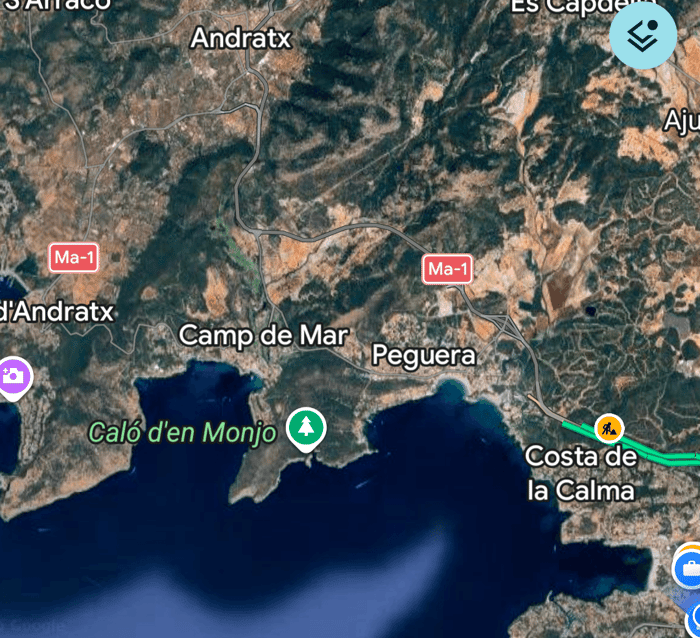
Tramuntana drives from southwest Mallorca begin closer to home than most residents realise. The Serra de Tramuntana — the UNESCO World Heritage mountain range that runs along the entire northwest coast of the island — starts effectively at Andratx, which is 20 minutes west of Santa Ponsa by motorway. The road that climbs out of Andratx toward Estellencs is the beginning of the Ma-10, one of the most celebrated driving roads in the Mediterranean: a narrow, well-surfaced mountain road that follows the edge of the range for 90 kilometres north to Pollenca, passing through some of the most extraordinary scenery in Europe at every turn. For residents in Santa Ponsa, Portals Nous and the surrounding area, the Tramuntana is not a day trip that requires planning — it is a morning out, close enough to do casually and spectacular enough to do repeatedly without the landscape ever feeling familiar. This guide covers the best routes, what to stop for and how to approach the roads without the frustration of arriving behind a tourist coach in August.
Drive 1 — The Ma-10 Andratx to Valldemossa: The Classic Route
Distance from Santa Ponsa: approximately 25 kilometres to Andratx, then 45 kilometres along the Ma-10 to Valldemossa. Total drive time without stops: 1 hour 30 minutes. Best done: on a weekday, leaving by 8:30am to reach Andratx before the coastal road fills with cyclists and tourist coaches.
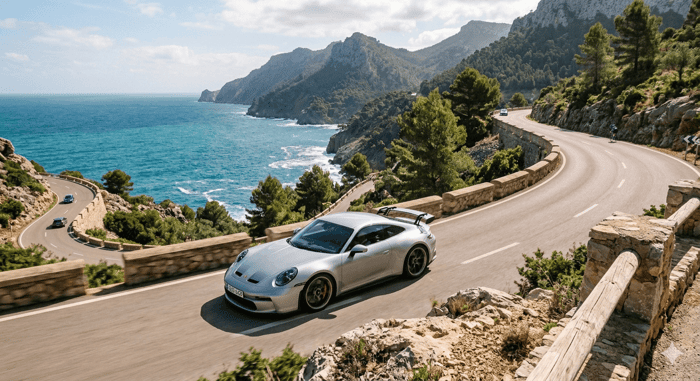
The drive begins properly at the roundabout on the western edge of Andratx where the Ma-10 climbs away from the valley. Within the first three kilometres the road has already changed character completely — the urban development falls away behind you, the pines close in on either side and the first views across the bay of Andratx and out to Sa Dragonera open to the left. The village of Estellencs, 15 kilometres from Andratx, is the first stop worth making: a small stone village clinging to the cliffs above the sea, with a terrace bar, a couple of restaurants and a mirador that looks directly across the water. The road between Estellencs and Banyalbufar — the next village — is where the Ma-10 reaches its most dramatic: a series of curves cut into near-vertical cliff faces above a coast that drops 300 metres to the sea, with the terraced olive and vegetable gardens of Banyalbufar visible ahead, built over the centuries onto the only flat land available to a village perched at this angle above the water.
Banyalbufar itself is worth a stop for coffee and a walk through the terraced garden streets before continuing. The road from Banyalbufar to Esporles descends from the clifftops into a more interior landscape before the Ma-10 joins the main Palma to Valldemossa road for the final approach to the village. Valldemossa is where the Ma-10 drive typically pauses for the first significant stop. The medieval charterhouse — La Cartuja — where Frederic Chopin and George Sand spent the winter of 1838 to 1839 is the formal tourist attraction, worth a visit if you have not been. The village itself is handsome and worth an hour regardless: a street of stone houses with flower-lined windowsills, two or three genuinely good restaurants, and a pastry — the coca de patata — that is specific to Valldemossa and very good. Arriving before 10am means you have the streets largely to yourself.
Drive 2 — Valldemossa to Deia and Soller: The Next Stage
Distance: 25 kilometres from Valldemossa to Soller via Deia. Drive time without stops: 45 minutes. This road is best done slowly.
The Ma-10 north of Valldemossa enters arguably the most photographed section of mountain road in Spain. The cliff faces are higher, the drops to the sea more vertiginous, the olive groves older and the light — particularly in the morning — remarkable. Deia, 10 kilometres from Valldemossa, is a village that has attracted artists, writers and musicians since Robert Graves settled here in 1929 and wrote I Claudius in the olive terraces above the sea. The village is beautiful, expensive, self-aware and absolutely worth stopping in. The road above the village offers one of the finest viewpoints on the island: the cluster of ochre stone houses above Cala Deia, with the sea visible far below and the mountains rising behind. Ca's Patro March at Cala Deia — accessible by a walking path from the village — is one of the island's most famous restaurants, made internationally visible by its appearance in the television series The Night Manager. Booking well in advance is essential in season.
Soller, at the end of this stage, sits in a broad orange-grove valley entirely hidden from the coast road — you arrive via a tunnel (toll: 5 euros) or over the Coll de Soller, a mountain pass with 27 hairpin bends that adds 20 minutes to the journey but is among the more impressive pieces of road on the island. The town has a Modernista church, a weekly market on Saturday mornings, a genuine local population that gives it a different character from the purely tourist villages to the south, and the famous wooden tram that runs from the town square down to the harbour at Port de Soller — 5 kilometres of narrow-gauge railway through the orange groves.
Drive 3 — Sa Calobra: The Road Worth the Detour
Distance from Soller: 30 kilometres each way. Drive time: 40 minutes each way. Best done: early morning or late afternoon, never in the middle of a summer day.
The road from Soller north along the Ma-10 climbs to the highest point of the range — passing the Gorg Blau and Cuber reservoirs, with Puig Major (the highest mountain in Mallorca at 1,445 metres) visible above — before the descent toward the coast. The turn-off for Sa Calobra onto the MA-2141 is where the driving becomes genuinely exceptional. The road drops 800 metres to sea level in five kilometres through 26 hairpin bends, including the celebrated Nus de Sa Corbata — the Knot of the Tie — where the road loops completely under itself in a 270-degree curve. The road is well maintained, wide enough for two cars to pass in most places and perfectly driveable at a sensible pace. At the bottom is a small car park, a beach bar and a 200-metre tunnel through the rock to the Torrent de Pareis — a deep limestone gorge that opens onto a pebble beach enclosed by cliffs 300 metres high. In summer this beach attracts significant numbers; arriving before 9am or after 5pm means something approaching solitude.
Drive 4 — The Andratx Interior Loop: The Short Route for a Morning
Distance from Santa Ponsa: approximately 60 kilometres round trip. Drive time: 1 hour 30 minutes without stops. This is the route for a morning rather than a day.
From Santa Ponsa west on the Ma-1 to Andratx, then inland on the Ma-1030 through Es Capdella and up to Galilea — a small hill village at 400 metres with a church, a restaurant, a handful of houses and a panoramic view across the pine-covered hills toward the sea that stops most first-time visitors in their tracks. From Galilea the road continues to Puigpunyent and then descends back toward Palma before the return via the motorway. This loop passes through three of the inland Calvia villages — Es Capdella, Galilea and the edge of Puigpunyent — all within 20 minutes of Santa Ponsa but largely unknown to the southwest's international community. The Galilea viewpoint is one of the finest in the southwest and the whole circuit can be completed in two and a half hours with a coffee stop in Galilea, making it a reasonable weekday morning rather than a committed day's expedition.
Practical Notes for Southwest Residents
The Ma-10 coastal road carries significant tourist coach and cycling traffic from mid-May to September. Coaches cannot overtake on most sections and create queues behind them; departing before 9am from Santa Ponsa puts you at Andratx and climbing before the coaches have left their hotels in Palma. Cyclists — of whom there are thousands on the Ma-10 in season, as the island is one of Europe's premier cycling destinations — move considerably faster than coaches downhill and must be overtaken with care on the blind curves. The road is closed periodically in winter for storm damage repairs; check the Govern de les Illes Balears road information service before making a winter trip north of Soller.
Petrol. The Ma-10 has no petrol stations between Andratx and Soller — a distance of approximately 50 kilometres. Fill up in Santa Ponsa or Andratx before heading into the mountains. Restaurants in the mountain villages operate on Spanish meal times — lunch from 1:30pm, dinner from 8:30pm — and many close on Monday or Tuesday. Checking before arriving avoids disappointment. The Soller tunnel toll is 5 euros each way in 2026; taking the mountain pass instead costs nothing and is dramatically more interesting, but adds 20 minutes and requires comfort with narrow mountain hairpin roads.
See all our properties for sale in Mallorca