Table of Contents
- Es Firó de Sóller — 7 to 11 May 2026 (Battle Day: Monday 11 May)
- Fira de Maig, Campanet — Second Weekend of May
- Feria de Abril, Alcúdia — 22 to 24 May 2026
- Mercat Medieval, Capdepera — Third Weekend of May
- Fira del Vi i del Formatge, Estellencs — 1 May 2026
- The Wednesday Market at Sineu — Every Wednesday
- Sant Pere Festivals, Port Towns — Late June
- A Practical Note on Getting Around
- Why These Fairs Matter
Mallorca's Village Fairs in May and June 2026: A Season of Local Culture
There is a particular kind of satisfaction in stumbling across a village fair in Mallorca when you happen to be passing through — the square unexpectedly full, a brass band striking up from somewhere near the church, tables of local produce stretching down the main street and the smell of grilled sobrassada drifting from a corner stall. Except that in May and June, these moments are not accidents. This is the busiest period in Mallorca's feria calendar, when dozens of towns and villages across the island host the annual celebrations that have marked the seasons here for generations.
For anyone spending time on the island during these weeks, the fairs are one of the most genuine ways to engage with Mallorca beyond the coastline and the restaurants. They are free, they are local, and they are entirely unlike anything you will find at a resort or a marina. Here is a guide to the most significant events running through the end of May and into June 2026.
Es Firó de Sóller — 7 to 11 May 2026 (Battle Day: Monday 11 May)
Es Firó is in a category of its own. It is not a market fair or a food festival — it is a full-scale historical re-enactment of one of the most dramatic episodes in Mallorca's history, and it has been running in some form since 1855. The event marks the defence of Sóller against a pirate raid on 11 May 1561, when Algerian and Turkish corsairs led by the feared Dragut landed at Port de Sóller with the intention of sacking the town and enslaving its inhabitants. The people of Sóller repelled them — and have been celebrating the fact every year since.
The five-day programme running from Thursday 7 May includes the investiture of the Valentes Dones (the Brave Women) at the magnificent Sant Bartomeu Church in Sóller's main square, a solemn procession carrying the statue of the Virgin of Victory through the streets, and a series of evening events building toward the main day. The battle itself takes place on Monday 11 May, beginning in the early afternoon at Port de Sóller with the arrival of pirate ships on the horizon. Hundreds of local participants — families who have taken part for generations, in costumes prepared months in advance — recreate the landing, the fighting through the streets, and the final victory in the town square. The noise, the smoke and the sheer spectacle of it are entirely unlike anything else on the island's calendar.
Es Firó has been declared a Fiesta of National Tourist Interest by the Spanish government — a recognition that carries weight. Entry is free and open to all. The practical advice is to take public transport: the historic Sóller train from Palma runs to the town and connects via tram to the port, and on the main battle day the roads around Sóller become very congested. Arriving by train and spending the day between the port and the town square is the way to experience Es Firó properly.
Fira de Maig, Campanet — Second Weekend of May
Campanet is a small agricultural village in the Raiguer region, north of Inca, and its May Fair is one of the purest examples of what the traditional Mallorcan feria actually looks like. The market showcases the village's agricultural heritage — local produce, craft goods, farm animals and artisan products fill the streets around the main square. The fair dates back generations and has changed relatively little over that time, which is precisely its appeal.
The setting itself is worth the drive. Campanet sits on a hillside with views across the plain toward Palma and the Tramuntana mountains, and the village architecture — stone houses, a fine parish church, quiet lanes — is representative of the best of inland Mallorca. The fair draws people from across the island but remains an entirely local affair in character.
Feria de Abril, Alcúdia — 22 to 24 May 2026
Alcúdia is one of the most historically significant towns in Mallorca — its medieval walled centre is one of the best preserved on the island — and each spring it hosts an Andalusian-style April Fair that transforms the town for three days. Confirmed for 22 to 24 May 2026, the Feria de Abril brings flamenco dress, sevillanas dancing, casetas (decorated marquees) and the full atmosphere of the southern Spanish tradition to the north of the island.
This is a particularly festive and visually spectacular event — the contrast between Alcúdia's medieval stone streets and the colours, music and movement of an Andalusian feria is striking. The event is free and runs across the main public spaces of the town. Alcúdia's restaurants and bars around the port stay busy throughout the three days, making it a natural occasion to combine with a lunch or dinner on the Passeig Marítim.
Mercat Medieval, Capdepera — Third Weekend of May
Every May, the hilltop castle town of Capdepera in the northeast of the island steps back several centuries for its Medieval Market. The castle of Capdepera — one of the best-preserved fortified complexes in Mallorca, dating to the 14th century — provides the backdrop for a fair of medieval traders, craftspeople, musicians and performers who fill the streets below and around the walls.
Capdepera is worth visiting at any time of year for the castle and the views it commands across the northeastern coast and toward Menorca on a clear day, but the Medieval Market gives it an additional dimension. Artisan goods, period food and drink, historical demonstrations and costumed participants create an atmosphere that is both educational and genuinely entertaining. For families with children, it is one of the most engaging events in the spring calendar.
Fira del Vi i del Formatge, Estellencs — 1 May 2026
Estellencs is one of Mallorca's smallest and most picturesque villages, clinging to the terraced slopes of the Serra de Tramuntana above the sea. Each year on 1 May it hosts a wine and cheese fair that has been running since 2009 and has quietly become one of the most enjoyable specialist food events on the island. Mallorcan producers bring their best — local wines, farmhouse cheeses, olive oils and charcuterie — to a village that on any normal day sees relatively few visitors. The fair is compact, relaxed and set against one of the most dramatic landscapes on the island.
The drive to Estellencs along the Ma-10 coast road is itself one of Mallorca's great pleasures, particularly in late spring when the hillsides are still green and the wisteria is in flower. Combining a visit to the fair with a walk on one of the nearby Tramuntana trails makes for an excellent day out.
The Wednesday Market at Sineu — Every Wednesday
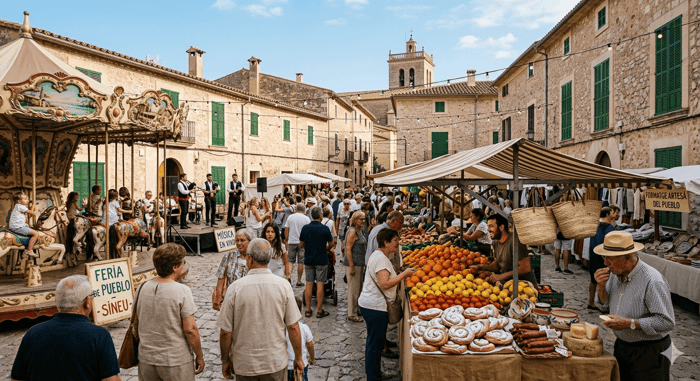
Sineu's Wednesday market deserves a mention in any guide to authentic Mallorcan culture, not because it is a seasonal event — it runs year-round — but because May and June are the best months to experience it. The market in the central Mallorcan town of Sineu is one of the oldest on the island, dating back to royal decree in the 13th century, and it remains one of the most genuine weekly markets still operating in the traditional way.
The livestock section — with sheep, goats and poultry traded in the square below the church — is the part that most visitors have never seen before and that stays with them longest. The surrounding streets fill with fresh produce, flowers, textiles, ceramics and local crafts. The cafes around the main square serve breakfast to farmers who have been there since dawn. Sineu on a Wednesday morning in May is about as close to old Mallorca as it is possible to get in the twenty-first century.
Sant Pere Festivals, Port Towns — Late June
The feast day of Sant Pere (Saint Peter), patron saint of fishermen, falls on 29 June and is marked with particular enthusiasm in Mallorca's fishing ports. Small processions take to the water in ports across the island — boats decorated and blessed, fireworks over the harbour, and the kind of low-key seaside festivities that the tourist industry has never managed to package into anything as real as this. Port de Pollença, Portocolom, Cala Figuera and others each mark the day in their own way. For anyone based near the coast in late June, it is worth finding out what is happening at the nearest fishing port.
A Practical Note on Getting Around
Most of the villages hosting May and June fairs are accessible from Palma in under an hour. Sóller is best reached by the historic narrow-gauge train — a journey that is an experience in itself, climbing through the Tramuntana mountains via a tunnel and emerging into the orange-grove valley. Alcúdia and Capdepera are straightforward drives on the main northern motorway. Estellencs and the Tramuntana villages require the scenic mountain road, which is perfectly manageable but demands more time and concentration than the main routes.
Parking at the larger events — particularly Es Firó and the Alcúdia Feria de Abril — fills quickly. Arriving before midday or using public transport where available is the straightforward solution. Most fairs run from late morning through to the evening, with the afternoon hours being the most active.
For updated programmes and specific timings, The Calendar Mallorca and the individual ajuntament websites for each town are the most reliable sources. Exact timings for many events are confirmed only in the days before the fair itself — the broad dates are fixed, but the detailed programmes follow local tradition in being announced at relatively short notice.
Why These Fairs Matter
Mallorca's feria calendar is not a tourist construct. The May and June fairs exist because they have always existed — rooted in agricultural cycles, religious traditions and community identity that predate the tourism industry by several centuries. They are the moments when the island's permanent residents, many of whom spend the summer working flat-out in the visitor economy, celebrate being from here. Attending them as a visitor or resident is a different experience from most things the island offers — less curated, more authentic, and considerably more memorable.
The island is at its most beautiful in May and June, before the intense heat of July and August arrives. The combination of green hillsides, warm evenings, empty beaches in the early mornings and a calendar full of local culture makes this period one of the most rewarding times of year to be in Mallorca.