Table of Contents
Nit de Sant Joan: Mallorca's Night of Fire is This Tuesday 23 June
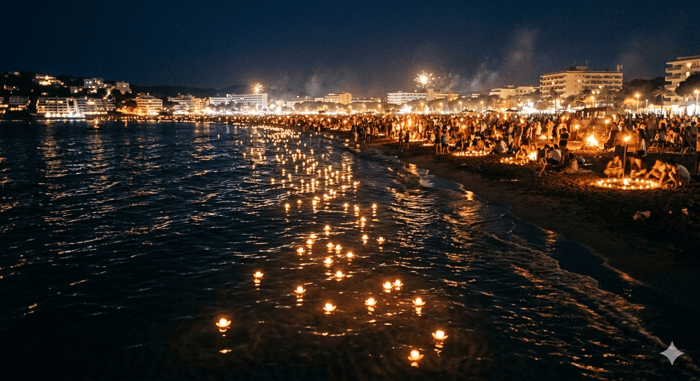
Six days from now, on the evening of Tuesday 23 June, Mallorca lights up. The Nit de Sant Joan — the Night of Saint John — is the island's most spectacular annual celebration, a midsummer festival rooted in pre-Christian solstice ritual that has been absorbed into the Catholic calendar and transformed over centuries into something entirely its own. Bonfires on every beach. Fire runs through the streets of Palma. Fireworks. Families of thirty gathered on the sand. Paper boats with candles set adrift on the sea. A midnight swim. It is the kind of night that people who have been here for it once plan their summer around the next year.
If you are on Mallorca on 23 June 2026 and you have not been to a Nit de Sant Joan before, this is what to expect and where to be.
What the Night Is
Sant Joan — Saint John the Baptist — has his feast day on 24 June. The eve, the 23rd, is the celebration, and it coincides with the summer solstice: the shortest night of the year, the longest day, the turning point of summer. The origins of the bonfire tradition are older than Christianity — fire on the solstice was a purification ritual, a way of marking the sun at its peak and warding off what the darkness might bring. The Christian church absorbed the date and gave it new meaning. Mallorca kept the fire.
The result is a night that feels genuinely ancient and completely alive at the same time. It is one of the most authentically Mallorcan things you can experience, precisely because it is not staged for visitors — the whole island simply does it, as it has always done.
Thinking about buying or selling in Mallorca?
Palma: The Correfoc and the Nit de Foc
The main event in Palma is the Nit de Foc — Night of Fire — which centres on the Parc de la Mar, the open space directly below the cathedral. This is where the correfoc happens: fire runners in devil costumes carrying spinning firework contraptions move through the crowd, sparks flying in all directions. The crowd surges around them. It is loud, chaotic, genuinely exciting and perfectly safe if you keep sensible distance and wear clothes you do not mind getting spark marks on. Old clothes and covered arms are the practical advice given to everyone experiencing their first correfoc.
The Parc de la Mar fills early. If you want a good position, being in place by 21:00 is sensible. The fire run typically begins around 22:00 and the celebrations continue well past midnight. The cathedral behind the park, lit up against the sky with flames and fireworks in front of it, is one of those images that stays with you.
The Beaches: Where the Rest of Mallorca Celebrates
Outside Palma, the Nit de Sant Joan belongs to the beach. From late afternoon on 23 June, families claim their spots on every accessible stretch of sand around the island — sometimes arriving hours early with chairs, grills, picnic boxes and candles. The beaches of Santa Ponsa, Peguera, Palmanova and Camp de Mar on the southwest coast are all popular gathering points. The social contract is relaxed: if you find a spot next to a group with a barbecue going, they are unlikely to object if you join the general warmth of the occasion.
Bonfires are lit as darkness falls. The traditional customs at the beach include writing your fears on a piece of paper and burning it in the bonfire — a purification ritual that persists because people find it genuinely satisfying regardless of whether they believe in its power. Paper boats with lit candles are floated out to sea. The midnight swim is considered particularly auspicious: entering the sea at midnight on the eve of Sant Joan, with a wish in mind, is one of those traditions that has survived because it is simply a very good idea on a warm June night.
Securing a beach spot early is not optional if you want one — particularly on the southwest coast beaches which attract large local crowds. Aim for late afternoon. Bring everything you need: wood or charcoal for the bonfire, food, water, blankets for later in the night, candles, and something to write your fears on if you want to observe the tradition.
Villages and Towns Across the Island
Every Mallorcan town and village marks Sant Joan in its own way. Alcúdia has intimate beach bonfires along its bay. Artà and other interior towns have traditional dances and community events. Pollença, Manacor, Felanitx — each adds its own character to the same common thread of fire, community, and the turning of the year. The island-wide quality of the celebration is part of what makes it different from a concert or a festival: it is not one event you travel to, it is something the whole of Mallorca does simultaneously.
Practical Notes for 23 June
Roads across the island will be busy from late afternoon. If you are driving to a beach, plan for traffic and leave time. Public transport in Palma runs extended services on Sant Joan night. Parking near Palma's Parc de la Mar is very limited — arriving by foot, bike or taxi from elsewhere in the city is the practical choice.
For the correfoc, wear old clothes with long sleeves if possible. Sparks from the fire-runners do land on bystanders — it is part of the experience, not an accident, but it will ruin a good shirt. Close-toed shoes are advisable. Do not bring anything irreplaceable into the thick of the crowd.
Most restaurants and beach bars across the island will be busy. Booking for dinner on the 23rd is strongly advisable if you want a table. Many places close early specifically so staff can join the celebrations — calling ahead to confirm hours is sensible.
The celebrations continue into the early hours of 24 June, which is the actual feast day of Sant Joan and a public holiday in the Balearic Islands. Plan accordingly if you have anything scheduled for the morning of the 24th.
If you are based in southwest Mallorca and would like to know more about life on the island year-round, visit imperial-properties.com.