Table of Contents
Soller and the Wooden Train: The Northwest Town That Earns Its Reputation
Most places described as hidden gems on Mallorca are neither hidden nor particularly gemlike. Soller is different. It earns its reputation honestly — not through marketing but through geography, history, and a valley of orange trees that still smells the same as it did when the train first arrived in 1912.
Soller sits in a natural bowl in the Serra de Tramuntana, surrounded on three sides by mountain peaks and open only to the northwest, where the valley descends to Port de Soller on the Mediterranean coast. The mountains that make it feel enclosed are the same mountains that kept it isolated for most of its history — and the isolation is what shaped everything that makes Soller worth a day or longer today.
Why the Train Exists: Oranges and France
The Soller Valley was, by the late nineteenth century, one of the most productive citrus-growing areas in the Mediterranean. The oranges were excellent. The problem was that getting them to Palma's port for export meant a long, brutal road journey over the Tramuntana — impractical at scale, damaging to produce, and slow. The valley needed a railway.
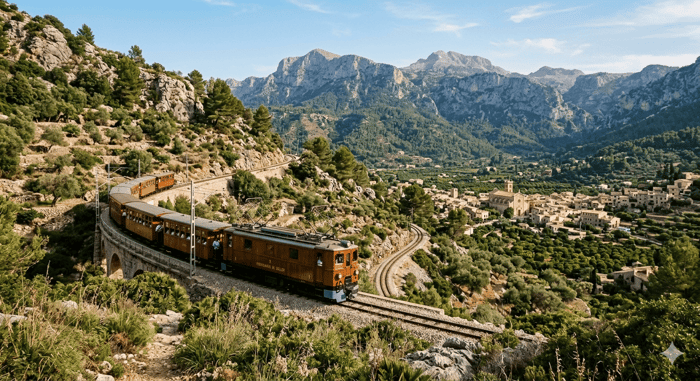
Local businessman Jeroni Estades led the project, funded substantially by the profits of the orange trade itself. Construction began in 1907 and required an extraordinary feat of engineering: a tunnel 2,856 metres long bored through the Serra d'Alfabia, which took four years to complete. The railway opened on 16 April 1912 with wooden carriages, brass fittings and leather seats. Those same carriages are still running today.
The French connection is inseparable from Soller's character. The orange trade sent waves of Sollerics to France — Lyon, Paris, Marseille — where they sold the produce and built businesses. The money they made and sent back built the modernist palaces along the town's main streets, gave the local architecture a distinctly French-influenced grandeur, and created a cultural connection between this valley and France that persists in the local accent, family names, and the town's own sense of itself. A Saturday in Soller still draws families speaking French alongside Mallorquin.
Thinking about buying or selling in Mallorca?
The Train Journey: 27 Kilometres Through the Mountains
The Tren de Soller departs from a station on Carrer Eusebi Estada in Palma, a short walk from Placa d'Espanya. The journey covers 27 kilometres, passes through 13 tunnels and over stone viaducts, and takes about 55 minutes. The train moves through citrus groves, then climbs through the mountain landscape before emerging from the final tunnel into the valley itself, which opens below like a green bowl with the mountains behind and the sea in the distance.
The carriages are original — polished wood, brass fittings, slatted seats. The Spanish government declared the line a Bien de Interes Cultural (Asset of Cultural Interest) in 1985. It is often called the Orange Express, and the nickname is earned: the valley groves are visible from the windows most of the journey, and the scent of blossom in spring carries through the open windows of the carriages.
Tickets should be bought in advance, particularly in high season. The station ticket window accepts cash only; card payments require online purchase. The train makes a scheduled stop at the Bunyola mirador during some services — a brief viewpoint stop worth having a camera ready for.
The Tram to Port de Soller
On arrival in Soller, a second piece of historic transport connects the town to Port de Soller on the coast. The tramvia — an electric tram inaugurated in October 1913, the first electric tramline in Mallorca — runs the five kilometres from Soller's central square to the port, passing through orange groves, along quiet streets and down to the waterfront. It departs roughly every half hour and takes about fifteen minutes each way.
Port de Soller is a sheltered horseshoe bay with a small beach, seafront restaurants and the kind of calm that is increasingly hard to find on the busier parts of the Mallorca coast. The port has its own rhythm: fishing boats, a naval museum in the old lighthouse, boat trips to Sa Calobra and the Torrent de Pareis gorge departing from the pier. It is a full day's destination in itself.
Soller Town: What to Do There
The town is compact and centred on Placa de la Constitucio, where the Modernista facade of the church of Sant Bartomeu — designed by a student of Gaudi — faces a weekly Saturday market that has been running for centuries. The surrounding streets have galleries, independent food shops, and the Museu de Soller, which covers the town's natural history and the story of the emigrant families who built its architecture.
Soller has a small but genuine food scene. The valley's citrus — oranges, lemons, mandarins — appears in everything from marmalades to pastries sold from local producers. Restaurants here tend toward Mallorcan cooking rather than tourist menus. The Ca'n Pintxo restaurant on Carrer Isabel Alcover is consistently rated among the better traditional Mallorcan places on the island.
Walking routes from the town include the path to the Jardins d'Alfabia — formal gardens on the main road that have been cultivated since the Arab period — and the beginning of several Tramuntana trails, including routes toward the Barranc de Biniaraix and the mountain village of Fornalutx, considered one of the most beautiful villages in Spain.
Getting There and When to Go
By train from Palma is the natural choice — it takes less than an hour and is the journey itself. By road, the Ma-11 through the mountains takes around 30 minutes from Palma. The tunnel under the Tramuntana is the practical route for those driving; the old road over the Coll de Soller is slower and steeper but worth it for the views if you have time.
Soller works well year-round. Spring — when the orange blossom is in flower and the valley is at its most fragrant — is the most atmospheric time. Summer is busy but the town handles it better than the coastal resorts. Autumn and winter are quieter, cooler, and give a more honest sense of what it is to live there rather than visit.
To explore property in Mallorca, including the northwest and beyond, visit imperial-properties.com.