Table of Contents
The Plusvalía Tax: The Selling Cost in Spain That Surprises Most Property Owners
Most property owners in Mallorca are familiar with the taxes they paid when they bought — ITP, notary fees, Land Registry fees, legal costs. Fewer are fully prepared for what happens when they sell. Among the costs that catch sellers by surprise, the plusvalía municipal is consistently near the top of the list.
It is not a large tax in the context of a typical transaction. But it is a tax that falls on the seller, not the buyer, and it is levied not on the profit from the sale but on the theoretical increase in the cadastral value of the land over the period of ownership. Understanding how it works, how it is calculated and when it applies is essential for anyone planning to sell a property in Mallorca.
Thinking about buying or selling in Mallorca?
What Is the Plusvalía Tax?
Plusvalía municipal — formally the Impuesto sobre el Incremento de Valor de los Terrenos de Naturaleza Urbana (IIVTNU) — is a municipal tax levied by town halls across Spain on the transfer of urban land. It applies when a property is sold, donated or inherited, and it is charged on the increase in the cadastral value of the land (not the building on it) over the period of ownership.
The key word is land. The tax is calculated on the underlying plot value as recorded in the catastro — the official property register — not on the total transaction price. In practice this means the tax is often significantly lower than a headline percentage of the sale price would suggest, but it is real and it must be paid.
The tax is a local one, administered by the Ajuntament (town hall) of the municipality where the property is located. In Santa Ponsa, Portals Nous, Peguera and the rest of the southwest, this means the Ajuntament de Calvià. Rates and calculation methods vary slightly between municipalities.
How It Is Calculated
Until 2021, the plusvalía was calculated using a fixed formula based on the cadastral land value multiplied by official government coefficients that increased with the years of ownership. This produced a tax liability regardless of whether the seller had actually made a profit — which led to legal challenges when property values fell during the financial crisis.
In October 2021, Spain's Constitutional Court ruled that the fixed-formula method was unconstitutional in cases where the seller had made no real gain or had made a loss. The Spanish government responded in November 2021 with a reformed law that introduced two alternative calculation methods, giving sellers the right to choose whichever produces the lower tax liability.
Method 1 — The objective method: The cadastral land value is multiplied by a government-set coefficient corresponding to the number of years of ownership. These coefficients are set annually by the national government and vary from 0.14 for ownership periods under one year to 0.45 for ownership periods of 20 years or more. The result is multiplied by the municipal tax rate — in Calvià, this is set by the Ajuntament and cannot exceed the legal maximum of 30%.
Method 2 — The real gain method: If the seller can demonstrate that the actual increase in the land value (calculated from the proportion of the purchase price attributable to land, compared to the proportion of the sale price attributable to land) is lower than the result under Method 1, the real gain figure can be used instead. This method benefits sellers whose property value has increased only modestly.
Sellers are entitled to ask their lawyer or tax advisor to run both calculations and apply whichever produces the lower figure. The burden of proving the real gain calculation rests with the seller.
When Does It Apply?
Plusvalía applies to all transfers of urban property — sales, donations and inheritances. It does not apply to rustic land (suelo rústico). It applies to both residents and non-residents selling property in Spain.
Since the 2021 reform, sellers who can demonstrate that they made no profit on the sale — where the sale price is lower than or equal to the purchase price — are exempt from the tax. This requires providing documentation to the town hall showing the original purchase price and the current sale price. Previously, this exemption did not exist and sellers could be taxed even on a loss-making sale.
Who Pays and When
In a standard sale, the plusvalía is paid by the seller. The tax must be paid to the relevant town hall — in the southwest, the Ajuntament de Calvià — within 30 days of the completion of the sale (the signing of the escritura at the notary). Non-payment within this window attracts penalties and interest.
In some transactions, particularly where the seller is a non-resident, the buyer may agree to retain a sum from the purchase price to cover the plusvalía and pay it directly to the town hall on the seller's behalf. This protects the buyer in case the seller fails to pay — since unpaid plusvalía can become a charge against the property. Any such arrangement should be documented in the sale contract.
How Much Should You Expect to Pay?
It is not possible to give a precise figure without knowing the specific cadastral land value, the years of ownership and the applicable municipal rate. As a broad indication, for a typical apartment held for ten years in Santa Ponsa, the plusvalía liability is likely to fall in the range of a few hundred to a few thousand euros — significant but not prohibitive relative to the transaction value.
For larger properties with higher cadastral values, or for properties held for many years, the figure can be higher. For properties bought and sold within a short period (under two years), the coefficient for short holding periods means the tax can be relatively modest. A property lawyer or tax advisor in Mallorca can calculate the likely liability before you commit to a sale price.
Practical Advice for Sellers
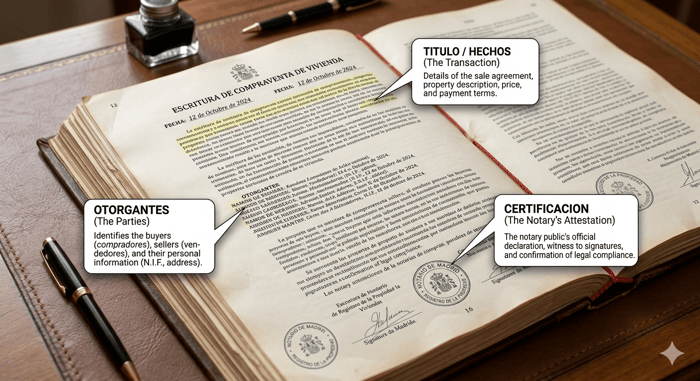
Keep your original escritura de compraventa. The purchase price and date recorded in it are the starting point for any plus valía calculation and for the real gain method if you choose to use it. If you have made improvements to the property, the costs of these can sometimes be factored into the gain calculation — your lawyer can advise.
Plan for the plusvalía as part of your selling costs alongside estate agent fees, notary fees and any income tax or capital gains tax liability. Factor it into your net sale proceeds calculation before setting your asking price.
If you are selling and buying simultaneously in Spain, the timing of the plusvalía payment — 30 days post-completion — can be coordinated with your lawyer to ensure it does not create a cash flow problem between transactions.
Imperial Properties has been selling property in the southwest of Mallorca since 1985. If you are considering selling and would like guidance on the full cost structure of a sale, the team is happy to talk through the numbers with you. Contact us on +34 971 692 434, by WhatsApp at wa.me/34971692434, or by email at help@imperial-properties.com.