The Fortress Isle: Why Mallorca Remains a Defensible Investment in 2025
As we reach the end of 2025, the headlines across the European real estate sector have been mixed. Yet, amidst continental fluctuations, Mallorca has once again demonstrated its unique economic resilience. At Imperial Properties, we prefer to look beyond the sentiment and focus on the data. The numbers for the closing year are now in, and they tell a story not just of stability, but of sustained, defensive growth that separates the Balearics from the mainland markets.
For the aspirational buyer or the strategic investor, the question is no longer "is it safe to buy?" but rather "how do I secure the right asset in a supply-constrained market?" The convergence of stabilizing mortgage rates and record-breaking price resilience has created a specific window of opportunity this December. Below, we break down the three defensible pillars that make Mallorca a solid hold for 2026.
1. The Financial Argument: Mortgage Rates at a Sweet Spot
The most significant shift in the last quarter of 2025 has been the stabilization of financing costs. After the volatility of previous years, we have seen the 12-month Euribor settle at 2.268% as of December 9, 2025. This is a critical metric for any leverage strategy. It represents a functional normalization of credit markets that we have not seen for some time.
For buyers, this translates into tangible value. Currently, Spanish lenders are offering fixed-rate mortgages in the bracket of 2.25% to 3.0% for qualifying profiles. This is historically attractive. It allows investors to lock in low financing costs while the asset itself continues to appreciate. The "wait and see" strategy that held some buyers back in 2024 is now obsolete; the cost of waiting (in terms of lost appreciation) now outweighs the cost of borrowing.
2. The Performance Argument: 2025 Price Growth
While other luxury markets have corrected, Mallorca has continued its upward trajectory. The data for 2025 is definitive: the average price per square meter for houses on the island has increased by 8.07% this year. In the broader Balearic region, listing prices have broken the €5,000/m² barrier for the first time, recording a staggering 21% year-on-year increase in some metrics.
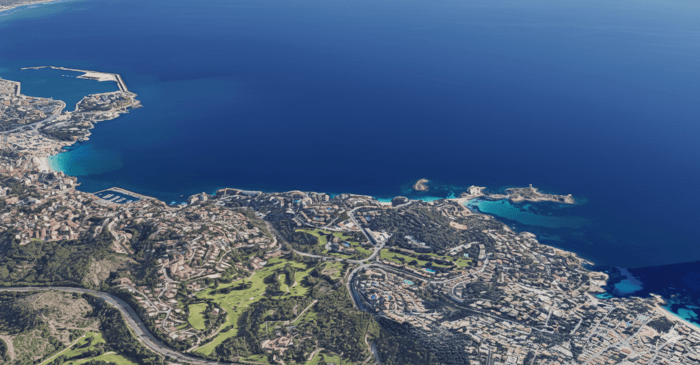
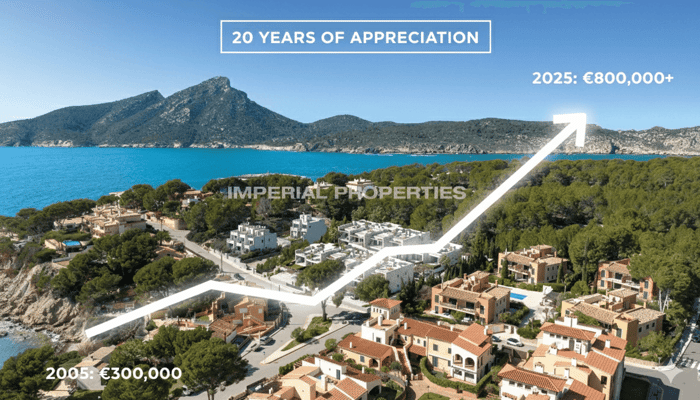
Imagine a client who purchased a property in the coveted South West area of Calvià, which includes prime locations like Puerto Portals, Port Adriano, and Santa Ponsa, approximately 20 years ago in 2005 for €300,000. This period encompasses the full cycle of the financial crisis, the subsequent recovery, and the decade-long boom driven by sustained international demand.
Based on historical price indices for the Calvià area, which consistently outperforms general regional averages due to limited supply, high quality of life, and international appeal, we can make an estimated calculation of capital appreciation over the past two decades.
Property Value Calculation (2005 – 2025)
Initial Investment (2005): €300,000
Estimated Capital Appreciation (20 years): ~175%
Estimated Current Market Value (2025): €825,000
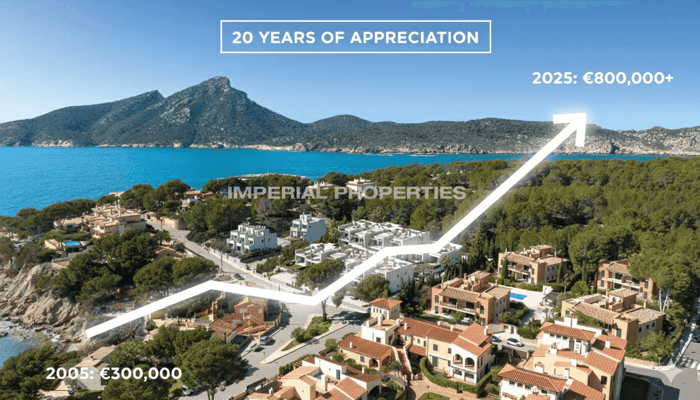
This estimated appreciation reflects the enduring strength and resilience of prime Mallorcan real estate, securing a tangible asset that has significantly multiplied its value for the owner.
This growth is not speculative bubbles; it is structural. The island has entered a "mature, low-volatility" phase. We are not seeing the frantic flipping of 2022, but rather a steady accumulation of prime assets by international buyers who view Mallorca as a safe haven. The average price for houses has reached €4,485/m², validating the strategy of long-term holding. If you purchased a property in January 2025, your asset has effectively earned a gross return of over 8% in capital appreciation alone—outperforming most traditional equity indices this year.
3. The Scarcity Argument: Geography as a Moat
The fundamental driver of Mallorca’s investment case remains its geography. We are an island with finite land. Strict urban planning regulations and a high percentage of protected rural land mean that supply can never fundamentally meet demand. In 2025, we saw new build activity increase slightly, but it remains strictly capped, ensuring that "overbuilding" is a physical impossibility in prime coastal areas.
Furthermore, the market dynamics are supported by a diverse international buyer base. Approximately 33% of transactions in the Balearics are driven by foreign capital, with a dominant presence from German, British, and Northern European buyers. This diversity protects the market from a downturn in any single national economy. It creates a liquidity buffer that ensures high-end properties in areas like the Southwest or Son Vida remain liquid assets, even in challenging global conditions.
Summary: The Outlook for 2026
Entering 2026, the data points to a continued "flight to quality." With mortgage rates stabilizing around the 2.5% mark and supply remaining tight, the floor for prices is exceptionally high. Buying in Mallorca is not just about purchasing a holiday home; it is about allocating capital to a region with a proven track record of wealth preservation. The 2025 figures are the evidence: in a world of uncertainty, Mallorca remains a fortress.
La Isla Fortaleza: Por Qué Mallorca Sigue Siendo una Inversión Defendible en 2025
Al llegar al final de 2025, los titulares del sector inmobiliario europeo han sido mixtos. Sin embargo, en medio de las fluctuaciones continentales, Mallorca ha demostrado una vez más su resiliencia económica única. En Imperial Properties, preferimos mirar más allá del sentimiento y centrarnos en los datos. Las cifras del año que cierra ya están aquí, y cuentan una historia no solo de estabilidad, sino de un crecimiento sostenido y defensivo que separa a las Baleares de los mercados peninsulares.
Para el comprador aspiracional o el inversor estratégico, la pregunta ya no es "¿es seguro comprar?", sino "¿cómo aseguro el activo correcto en un mercado con oferta limitada?". La convergencia de tipos hipotecarios estabilizados y una resiliencia de precios récord ha creado una ventana de oportunidad específica este diciembre. A continuación, desglosamos los tres pilares defendibles que hacen de Mallorca una apuesta sólida para 2026.
1. El Argumento Financiero: Tipos Hipotecarios en el Punto Dulce
El cambio más significativo en el último trimestre de 2025 ha sido la estabilización de los costes de financiación. Tras la volatilidad de años anteriores, hemos visto cómo el Euríbor a 12 meses se ha asentado en el 2,268% a fecha de 9 de diciembre de 2025. Esta es una métrica crítica para cualquier estrategia de apalancamiento. Representa una normalización funcional de los mercados crediticios que no habíamos visto en algún tiempo.
Para los compradores, esto se traduce en valor tangible. Actualmente, las entidades financieras españolas están ofreciendo hipotecas a tipo fijo en la horquilla del 2,25% al 3,0% para perfiles cualificados. Esto es históricamente atractivo. Permite a los inversores bloquear costes de financiación bajos mientras el activo en sí continúa revalorizándose. La estrategia de "esperar y ver" que retuvo a algunos compradores en 2024 es ahora obsoleta; el coste de esperar (en términos de apreciación perdida) supera ahora al coste de pedir prestado.
2. El Argumento del Rendimiento: Crecimiento de Precios en 2025
Mientras otros mercados de lujo han corregido, Mallorca ha continuado su trayectoria ascendente. Los datos de 2025 son definitivos: el precio medio por metro cuadrado para casas en la isla ha aumentado un 8,07% este año. En la región balear más amplia, los precios de oferta han roto la barrera de los 5.000 €/m² por primera vez, registrando un asombroso aumento interanual del 21% en algunas métricas.
Imagine un cliente que compró una propiedad en la codiciada zona suroeste de Calvià, que incluye ubicaciones privilegiadas como Puerto Portals, Port Adriano y Santa Ponsa, hace aproximadamente 20 años, en 2005, por 300.000 €. Este período abarca el ciclo completo de la crisis financiera, la posterior recuperación y el auge de una década impulsado por una demanda internacional sostenida.
Basándonos en los índices históricos de precios para la zona de Calvià, que supera consistentemente los promedios regionales generales debido a la oferta limitada, la alta calidad de vida y el atractivo internacional, podemos hacer un cálculo estimado de la apreciación del capital durante las últimas dos décadas.
Cálculo del Valor de la Propiedad (2005 – 2025)
Inversión Inicial (2005): 300.000 €
Apreciación de Capital Estimada (20 años): ~175%
Valor Actual de Mercado Estimado (2025): 825.000 €
Esta apreciación estimada refleja la fuerza y la resistencia duraderas de las propiedades inmobiliarias de primera calidad en Mallorca, asegurando un activo tangible que ha multiplicado significativamente su valor para el propietario.
Este crecimiento no son burbujas especulativas; es estructural. La isla ha entrado en una fase "madura y de baja volatilidad". No estamos viendo la reventa frenética de 2022, sino una acumulación constante de activos prime por parte de compradores internacionales que ven a Mallorca como un refugio seguro. El precio medio de las casas ha alcanzado los 4.485 €/m², validando la estrategia de tenencia a largo plazo. Si compró una propiedad en enero de 2025, su activo ha ganado efectivamente un rendimiento bruto de más del 8% solo en apreciación de capital, superando a la mayoría de los índices de renta variable tradicionales este año.
3. El Argumento de la Escasez: La Geografía como Foso
El motor fundamental del caso de inversión de Mallorca sigue siendo su geografía. Somos una isla con tierra finita. Las estrictas regulaciones de planificación urbana y un alto porcentaje de suelo rústico protegido significan que la oferta nunca puede satisfacer fundamentalmente a la demanda. En 2025, vimos aumentar ligeramente la actividad de obra nueva, pero permanece estrictamente limitada, asegurando que el "exceso de construcción" sea una imposibilidad física en las zonas costeras prime.
Además, la dinámica del mercado está respaldada por una base de compradores internacionales diversa. Aproximadamente el 33% de las transacciones en Baleares son impulsadas por capital extranjero, con una presencia dominante de compradores alemanes, británicos y del norte de Europa. Esta diversidad protege al mercado de una recesión en cualquier economía nacional única. Crea un amortiguador de liquidez que asegura que las propiedades de alta gama en áreas como el Suroeste o Son Vida sigan siendo activos líquidos, incluso en condiciones globales desafiantes.
Resumen: La Perspectiva para 2026
Entrando en 2026, los datos apuntan a un continuo "vuelo hacia la calidad". Con los tipos hipotecarios estabilizándose alrededor de la marca del 2,5% y la oferta manteniéndose ajustada, el suelo para los precios es excepcionalmente alto. Comprar en Mallorca no es solo adquirir una casa de vacaciones; es asignar capital a una región con un historial probado de preservación de riqueza. Las cifras de 2025 son la evidencia: en un mundo de incertidumbre, Mallorca sigue siendo una fortaleza.
Die Festungsinsel: Warum Mallorca auch 2025 eine vertretbare Investition bleibt
Zum Ende des Jahres 2025 waren die Schlagzeilen im europäischen Immobiliensektor gemischt. Doch inmitten der kontinentalen Schwankungen hat Mallorca erneut seine einzigartige wirtschaftliche Widerstandsfähigkeit unter Beweis gestellt. Bei Imperial Properties ziehen wir es vor, über die Stimmung hinaus auf die Daten zu schauen. Die Zahlen für das abschließende Jahr liegen nun vor, und sie erzählen eine Geschichte nicht nur von Stabilität, sondern von nachhaltigem, defensivem Wachstum, das die Balearen von den Festlandmärkten unterscheidet.
Für den anspruchsvollen Käufer oder den strategischen Investor lautet die Frage nicht mehr "Ist es sicher zu kaufen?", sondern "Wie sichere ich mir das richtige Asset in einem angebotsbeschränkten Markt?". Das Zusammentreffen von sich stabilisierenden Hypothekenzinsen und einer rekordverdächtigen Preisbeständigkeit hat diesen Dezember ein spezifisches Gelegenheitsfenster geschaffen. Nachfolgend schlüsseln wir die drei vertretbaren Säulen auf, die Mallorca zu einer soliden Halteposition für 2026 machen.
1. Das finanzielle Argument: Hypothekenzinsen am Sweet Spot
Die bedeutendste Verschiebung im letzten Quartal 2025 war die Stabilisierung der Finanzierungskosten. Nach der Volatilität der Vorjahre haben wir gesehen, wie sich der 12-Monats-Euribor zum 9. Dezember 2025 bei 2,268 % eingependelt hat. Dies ist eine kritische Kennzahl für jede Hebelstrategie. Sie stellt eine funktionale Normalisierung der Kreditmärkte dar, die wir seit einiger Zeit nicht mehr gesehen haben.
Für Käufer bedeutet dies einen greifbaren Wert. Derzeit bieten spanische Kreditgeber Festzinshypotheken im Bereich von 2,25 % bis 3,0 % für qualifizierte Profile an. Dies ist historisch attraktiv. Es ermöglicht Investoren, niedrige Finanzierungskosten zu sichern, während das Asset selbst weiter an Wert gewinnt. Die "Abwarten und Tee trinken"-Strategie, die einige Käufer 2024 zurückhielt, ist nun obsolet; die Kosten des Wartens (in Form von entgangener Wertsteigerung) überwiegen nun die Kosten der Kreditaufnahme.
2. Das Leistungsargument: Preiswachstum 2025
Während andere Luxusmärkte korrigiert haben, hat Mallorca seinen Aufwärtstrend fortgesetzt. Die Daten für 2025 sind definitiv: Der Durchschnittspreis pro Quadratmeter für Häuser auf der Insel ist in diesem Jahr um 8,07 % gestiegen. In der breiteren Balearenregion haben die Angebotspreise erstmals die Barriere von 5.000 €/m² durchbrochen und verzeichnen in einigen Kennzahlen einen erstaunlichen Anstieg von 21 % im Jahresvergleich.
Stellen Sie sich einen Kunden vor, der vor etwa 20 Jahren, im Jahr 2005, eine Immobilie in der begehrten Region Südwesten von Calvià, zu der Top-Lagen wie Puerto Portals, Port Adriano und Santa Ponsa gehören, für 300.000 € erworben hat. Dieser Zeitraum umfasst den gesamten Zyklus der Finanzkrise, die anschließende Erholung und den jahrzehntelangen Boom, der durch anhaltende internationale Nachfrage angetrieben wurde.
Basierend auf den historischen Preisindizes für die Region Calvià, die aufgrund des begrenzten Angebots, der hohen Lebensqualität und der internationalen Anziehungskraft stets besser abschneidet als die allgemeinen regionalen Durchschnitte, können wir eine Schätzung des Kapitalzuwachses über die letzten zwei Jahrzehnte vornehmen.
Berechnung des Immobilienwerts (2005 – 2025)
Anfangsinvestition (2005): 300.000 €
Geschätzter Kapitalzuwachs (20 Jahre): ~175%
Geschätzter Aktueller Marktwert (2025): 825.000 €
Dieser geschätzte Zuwachs spiegelt die anhaltende Stärke und Widerstandsfähigkeit von erstklassigen Immobilien auf Mallorca wider und sichert ein Sachwert, der seinen Wert für den Eigentümer signifikant vervielfacht hat.
Dieses Wachstum sind keine spekulativen Blasen; es ist strukturell. Die Insel ist in eine "reife Phase mit geringer Volatilität" eingetreten. Wir sehen nicht das hektische "Flipping" von 2022, sondern eine stetige Akkumulation von erstklassigen Assets durch internationale Käufer, die Mallorca als sicheren Hafen betrachten. Der Durchschnittspreis für Häuser hat 4.485 €/m² erreicht, was die Strategie des langfristigen Haltens bestätigt. Wenn Sie im Januar 2025 eine Immobilie gekauft haben, hat Ihr Asset effektiv eine Bruttorendite von über 8 % allein durch Kapitalzuwachs erzielt – und damit die meisten traditionellen Aktienindizes in diesem Jahr übertroffen.
3. Das Knappheitsargument: Geographie als Burggraben
Der grundlegende Treiber für das Investitionsszenario Mallorca bleibt seine Geographie. Wir sind eine Insel mit begrenztem Land. Strenge Stadtplanungsregulierungen und ein hoher Prozentsatz an geschütztem ländlichem Land bedeuten, dass das Angebot die Nachfrage niemals grundlegend decken kann. Im Jahr 2025 sahen wir einen leichten Anstieg der Neubautätigkeit, aber sie bleibt streng gedeckelt, was sicherstellt, dass eine "Überbauung" in erstklassigen Küstengebieten eine physikalische Unmöglichkeit ist.
Darüber hinaus wird die Marktdynamik durch eine diverse internationale Käuferbasis gestützt. Etwa 33 % der Transaktionen auf den Balearen werden durch ausländisches Kapital getrieben, mit einer dominanten Präsenz von Käufern aus Deutschland, Großbritannien und Nordeuropa. Diese Vielfalt schützt den Markt vor einem Abschwung in einer einzelnen nationalen Wirtschaft. Sie schafft einen Liquiditätspuffer, der sicherstellt, dass High-End-Immobilien in Gebieten wie dem Südwesten oder Son Vida auch unter schwierigen globalen Bedingungen liquide Assets bleiben.
Zusammenfassung: Der Ausblick für 2026
Zu Beginn des Jahres 2026 deuten die Daten auf eine fortgesetzte "Flucht in die Qualität" hin. Da sich die Hypothekenzinsen um die Marke von 2,5 % stabilisieren und das Angebot knapp bleibt, ist der Boden für die Preise außergewöhnlich hoch. Kaufen auf Mallorca bedeutet nicht nur den Erwerb eines Ferienhauses; es bedeutet die Allokation von Kapital in eine Region mit einer nachgewiesenen Erfolgsbilanz im Vermögenserhalt. Die Zahlen von 2025 sind der Beweis: In einer Welt der Unsicherheit bleibt Mallorca eine Festung.