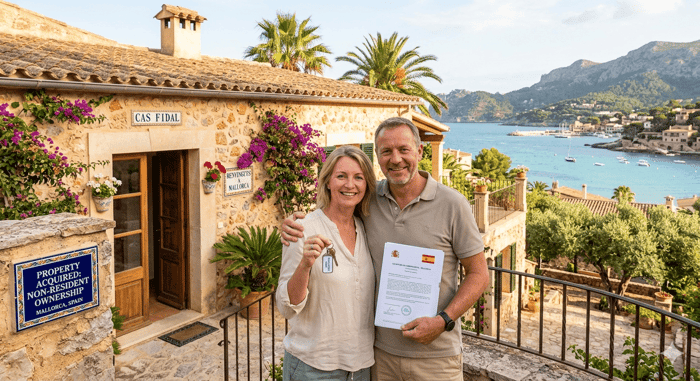
Can Non-Residents Buy Property in Mallorca?
The short answer is yes. Non-residents, whether from within the European Union or from further afield, are legally entitled to purchase property in Mallorca and across Spain. The country has a long and well-established tradition of welcoming international buyers, and the legal framework governing foreign ownership is clear and well-defined. That said, buying property as a non-resident comes with a set of requirements, tax obligations, and ongoing annual costs that are distinct from what Spanish residents face. Understanding these differences clearly before you commit to a purchase is one of the most important things you can do to protect your investment and ensure that ownership of your Mallorca property is as straightforward and rewarding as possible.
The Legal Requirement: NIE and Spanish Bank Account
Before any property purchase can be completed in Spain, foreign buyers must obtain a NIE (Numero de Identificacion de Extranjero). This is a personal identification number issued by the Spanish authorities to non-residents and is required for every stage of the buying process, including signing the purchase deed at the notary. The NIE must be obtained in Spain, either in person or through a legally appointed representative, and it is advisable to start the process as early as possible, since administrative timelines can vary by province and time of year.
In addition to the NIE, buyers will need a Spanish bank account. This is used not only for the property purchase itself but also for the payment of ongoing annual taxes and utility costs once you are an owner. Most major Spanish banks including CaixaBank and Santander are experienced in opening accounts for non-resident foreign buyers, and the process is straightforward with the right documentation in place.
Purchase Costs and Taxes at the Point of Sale
When buying a second-hand property, which describes the majority of residential properties that come to market in Mallorca, the principal tax at the point of sale is the Impuesto sobre Transmisiones Patrimoniales, known as ITP or Property Transfer Tax. This is a Balearic Islands regional tax applied to the purchase price on a tiered basis. The current Balearic rates are 8 percent on the first 400,000 euros of purchase price, 9 percent on the tranche between 400,001 and 600,000 euros, 10 percent on the tranche between 600,001 and 1,000,000 euros, 12 percent on the tranche between 1,000,001 and 2,000,000 euros, and 13 percent on any amount above 2,000,001 euros.
For brand-new properties sold by a developer, ITP is replaced by Spanish VAT (IVA) at 10 percent of the purchase price, together with Stamp Duty (AJD) at approximately 1.2 percent. Buyers should note that regardless of whether the property is new or resale, additional costs for notary fees, Land Registry inscription, legal fees, and administrative management (gestoria) add approximately a further 1 to 2 percent to the total purchase cost. A reliable working budget for total purchase costs is between 8 and 12 percent of the purchase price for resale properties, and between 11 and 13 percent for new builds.
Annual Taxes for Non-Resident Owners
Owning property in Mallorca as a non-resident creates a set of annual tax obligations that many buyers from countries with different property tax systems find surprising. Understanding these in advance ensures there are no unexpected costs once ownership is established.
The first annual obligation is the IBI (Impuesto sobre Bienes Inmuebles), which is a local council tax based on the property's cadastral value rather than its market value. Rates are set by each municipality and typically range from 0.4 to 1.1 percent of the cadastral value. For most Mallorcan properties, the resulting annual payment is modest relative to the market value of the property, since cadastral values are generally set well below actual transaction prices.
The second obligation is the Non-Resident Income Tax (IRNR), filed annually using Modelo 210. Even if you do not rent out your property and leave it entirely empty when you are not using it, Spain's tax law applies a deemed rental income to all residential properties owned by non-residents. This imputed income is calculated as a percentage of the cadastral value of the property, and it is then taxed at 19 percent for residents of EU and European Economic Area (EEA) countries, or 24 percent for residents of countries outside the EU and EEA.
If you do rent out your property, you are taxed on the actual rental income received rather than the imputed figure, with the same rates applying. EU and EEA residents are entitled to deduct allowable expenses including maintenance costs, mortgage interest, community fees, insurance, and property management costs before calculating their taxable income. Following a ruling by the Spanish National Court on 28 July 2025, non-EU residents are also now able to claim deductions for rental property expenses, which marks a significant change from the previous position.
Wealth Tax
The Balearic Islands impose a Wealth Tax on assets held in Spain. For non-residents, this tax applies only to Spanish assets and only when the total value of those assets exceeds 3,000,000 euros. For assets above that threshold, the Balearic rate ranges from 0.28 percent to 3.45 percent depending on the value of the assets held. For the majority of non-resident buyers, this tax is not a material consideration, but for high-value acquisitions it is a planning point that specialist tax advice addresses effectively.
Capital Gains Tax on Resale
When you sell a property in Mallorca as a non-resident, you are liable for Spanish Capital Gains Tax on the profit made. EU and EEA non-residents pay at a flat rate of 19 percent on the net gain. Non-EU residents pay at 24 percent. The taxable gain is calculated as the difference between the sale price and the original purchase price, with adjustments permitted for documented purchase costs, legal fees, and any proven improvement expenditure.
At the point of sale, Spanish law requires the buyer to withhold 3 percent of the agreed sale price and pay this directly to the Spanish tax authorities on behalf of the non-resident seller. This acts as an advance payment against the seller's capital gains tax liability. If the final capital gains tax bill is less than the 3 percent withheld, the seller has four months to file Modelo 210 and claim a refund of the difference. If the bill is higher, the seller pays the shortfall directly. Keeping clear records of original purchase costs, legal fees, and all improvement work is therefore essential for any property owner who plans to sell in the future.
Plusvalia Municipal
In addition to Capital Gains Tax, the seller is also typically responsible for the Plusvalia Municipal, a local tax levied by the relevant municipality based on the increase in the cadastral value of the land element of the property during the period of ownership. The amount varies by municipality, length of ownership, and the property's location, and it is worth requesting a calculation from your local town hall before agreeing a sale price in order to understand this liability clearly in advance.
The Proposed Non-EU Property Tax: Current Status
In January 2025, the Spanish Prime Minister outlined a package of housing measures that included a proposed additional tax aimed at non-EU, non-resident property buyers. The Spanish government submitted draft legislation to parliament in May 2025. As of the date of this article, this legislation has not been passed into law. The proposal, as drafted, targets only non-EU, non-resident individuals purchasing second-hand residential property, and it does not affect EU residents, including UK nationals holding a valid Spanish residence permit, nor does it apply to purchases subject to VAT, which includes new-build property. The situation continues to evolve, and buyers from outside the EU who are considering a purchase in Mallorca should ensure they take current legal advice before proceeding.
Residency Pathways for Property Buyers
For non-EU buyers who purchase property in Spain with a value of 500,000 euros or more (without a mortgage on that amount), Spain has historically offered a Golden Visa, granting residency rights in Spain and free movement across the Schengen area. However, the Spanish government cancelled the Golden Visa programme in April 2025. Other residency pathways remain available, including the Non-Lucrative Visa for those with sufficient passive income who wish to live in Spain without working, and the Digital Nomad Visa for remote workers. Each pathway carries specific income thresholds, documentation requirements, and tax implications, and professional immigration and tax advice is strongly recommended before committing to a route.
For EU residents, the process of owning property in Mallorca without seeking formal Spanish residency is entirely straightforward. EU freedom of movement means that EU nationals do not require any additional visa or permit to purchase, hold, and use property in Spain.
The Importance of Professional Advice
Buying property as a non-resident in Mallorca is a well-trodden path followed successfully by thousands of international buyers every year. The key to doing it well is ensuring that your legal, fiscal, and banking arrangements are set up correctly from the outset. Spain's property purchase process is thorough and offers strong protections to buyers, but it rewards preparation. A qualified local lawyer, a specialist tax adviser, and access to a knowledgeable estate agent who understands the specific requirements of non-resident buyers are the three professionals who make the difference between a straightforward transaction and an unnecessarily complicated one.
At Imperial Properties, we work with an established network of independent English, German, French, and Spanish-speaking lawyers and tax advisers who specialise in exactly this area. We are pleased to connect buyers with the right professionals and to guide you through every stage of your Mallorca property search and purchase with complete transparency.
Pueden los No Residentes Comprar Propiedad en Mallorca?
La respuesta corta es si. Los no residentes, tanto de dentro de la Union Europea como de mas lejos, tienen derecho legal a comprar propiedad en Mallorca y en toda Espana. El pais tiene una larga y bien establecida tradicion de acoger a compradores internacionales, y el marco legal que rige la propiedad extranjera es claro y bien definido. Dicho esto, comprar una propiedad como no residente conlleva una serie de requisitos, obligaciones fiscales y costes anuales continuos que son distintos de los que afrontan los residentes espanoles. Comprender estas diferencias claramente antes de comprometerse con una compra es una de las cosas mas importantes que puede hacer para proteger su inversion.
El Requisito Legal: NIE y Cuenta Bancaria Espanola
Antes de que se pueda completar cualquier compra de propiedad en Espana, los compradores extranjeros deben obtener un NIE (Numero de Identificacion de Extranjero). Se trata de un numero de identificacion personal emitido por las autoridades espanolas a los no residentes y es necesario en cada etapa del proceso de compra, incluida la firma de la escritura de compra ante notario. El NIE debe obtenerse en Espana, ya sea en persona o a traves de un representante legalmente designado, y es aconsejable iniciar el proceso lo antes posible.
Ademas del NIE, los compradores necesitaran una cuenta bancaria espanola. Esto se utiliza no solo para la propia compra de la propiedad, sino tambien para el pago de los impuestos anuales continuos y los costes de suministros una vez que sea propietario. La mayoria de los grandes bancos espanoles, incluidos CaixaBank y Santander, tienen experiencia en la apertura de cuentas para compradores extranjeros no residentes.
Costes de Compra e Impuestos en el Momento de la Venta
Al comprar una propiedad de segunda mano, que es la mayoria de las propiedades residenciales que salen al mercado en Mallorca, el principal impuesto en el momento de la venta es el Impuesto sobre Transmisiones Patrimoniales (ITP). Se trata de un impuesto regional de las Islas Baleares aplicado al precio de compra de forma escalonada. Los tipos actuales en Baleares son del 8% sobre los primeros 400.000 euros del precio de compra, 9% sobre el tramo entre 400.001 y 600.000 euros, 10% entre 600.001 y 1.000.000 euros, 12% entre 1.000.001 y 2.000.000 euros, y 13% sobre cualquier cantidad superior a 2.000.001 euros.
Para propiedades nuevas vendidas por un promotor, el ITP se sustituye por el IVA espanol al 10% del precio de compra, junto con el Impuesto de Actos Juridicos Documentados (AJD) de aproximadamente el 1,2%. Los costes adicionales de honorarios de notario, inscripcion en el Registro de la Propiedad, honorarios legales y gestion administrativa (gestoria) anadiran aproximadamente entre un 1 y un 2% adicional al coste total de compra.
Impuestos Anuales para Propietarios No Residentes
Ser propietario de una propiedad en Mallorca como no residente genera un conjunto de obligaciones fiscales anuales que muchos compradores encuentran sorprendentes.
La primera obligacion anual es el IBI (Impuesto sobre Bienes Inmuebles), un impuesto municipal basado en el valor catastral de la propiedad y no en su valor de mercado. Los tipos los fija cada municipio y suelen oscilar entre el 0,4% y el 1,1% del valor catastral.
La segunda obligacion es el Impuesto sobre la Renta de No Residentes (IRNR), que se declara anualmente mediante el Modelo 210. Incluso si no alquila su propiedad y la deja completamente vacia cuando no la utiliza, la ley fiscal espanola aplica una renta imputada a todas las propiedades residenciales de no residentes. Esta renta imputada se calcula como un porcentaje del valor catastral de la propiedad y se grava al 19% para residentes de paises de la UE y del Espacio Economico Europeo (EEE), o al 24% para residentes de paises fuera de la UE y el EEE.
Si alquila su propiedad, se le grava sobre la renta real recibida en lugar de la imputada. Los residentes de la UE y el EEE tienen derecho a deducir los gastos deducibles, incluidos los costes de mantenimiento, los intereses hipotecarios, las cuotas de comunidad, el seguro y los costes de gestion de la propiedad. Tras una resolucion del Tribunal Nacional espanol del 28 de julio de 2025, los no residentes de fuera de la UE tambien pueden ahora reclamar deducciones por gastos de propiedades en alquiler, lo que supone un cambio significativo respecto a la situacion anterior.
Impuesto sobre el Patrimonio
Las Islas Baleares aplican un Impuesto sobre el Patrimonio a los activos ubicados en Espana. Para los no residentes, este impuesto se aplica unicamente a los activos espanoles y solo cuando el valor total de esos activos supera los 3.000.000 de euros. Para los activos por encima de ese umbral, el tipo balear oscila entre el 0,28% y el 3,45% segun el valor de los activos.
Impuesto sobre las Ganancias de Capital en la Reventa
Cuando vende una propiedad en Mallorca como no residente, es responsable del Impuesto sobre las Ganancias de Capital espanol sobre el beneficio obtenido. Los no residentes de la UE y el EEE pagan a un tipo fijo del 19% sobre la ganancia neta. Los no residentes de fuera de la UE pagan al 24%. En el momento de la venta, la ley espanola exige que el comprador retenga el 3% del precio de venta acordado y lo ingrese directamente a las autoridades fiscales espanolas en nombre del vendedor no residente. Si la factura final del impuesto sobre las ganancias de capital es inferior al 3% retenido, el vendedor dispone de cuatro meses para presentar el Modelo 210 y reclamar la devolucion de la diferencia.
El Impuesto Propuesto para Compradores no Pertenecientes a la UE: Estado Actual
En enero de 2025, el Primer Ministro espanol presento un paquete de medidas de vivienda que incluia un impuesto adicional propuesto dirigido a compradores de propiedades no residentes en la UE. El gobierno espanol presento un proyecto de ley al Parlamento en mayo de 2025. A fecha de este articulo, esta legislacion no ha sido aprobada como ley. La propuesta, tal como esta redactada, se dirige unicamente a particulares no residentes en la UE que compren propiedades residenciales de segunda mano, y no afecta a los residentes de la UE, incluidos los ciudadanos britanicos con un permiso de residencia espanol valido. Los compradores de fuera de la UE que esten considerando una compra en Mallorca deben asegurarse de obtener asesoramiento legal actualizado antes de proceder.
La Importancia del Asesoramiento Profesional
Comprar una propiedad como no residente en Mallorca es un camino bien trazado que siguen con exito miles de compradores internacionales cada ano. La clave para hacerlo bien es garantizar que sus acuerdos legales, fiscales y bancarios esten correctamente configurados desde el principio. En Imperial Properties, trabajamos con una red establecida de abogados y asesores fiscales independientes especializados exactamente en esta area. Estamos encantados de conectar a los compradores con los profesionales adecuados y guiarles en cada etapa de la busqueda y compra de su propiedad en Mallorca con total transparencia.
Konnen Nicht-Residenten Immobilien auf Mallorca Kaufen?
Die kurze Antwort lautet: Ja. Nicht-Residenten, ob aus der Europaischen Union oder aus weiter entfernten Landern, sind rechtlich berechtigt, Immobilien auf Mallorca und in ganz Spanien zu kaufen. Das Land hat eine lange und gut etablierte Tradition der Aufnahme internationaler Kaufer, und der Rechtsrahmen fur auslandisches Eigentum ist klar und gut definiert. Dennoch bringt der Kauf einer Immobilie als Nicht-Residenter eine Reihe von Anforderungen, Steuerpflichten und laufenden jahrlichen Kosten mit sich, die sich von denen spanischer Residenten unterscheiden. Diese Unterschiede vor einer Kaufverpflichtung klar zu verstehen ist entscheidend, um Ihre Investition zu schutzen und sicherzustellen, dass der Besitz Ihrer Mallorca-Immobilie so einfach und lohnend wie moglich ist.
Die Rechtliche Anforderung: NIE und Spanisches Bankkonto
Bevor ein Immobilienkauf in Spanien abgeschlossen werden kann, mussen auslandische Kaufer eine NIE (Numero de Identificacion de Extranjero) beantragen. Dies ist eine personliche Identifikationsnummer, die von den spanischen Behorden an Nicht-Residenten ausgestellt wird und in jeder Phase des Kaufprozesses benotigt wird, einschliesslich der Unterzeichnung der Kaufurkunde beim Notar. Die NIE muss in Spanien beantragt werden, entweder personlich oder durch einen rechtlich bevollmachtigten Vertreter, und es empfiehlt sich, den Prozess so fruh wie moglich zu starten.
Zusatzlich zur NIE benotigen Kaufer ein spanisches Bankkonto. Dieses wird nicht nur fur den Immobilienkauf selbst benotigt, sondern auch fur die Zahlung der laufenden jahrlichen Steuern und Nebenkosten, sobald Sie Eigentumer sind. Die meisten grossen spanischen Banken, einschliesslich CaixaBank und Santander, haben Erfahrung mit der Kontoerofnung fur nicht-ansassige auslandische Kaufer.
Kaufkosten und Steuern beim Kauf
Beim Kauf einer Gebrauchtimmobilie, die den Grossteil der auf dem Markt angebotenen Wohnimmobilien auf Mallorca ausmacht, ist die wichtigste Steuer beim Kauf die Grunderwerbsteuer (ITP). Dies ist eine regionale Steuer der Balearen, die gestaffelt auf den Kaufpreis angewendet wird. Die aktuellen Balearischen Satze betragen 8 Prozent auf die ersten 400.000 Euro des Kaufpreises, 9 Prozent auf den Betrag zwischen 400.001 und 600.000 Euro, 10 Prozent zwischen 600.001 und 1.000.000 Euro, 12 Prozent zwischen 1.000.001 und 2.000.000 Euro und 13 Prozent auf jeden Betrag uber 2.000.001 Euro.
Bei Neubauten, die von einem Bautrager verkauft werden, wird die ITP durch die spanische Mehrwertsteuer (IVA) von 10 Prozent des Kaufpreises sowie die Stempelsteuer (AJD) von ca. 1,2 Prozent ersetzt. Zusatzliche Kosten fur Notargebtihren, Grundbucheintragung, Anwaltskosten und Verwaltungsgebuhrren fugen weitere ca. 1 bis 2 Prozent zu den Gesamterwerbskosten hinzu.
Jahrliche Steuern fur Nicht-Residente Eigentumer
Der Besitz einer Immobilie auf Mallorca als Nicht-Resident erzeugt eine Reihe von jahrlichen Steuerpflichten, die viele Kaufer aus Landern mit anderen Grundsteuerystemen uberraschen.
Die erste jahrliche Verpflichtung ist die IBI (Grundsteuer), eine Gemeindesteuer, die auf dem Katasterwert der Immobilie und nicht auf ihrem Marktwert basiert. Die Satze werden von jeder Gemeinde festgelegt und liegen in der Regel zwischen 0,4 und 1,1 Prozent des Katasterwertes.
Die zweite Verpflichtung ist die Einkommensteuer fur Nicht-Residenten (IRNR), die jahrlich mittels Modelo 210 eingereicht wird. Selbst wenn Sie Ihre Immobilie nicht vermieten und sie bei Nichtnutzung vollstandig leer stehen lassen, wendet das spanische Steuerrecht allen Wohnimmobilien im Besitz von Nicht-Residenten ein fiktives Mieteinkommen zu. Dieses fiktive Einkommen wird mit 19 Prozent fur Einwohner von EU- und EWR-Landern oder mit 24 Prozent fur Einwohner von Landern ausserhalb der EU und des EWR besteuert.
Wenn Sie Ihre Immobilie vermieten, werden Sie auf das tatsachlich erhaltene Mieteinkommen besteuert. EU- und EWR-Residenten sind berechtigt, zulassige Ausgaben abzuziehen, einschliesslich Wartungskosten, Hypothekenzinsen, Gemeinschaftsgebtihren, Versicherungen und Verwaltungskosten. Nach einem Urteil des Spanischen Nationalgerichts vom 28. Juli 2025 konnen Nicht-EU-Residenten jetzt ebenfalls Abzuge fur Mietobjektausgaben geltend machen, was eine wesentliche Anderung gegenuber der bisherigen Rechtslage darstellt.
Vermogensteuer
Die Balearen erheben eine Vermogensteuer auf in Spanien gehaltene Vermogenswerte. Fur Nicht-Residenten gilt diese Steuer nur fur spanische Vermogenswerte und nur dann, wenn der Gesamtwert dieser Vermogenswerte 3.000.000 Euro ubersteigt. Fur Vermogenswerte uber diesem Schwellenwert liegt der Balearische Satz zwischen 0,28 Prozent und 3,45 Prozent je nach dem Wert der gehaltenen Vermogenswerte.
Kapitalertragsteuer beim Wiederverkauf
Wenn Sie als Nicht-Resident eine Immobilie auf Mallorca verkaufen, sind Sie fur die spanische Kapitalertragsteuer auf den erzielten Gewinn haftbar. EU- und EWR-Nicht-Residenten zahlen einen Pauschalsatz von 19 Prozent auf den Nettogewinn. Nicht-EU-Residenten zahlen 24 Prozent. Beim Verkauf schreibt das spanische Recht vor, dass der Kaufer 3 Prozent des vereinbarten Verkaufspreises einbehalt und diesen direkt an die spanischen Steuerbehorden im Namen des nicht-residenten Verkaufers abfuhrt. Wenn die endgultige Kapitalertragsteuerrechnung unter den einbehaltenen 3 Prozent liegt, hat der Verkaufer vier Monate Zeit, das Modelo 210 einzureichen und eine Erstattung der Differenz zu beantragen.
Die Vorgeschlagene Steuer fur Nicht-EU-Kaufer: Aktueller Stand
Im Januar 2025 stellte der spanische Ministerprasident ein Massnahmenpaket fur den Wohnungsmarkt vor, das eine vorgeschlagene zusatzliche Steuer fur nicht in der EU ansassige Immobilienkaufer enthielt. Die spanische Regierung ubermittelte dem Parlament im Mai 2025 einen Gesetzentwurf. Zum Zeitpunkt dieses Artikels wurde diese Gesetzgebung noch nicht in Kraft gesetzt. Der Vorschlag, so wie er ausgearbeitet wurde, richtet sich nur an nicht in der EU ansassige Einzelpersonen, die Gebrauchtwohnimmobilien kaufen, und betrifft keine EU-Einwohner, einschliesslich britischer Staatsangehoriger mit einem gultigem spanischen Aufenthaltstitel. Kaufer ausserhalb der EU, die einen Kauf auf Mallorca in Betracht ziehen, sollten sicherstellen, dass sie vor dem Vorgehen aktuelle Rechtsberatung einholen.
Die Bedeutung Professioneller Beratung
Der Kauf einer Immobilie als Nicht-Resident auf Mallorca ist ein gut beschrittener Weg, dem jedes Jahr erfolgreich Tausende internationaler Kaufer folgen. Der Schlussel zum Erfolg liegt darin, sicherzustellen, dass Ihre rechtlichen, steuerlichen und bankbezogenen Vereinbarungen von Anfang an korrekt eingerichtet werden. Bei Imperial Properties arbeiten wir mit einem etablierten Netzwerk unabhangiger deutsch-, englisch-, franzosisch- und spanischsprachiger Anwalte und Steuerberater zusammen, die sich auf genau diesen Bereich spezialisiert haben. Wir verbinden Kaufer gerne mit den richtigen Fachleuten und begleiten Sie in jeder Phase Ihrer Mallorca-Immobiliensuche und des Kaufprozesses mit vollstandiger Transparenz.