Table of Contents
- What Is the Nota Simple?
- How to Obtain One
- What the Nota Simple Contains: The Three Key Sections
- What to Look For: The Five Critical Checks
- What the Nota Simple Does Not Tell You
- The Nota Simple and Your Mortgage
- Working with Imperial Properties
- Q&A
- ¿Qué es la Nota Simple?
- Cómo Obtener una Nota Simple
- Lo que Contiene la Nota Simple: Las Tres Secciones Clave
- Qué Buscar: Las Cinco Comprobaciones Críticas
- Lo que la Nota Simple No le Dice
- Trabajar con Imperial Properties
- Preguntas Frecuentes
- Was ist die Nota Simple?
- Wie Man Eine Erhält
- Was die Nota Simple Enthält: Die Drei Hauptabschnitte
- Worauf Man Achten Sollte: Die Fünf Kritischen Prüfungen
- Was die Nota Simple Nicht Aussagt
- Mit Imperial Properties Arbeiten
- Häufig Gestellte Fragen
Understanding the Nota Simple: What Every Mallorca Buyer Must Check Before Signing
If there is one document that every person buying property in Mallorca needs to understand before anything else, it is the Nota Simple. Ask any experienced property lawyer in Spain what the single most important piece of due diligence is in any transaction, and the answer will always begin here. It is the starting point for every serious buyer, the document that reveals the true legal status of a property before any deposit is paid, any contract is signed, or any emotional attachment becomes a financial commitment. And yet, despite its importance, a surprising number of international buyers arrive in Mallorca without a clear understanding of what the Nota Simple actually contains, what they should be looking for, and what should concern them when they find it.
This guide sets out everything you need to know, in plain language, so that when the time comes to make your move on a Mallorca property, you do so with complete confidence and clear eyes.
What Is the Nota Simple?
The Nota Simple Informativa is an official extract from Spain’s Land Registry, known as the Registro de la Propiedad. It is a publicly available document, meaning that any person with a legitimate interest in a property can request one, regardless of whether they are a Spanish resident, a foreigner, or the current owner. It is not a title deed and it does not carry the full legal force in court that the complete Certificado Registral does, but it is by far the most practical and important document for a buyer carrying out initial due diligence.
Importantly, the Nota Simple reflects the current registered status of a property at the time it is issued. Because the property market moves quickly and registrations are updated regularly, it is advisable to request a fresh Nota Simple as close as possible to the date of signing any purchase contract. A document that is more than three months old should be treated with caution, since changes in ownership, new charges, or legal proceedings may have been registered since it was issued.
In Mallorca, the relevant Land Registry offices are located in Palma, Inca, and Manacor, each covering different municipalities across the island. Your lawyer or estate agent will be able to confirm which office holds the registration for any specific property you are considering.
How to Obtain One
The Nota Simple can be requested in person at the relevant local Land Registry office, or online through the official portal of the Colegio de Registradores de España at www.registradores.org. The cost of an in-person request is approximately 3.64 euros plus VAT, and the online version costs approximately 9.02 euros plus VAT as of 2025. Online requests are typically processed within two hours, while in-person requests can be immediate or take a day or two depending on the workload of the office.
To request a Nota Simple you will need either the full name of the registered owner, the property’s Land Registry reference number (finca number), or the IDUFIR/CRU unique property identifier. Your lawyer or the selling agent will typically be able to supply these details. Many buyers have their lawyer request the Nota Simple on their behalf as part of the initial due diligence process, which is a perfectly sensible approach.
What the Nota Simple Contains: The Three Key Sections
The document is divided into three principal sections, each of which tells you something different and important about the property you are considering.
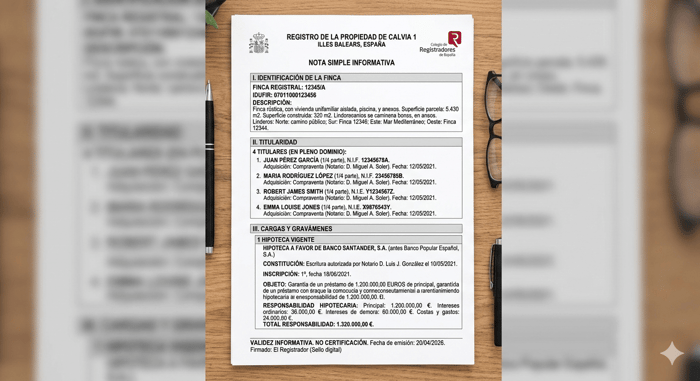
The first section is the property description (Descripción de la Finca). This sets out the official registered description of the property, including its location, the total registered surface area in square metres, the layout of the building as recorded, details of any share in communal areas, the cadastral reference number, and a description of the boundaries of the plot. This section is where you establish what you are officially buying according to the Land Registry, and it is essential to compare it against what is physically present at the property. Discrepancies between the registered description and what actually exists on the ground are common in Mallorca and must be fully understood before proceeding.
The second section is ownership (Titularidad). This confirms the full legal name of the registered owner or owners, their identification numbers, their respective ownership shares if there are multiple owners, and the legal basis by which they acquired the property, whether by purchase, inheritance, gift, or another mechanism. This section also confirms the date of the most recent transfer of ownership and references the notarial deed under which it took place. This is where you verify that the person selling you the property has the legal right to do so.
The third and most carefully scrutinised section is encumbrances and charges (Cargas). This section records every financial and legal obligation currently registered against the property. It includes mortgages, with the name of the lender and the registered amount of the debt, court-ordered embargos, tax liens, easements such as rights of way or servitude agreements, restrictions on use, and any other legal encumbrances that travel with the property to a new owner. If this section contains the phrase LIBRE DE CARGAS, the property carries no registered encumbrances, which is the cleanest possible position. Any entry in this section requires careful legal analysis before proceeding.
What to Look For: The Five Critical Checks
Beyond simply obtaining the document, understanding what to look for within it is the key to making it genuinely useful. There are five checks that experienced buyers and their lawyers carry out on every Nota Simple.
The first is ownership confirmation. The seller named on the purchase contract must match the owner named in the Nota Simple exactly. Any discrepancy, even a minor spelling difference, requires clarification. If there are multiple owners shown, all must participate in and consent to the sale.
The second is surface area and description accuracy. Compare the registered surface area with what the property is being sold as, and with the physical reality of what you have visited. In Mallorca it is common for properties to have extensions or additional structures added over the years without being formally registered, meaning the Nota Simple shows a smaller property than what actually exists on the ground. These unregistered elements need separate legal attention and may carry planning law implications.
The third is outstanding mortgages. Any mortgage registered against the property must be cleared by the seller at or before the point of sale, using funds from the sale proceeds. Your lawyer ensures that the mortgage cancellation is formally registered at the same time as the new ownership deed is signed. A mortgage appearing on the Nota Simple is not in itself a problem provided it is handled correctly, but it must not be overlooked.
The fourth is embargos and court orders. An embargo is a court-ordered legal charge, typically arising from an unpaid debt. If one is registered against the property, it takes priority over a sale and must be resolved before the property can be transferred cleanly. Unlike a mortgage, an embargo cannot simply be cancelled with sale proceeds at the notary; it requires separate legal proceedings and can significantly delay or complicate a transaction.
The fifth is easements and rights of third parties. These are rights that other people or organisations hold over the property, such as a right of way across the land, access rights for a neighbouring property, or underground utility lines belonging to third parties. Easements are common on rural properties in Mallorca in particular, and while they are not necessarily a problem, they need to be fully understood because they transfer to any new owner and can affect how the property is used.
What the Nota Simple Does Not Tell You
Understanding the limits of the Nota Simple is as important as understanding what it contains. There are several things this document does not reveal, each of which requires separate due diligence.
The Nota Simple does not confirm whether the property or any of its structures comply with planning regulations. A property can be fully registered and appear entirely clean on a Nota Simple while containing structures, extensions, or conversions that were carried out without the correct planning permissions. In Mallorca, where rustic land planning law is complex and where many properties have been extended informally over the years, this is a particularly important gap to fill through separate checks with the relevant town hall and a specialist architect or lawyer.
It does not include the sale price from any previous transaction. It does not show the detailed history of past owners beyond the current registered owner. It does not confirm whether community fees are up to date, whether local property taxes (IBI) are paid, or whether there are unpaid utility bills attached to the property. All of these require separate verification as part of a comprehensive pre-purchase due diligence process.
Finally, the Nota Simple does not reveal whether the property is affected by Spain’s Ley de Costas (coastal law), flood zone designations, or archaeological protection orders. For coastal and rural properties in particular, these are separate checks that an experienced property lawyer will carry out alongside the Land Registry review.
The Nota Simple and Your Mortgage
If you are planning to finance your Mallorca purchase with a mortgage from a Spanish bank, the lender will require a current Nota Simple as a standard part of the mortgage application process. The bank uses this document to verify ownership, assess any existing charges against the property, and confirm the registered details before commissioning a formal valuation. Banks in Spain are legally required to base their mortgage offer on the lesser of the purchase price and the bank’s own valuation, so ensuring that the Nota Simple is accurate and up to date matters for the lending process as well as for your own protection.
Working with Imperial Properties
At Imperial Properties, obtaining and reviewing the Nota Simple is a standard part of the due diligence process we guide every buyer through, from the moment a property becomes a serious prospect. We work with a trusted network of independent lawyers who are fluent in English, German, French, and Spanish and who specialise in Mallorca property transactions. Between us, we ensure that the Nota Simple is not just obtained but genuinely understood, and that any issues it reveals are addressed clearly and professionally before you are asked to commit to anything.
If you have questions about a specific property or are beginning your search in Mallorca, we are happy to talk you through the process in full. Visit www.imperial-properties.com or contact our team directly.
Q&A
What is a Nota Simple and why do I need one before buying in Mallorca?
How long does a Nota Simple take to obtain and how much does it cost?
Can a non-resident foreigner request a Nota Simple?
What does LIBRE DE CARGAS mean on a Nota Simple?
Does the Nota Simple confirm that a property is legally planning-compliant?
What happens if there is a mortgage registered on the property I want to buy?
Why might the surface area on the Nota Simple differ from what I have been shown?
How recent should a Nota Simple be at the point of purchase?
Comprender la Nota Simple: Lo que Todo Comprador en Mallorca Debe Revisar Antes de Firmar
Si hay un documento que toda persona que compre una propiedad en Mallorca necesita comprender antes que cualquier otra cosa, ese es la Nota Simple. Preguntele a cualquier abogado inmobiliario con experiencia en España cuál es el paso de diligencia debida más importante en cualquier transacción, y la respuesta siempre comenzará aquí. Es el punto de partida para todo comprador serio, el documento que revela el verdadero estado legal de una propiedad antes de pagar ningún depósito, firmar ningún contrato o que cualquier vinculación emocional se convierta en un compromiso financiero.
Esta guía explica todo lo que necesita saber, en un lenguaje claro y directo, para que cuando llegue el momento de dar el paso en una propiedad en Mallorca, lo haga con plena confianza y con los ojos bien abiertos.
¿Qué es la Nota Simple?
La Nota Simple Informativa es un extracto oficial del Registro de la Propiedad de España. Es un documento de acceso público, lo que significa que cualquier persona con un interés legítimo en una propiedad puede solicitarlo, independientemente de si es residente español, extranjero o el propietario actual. No es una escritura y no tiene plena fuerza legal en un tribunal de la forma en que lo hace el Certificado Registral completo, pero es con diferencia el documento más práctico e importante para un comprador que realiza la diligencia debida inicial.
La Nota Simple refleja el estado registrado actual de una propiedad en el momento de su emisión. Se aconseja solicitar una Nota Simple actualizada lo más cerca posible de la fecha de firma de cualquier contrato de compra. Un documento que tenga más de tres meses debe tratarse con precaución, ya que pueden haberse producido cambios de titularidad, nuevas cargas o procedimientos judiciales desde su emisión.
Cómo Obtener una Nota Simple
La Nota Simple puede solicitarse en persona en la oficina del Registro de la Propiedad local correspondiente, o en línea a través del portal oficial del Colegio de Registradores de España en www.registradores.org. El coste de una solicitud en persona es de aproximadamente 3,64 euros más IVA, y la versión en línea cuesta aproximadamente 9,02 euros más IVA en 2025. Las solicitudes en línea se procesan normalmente en dos horas. Para solicitarla necesitará el nombre completo del propietario registrado, el número de finca registral o el identificador IDUFIR/CRU. Su abogado o el agente vendedor podrán facilitarle estos datos.
Lo que Contiene la Nota Simple: Las Tres Secciones Clave
El documento se divide en tres secciones principales, cada una de las cuales le dice algo diferente e importante sobre la propiedad que está considerando.
La primera sección es la descripción de la finca. Esta establece la descripción registrada oficial de la propiedad, incluyendo su ubicación, la superficie total registrada en metros cuadrados, el diseño del edificio tal como está registrado, los detalles de cualquier participación en áreas comunes, la referencia catastral y una descripción de los límites de la parcela. Es esencial comparar esta sección con la realidad física de la propiedad que ha visitado, ya que las discrepancias son habituales en Mallorca.
La segunda sección es la titularidad. Confirma el nombre legal completo del propietario o propietarios registrados, sus números de identificación, sus respectivas participaciones de propiedad si hay varios propietarios, y la base legal por la que adquirieron la propiedad. Aquí es donde verifica que la persona que le vende la propiedad tiene el derecho legal de hacerlo.
La tercera y más minuciosamente examinada sección son las cargas. Esta sección registra cada obligación financiera y legal actualmente registrada contra la propiedad, incluyendo hipotecas, embargos ordenados por tribunales, gravamenes fiscales, servidumbres y cualquier otra carga legal que se transfiere con la propiedad al nuevo propietario. Si esta sección contiene la frase LIBRE DE CARGAS, la propiedad no tiene cargas registradas, que es la posición más limpia posible.
Qué Buscar: Las Cinco Comprobaciones Críticas
La primera es la confirmación de la titularidad: el vendedor nombrado en el contrato de compra debe coincidir exactamente con el propietario de la Nota Simple. La segunda es la precisión de la superficie: compare la registrada con la realidad física, ya que en Mallorca las ampliaciones sin registrar son habituales. La tercera son las hipotecas pendientes, que el vendedor debe cancelar con los fondos de la venta. La cuarta son los embargos y órdenes judiciales, que deben resolverse antes de la transmisión. La quinta son las servidumbres y derechos de terceros, que se transmiten al nuevo propietario y pueden afectar al uso de la propiedad.
Lo que la Nota Simple No le Dice
La Nota Simple no confirma si la propiedad o cualquiera de sus estructuras cumple con las normativas urbanísticas. Una propiedad puede aparecer completamente limpia en una Nota Simple mientras contiene estructuras o ampliaciones realizadas sin los permisos de construcción correctos. En Mallorca, donde la ley urbanística del suelo rústico es compleja, es esencial realizar una comprobación separada con el ayuntamiento correspondiente y un arquitecto o abogado especializado.
Tampoco revela si la propiedad está afectada por la Ley de Costas, las designaciones de zonas inundables o las órdenes de protección arqueológica. No confirma si las cuotas de comunidad, el IBI o los suministros están al día. Todas estas verificaciones deben realizarse de forma separada como parte de un proceso de diligencia debida exhaustivo.
Trabajar con Imperial Properties
En Imperial Properties, obtener y revisar la Nota Simple es una parte estándar del proceso de diligencia debida que guiamos a cada comprador desde el momento en que una propiedad se convierte en una perspectiva seria. Trabajamos con una red de confianza de abogados independientes fluidos en inglés, alemán, francés y español que se especializan en transacciones inmobiliarias en Mallorca. Si tiene preguntas sobre una propiedad específica o está comenzando su búsqueda en Mallorca, estamos encantados de explicarle el proceso completo. Visite www.imperial-properties.com o contacte directamente con nuestro equipo.
Preguntas Frecuentes
¿Qué es una Nota Simple y por qué la necesito antes de comprar en Mallorca?
¿Puede un extranjero no residente solicitar una Nota Simple?
¿Qué significa LIBRE DE CARGAS en una Nota Simple?
¿La Nota Simple confirma que una propiedad cumple con el urbanismo?
¿Qué ocurre si hay una hipoteca sobre la propiedad que quiero comprar?
¿Con qué antelación debo solicitar la Nota Simple?
Die Nota Simple Verstehen: Was Jeder Käufer auf Mallorca Vor der Unterzeichnung Prüfen Muss
Wenn es ein Dokument gibt, das jeder Immobilienkäufer auf Mallorca vor allem anderen verstehen muss, dann ist es die Nota Simple. Fragen Sie jeden erfahrenen Immobilienanwalt in Spanien, was der wichtigste Sorgfaltspflicht-Schritt in einer Transaktion ist, und die Antwort beginnt immer hier. Es ist der Ausgangspunkt für jeden ernsthaften Käufer, das Dokument, das den wahren rechtlichen Status einer Immobilie aufdeckt, bevor eine Anzahlung geleistet, ein Vertrag unterzeichnet oder eine emotionale Bindung zu einer finanziellen Verpflichtung wird.
Dieser Leitfaden erklärt alles, was Sie wissen müssen, in klarer Sprache, damit Sie, wenn der Zeitpunkt kommt, eine Mallorca-Immobilie zu erwerben, dies mit vollständiger Zuversicht und klarem Blick tun.
Was ist die Nota Simple?
Die Nota Simple Informativa ist ein offizieller Auszug aus Spaniens Grundbuch, dem Registro de la Propiedad. Es ist ein öffentlich zugängliches Dokument, was bedeutet, dass jede Person mit einem berechtigten Interesse an einer Immobilie eines beantragen kann, unabhängig davon, ob sie spanische Einwohner, Ausländer oder aktuelle Eigentümer sind. Es ist keine Eigentumsurkunde und hat nicht die volle Rechtskraft des vollständigen Zertifikats, aber es ist bei weitem das praktischste und wichtigste Dokument für einen Käufer, der eine erstmalige Sorgfaltspflichtprüfung durchführt.
Die Nota Simple spiegelt den aktuell registrierten Status einer Immobilie zum Zeitpunkt ihrer Ausstellung wider. Da sich der Immobilienmarkt schnell bewegt, ist es ratsam, eine aktuelle Nota Simple so nah wie möglich am Datum der Unterzeichnung eines Kaufvertrags anzufordern. Ein Dokument, das älter als drei Monate ist, sollte mit Vorsicht behandelt werden.
Wie Man Eine Erhält
Die Nota Simple kann persönlich beim zuständigen lokalen Grundbuchamt beantragt werden oder online über das offizielle Portal des Colegio de Registradores de España unter www.registradores.org. Die Kosten für eine persönliche Anfrage betragen etwa 3,64 Euro plus MwSt., und die Online-Version kostet etwa 9,02 Euro plus MwSt. (Stand 2025). Online-Anfragen werden typischerweise innerhalb von zwei Stunden bearbeitet.
Was die Nota Simple Enthält: Die Drei Hauptabschnitte
Der erste Abschnitt ist die Immobilienbeschreibung (Descripción de la Finca). Dieser legt die offizielle registrierte Beschreibung der Immobilie fest, einschließlich ihres Standorts, der registrierten Gesamtfläche in Quadratmetern, des Gebäude-Layouts, Details zu Anteilen an Gemeinschaftsflächen und der Katasterreferenznummer. Es ist wesentlich, diese Angaben mit der physischen Realität der Immobilie zu vergleichen, da Abweichungen auf Mallorca häufig vorkommen.
Der zweite Abschnitt ist das Eigentum (Titularidad). Dieser bestätigt den vollständigen rechtlichen Namen des registrierten Eigentümers oder der Eigentümer, ihre Identifikationsnummern und die Rechtsgrundlage, auf der sie die Immobilie erworben haben. Hier verifizieren Sie, dass die Person, die Ihnen die Immobilie verkauft, das gesetzliche Recht dazu hat.
Der dritte und am sorgfältigsten geprüfte Abschnitt sind Belastungen (Cargas). Dieser Abschnitt erfasst jede finanzielle und rechtliche Verpflichtung, die derzeit gegen die Immobilie eingetragen ist, einschließlich Hypotheken, gerichtlich angeordneter Pfandungen, Steuerpfandrechte und Dienstbarkeiten. Wenn dieser Abschnitt die Phrase LIBRE DE CARGAS enthält, trägt die Immobilie keine eingetragenen Belastungen.
Worauf Man Achten Sollte: Die Fünf Kritischen Prüfungen
Erstens die Eigentumsbestätigung: Der im Kaufvertrag genannte Verkäufer muss exakt mit dem in der Nota Simple genannten Eigentümer übereinstimmen. Zweitens die Genauigkeit von Fläche und Beschreibung: Auf Mallorca sind nicht eingetragene Anbauten häufig. Drittens ausstehende Hypotheken, die vom Verkäufer beim Verkauf bereinigt werden müssen. Viertens Pfandungen und Gerichtsbeschlüsse, die vor einer sauberen Eigentumsübertragung gelöst werden müssen. Fünftens Dienstbarkeiten und Rechte Dritter, die auf jeden neuen Eigentümer übertragen werden.
Was die Nota Simple Nicht Aussagt
Die Nota Simple bestätigt nicht, ob die Immobilie oder ihre Strukturen mit den Bauvorschriften übereinstimmen. Eine Immobilie kann in einer Nota Simple vollständig sauber erscheinen, während sie Strukturen oder Erweiterungen enthält, die ohne die richtigen Baugenehmigungen durchgeführt wurden. Auf Mallorca, wo das Planungsrecht komplex ist, ist eine separate Prüfung beim zuständigen Rathaus unbedingt erforderlich.
Sie offenbart auch nicht, ob die Immobilie vom Ley de Costas, Überschwemmungsgebiet-Ausweisungen oder archäologischen Schutzanordnungen betroffen ist, und bestätigt nicht, ob Gemeinschaftsgebühren, Grundsteuer oder Nebenkosten bezahlt sind. All diese Punkte erfordern separate Prüfungen.
Mit Imperial Properties Arbeiten
Bei Imperial Properties ist das Einholen und Prüfen der Nota Simple ein Standardteil des Sorgfaltspflicht-Prozesses, durch den wir jeden Käufer führen, sobald eine Immobilie zu einem ernsthaften Kaufkandidaten wird. Wir arbeiten mit einem vertrauenswürdigen Netzwerk unabhängiger Anwälte zusammen, die Englisch, Deutsch, Französisch und Spanisch fließend sprechen und sich auf Mallorca-Immobilientransaktionen spezialisiert haben. Besuchen Sie www.imperial-properties.com oder kontaktieren Sie unser Team direkt.