Table of Contents
Short-Term Holiday Rental Licences in Mallorca: What Changed, Who Qualifies and What Buyers Must Know
One of the most consequential decisions the Balearic Government has made in the last decade is the moratorium on new short-term tourist rental licences — known in Mallorca as ETV licences (Estança Turística en Vivenda) — across significant portions of the island, including most of Calvià. The decision affects the economics of property ownership in the southwest in a way that is genuinely significant, and it is one of the most searched and least clearly explained topics for international buyers in the area.
This guide covers what an ETV licence is, what the current rules are, where the moratorium applies, what properties with existing licences are worth and what buyers need to verify before making any assumption about rental income from a property purchase in the southwest.
Thinking about buying or selling in Mallorca?
What Is an ETV Licence?
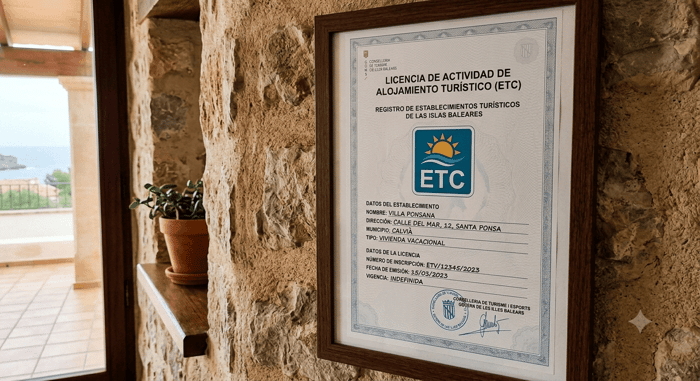
An ETV licence (Estança Turística en Vivenda — Tourist Stay in a Dwelling) is the official authorisation issued by the Balearic Government's tourism authority (ATIB — Agència Tributària de les Illes Balears) that allows a residential property to be let to tourists on a short-term basis — typically periods of less than one month. Without a valid ETV licence, advertising a property on short-term holiday rental platforms such as Airbnb, Booking.com or similar is illegal in the Balearic Islands, and enforcement is active.
The ETV regime was introduced in 2012 and has been amended several times since, most significantly in 2017 under the Tourism Law of the Balearic Islands (Llei 6/2017 de modificació de la Llei 8/2012 del Turisme de les Illes Balears). The most recent amendments have progressively tightened the availability of new licences, introduced zoning restrictions and created significant differences between what is legally possible in different parts of the island and within different property types.
The Moratorium: What It Means in Practice
The Balearic Government suspended the granting of new ETV licences for apartments in the most tourist-saturated zones of the island. In Calvià — the municipality that includes Santa Ponsa, Nova Santa Ponsa, Peguera, Portals Nous, El Toro and the wider southwest — apartments (pisos) have been subject to this moratorium and new licences for apartments in these zones have not been available for several years.
This is not a blanket ban on all tourist rental. The key distinctions are:
Apartments (pisos) in Calvià: New ETV licences for apartments are suspended. Existing licences attached to a property can be transferred with the property on sale, but they cannot be created fresh. An apartment in Santa Ponsa without an existing ETV licence cannot legally be let to tourists on short-term rentals under current regulations.
Villas and single-family detached homes (unifamiliars aïllades): The rules are different. Single-family detached properties may apply for ETV licences under conditions set by the municipality, including minimum plot sizes and infrastructure requirements. However, Calvià imposes its own additional requirements that must be verified against the specific property.
Properties in non-saturated zones: Some interior and rural areas of Mallorca outside the tourist saturation zones operate under different rules. For buyers specifically interested in rental income, properties in these zones may have different licence availability — though Calvià is almost entirely within a saturated zone designation.
Existing ETV Licences: What They Are Worth
A residential property in Calvià or Santa Ponsa that carries an existing, valid ETV licence is a materially different asset from one without. The licence allows the property to generate short-term tourist rental income legally. Because no new licences are being issued for apartments in these areas, existing licences represent a finite pool — and they carry a clear market premium.
Buyers interested in tourism rental income should ask explicitly, at the earliest stage of any enquiry, whether an apartment comes with a transferred ETV licence. The licence should appear in the property's official tourism register and can be verified through ATIB. A seller's or agent's claim that a property can be legally rented short-term must be backed by a verified, current licence number — not an assumption or an informal arrangement.
It is also worth noting that ETV licences are subject to annual renewal requirements and compliance conditions — the property must meet habitability, safety and quality standards set by the tourism authority. A licence that has lapsed or been revoked does not transfer. Buyers should request sight of the current licence and its renewal status before proceeding.
Long-Term Rental: The Alternative
The moratorium on short-term tourist rental licences has had one clear secondary effect: it has sustained demand for long-term residential rental (alquiler de larga duración) in the southwest. Owners who cannot legally use their property for tourist rental can still let it as a long-term residential tenancy — typically defined as contracts of one year or more — under standard Spanish tenancy law (Ley de Arrendamientos Urbanos).
Long-term rental in the southwest commands strong rates, driven by the consistent demand from residents who are in the area for work, family or lifestyle reasons and who are not in a position to buy. Yields from long-term residential rental in Calvià are competitive with other Spanish coastal markets and have been sustained by supply constraints that are unlikely to change in the near term.
For buyers who are not dependent on tourist rental income, the long-term rental route offers a simpler, less regulated income stream with lower management overhead than tourist rental. For buyers who specifically want tourist rental income, the ETV question is fundamental and must be resolved before purchase — not after.
What Buyers Must Check
Before making any offer on a property in the southwest with the intention of generating rental income, the following checks are essential.
First, confirm the property type. Is it an apartment (piso), a townhouse (adosado), a villa (xalet/villa) or a ground-floor unit with private garden? The property type determines which regime applies. An apartment in Calvià municipality currently cannot obtain a new ETV licence. A detached villa may be eligible, subject to conditions.
Second, if the seller claims the property has an existing ETV licence, request the licence number and verify it directly with ATIB at atib.es. Confirm the licence is current, valid, not subject to any disciplinary proceedings and correctly associated with the property's catastral reference.
Third, confirm the zone. Calvià has its own municipal regulations that operate alongside the regional Balearic rules. The Ajuntament de Calvià planning and tourism departments can confirm the status of any specific address.
Fourth, take legal advice from a Spanish property lawyer (abogado) who specialises in Balearic tourism law before relying on any rental income projections in your purchase decision. The penalties for letting without a valid ETV licence include fines of up to €400,000 and forced removal from rental platforms.
The Bigger Picture
The ETV moratorium is part of a broader Balearic Government policy aimed at managing the housing supply crisis driven by over-tourism and the conversion of residential stock to tourist use. The political direction — supported by the anti-tourism protests announced for 26 July 2026 — is unlikely to reverse. If anything, the trend is toward further tightening rather than liberalisation.
For buyers who want to live in the southwest or use their property as a seasonal second home, this has no practical effect. For buyers who are making their purchase decision partly or primarily on tourist rental income, it is the single most important regulatory fact to establish before proceeding.
Imperial Properties has been advising buyers in Santa Ponsa and the Calvià municipality since 1985 and can connect you with trusted local lawyers who specialise in this area. Contact us on +34 971 692 434, by WhatsApp at wa.me/34971692434, or browse current listings at imperial-properties.com.