Table of Contents
Gaudi in the Cathedral of Mallorca: The Exhibition That Reveals a Hidden Chapter of La Seu
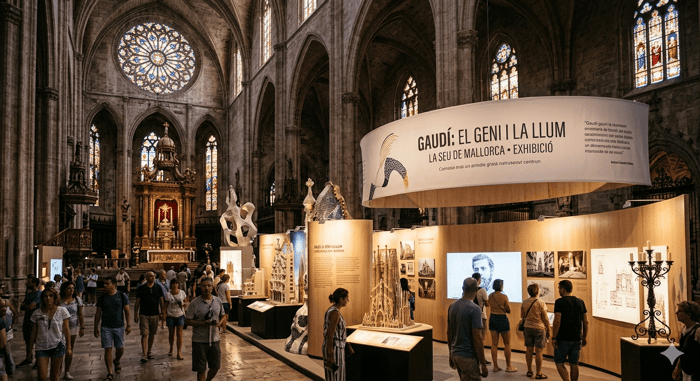
Tonight at 18:30, Palma Cathedral opens an exhibition that most visitors to the island do not know they need. "Gaudi in the Cathedral of Mallorca: Liturgy, Art and Modernity" runs from 18 June through to September 2026 and documents one of the most surprising collaborations in European architectural history: the eleven years Antoni Gaudi spent working inside La Seu, transforming a medieval Gothic cathedral from the inside at the same time as he was building the Sagrada Familia in Barcelona.
The Gaudi connection to Palma Cathedral is one of those facts that lands differently once you know it. Most people arrive at La Seu knowing it as one of the great Gothic buildings of the Mediterranean — the second-largest Gothic nave in Europe, the extraordinary rose window, the weight of eight centuries of history. What very few know before they walk through the door is that the interior they are looking at was partially reshaped by the most famous architect of the twentieth century, working here between 1904 and 1914.
What Gaudi Actually Did at La Seu
Bishop Pere Campins invited Gaudi to Mallorca in 1901 to carry out a liturgical restoration of the cathedral — the goal was to return the interior to what Campins believed was a more authentic early Christian arrangement, moving the choir from the centre of the nave back behind the altar and improving sightlines for the congregation. Gaudi accepted and brought his collaborators Josep Maria Jujol and Joan Rubio with him.
What followed was one of the most contentious restoration projects of its era. Gaudi removed the Baroque altar that had accumulated over centuries, repositioned the Gothic royal tombs, and installed a dramatic baldachin — a canopy above the altar — hung with lanterns and crowned with a polychrome terracotta sculpture of the crucifixion surrounded by the apostles. He also repositioned the famous rose window above the Portal del Mirador to allow morning light to fall directly onto the altar at Easter — a piece of solar liturgical planning that required precise mathematical calculation and is now one of the most photographed light effects in Spain each spring.
Not everyone was pleased. The project generated significant controversy among the Mallorcan clergy and public, and Gaudi withdrew from the commission in 1914 before it was fully complete. He left behind a cathedral interior that is neither purely Gothic nor purely Modernista but something genuinely singular — a medieval space with the fingerprints of one of history's most original architectural minds pressed into it.
Thinking about buying or selling in Mallorca?
What the Exhibition Covers
The exhibition opening tonight is designed to make this history accessible and well-documented for a general audience. It covers the circumstances of Gaudi's commission, the specific interventions he made inside the cathedral, the controversy that surrounded the work, and its legacy — both for the building itself and for the understanding of Gaudi as an architect whose ambitions extended well beyond Barcelona.
For anyone who has visited the Sagrada Familia or the Palau Guell in Barcelona, the Palma Cathedral exhibition provides important context: this is Gaudi at mid-career, already fully formed in his approach but working within an existing Gothic structure rather than building from the ground up, which produced different solutions and different tensions.
The cathedral itself is at Placa de la Seu, Palma, directly overlooking the sea. It is open to visitors daily. The exhibition runs as part of the cathedral's permanent offer through the summer and into September. Entry is included with the standard cathedral ticket.
Visiting La Seu: What Else to Know
The cathedral is best visited on weekday mornings when crowds are lighter. The Easter light effect — when the rising sun aligns through Gaudi's repositioned rose window to illuminate the altar — is the most dramatic single moment the building offers, but the interior is extraordinary at any time of year. The royal tombs of Jaume II and Jaume III of Mallorca are in the Trinity Chapel behind the main altar. The museum attached to the cathedral contains mediaeval silverwork, processional items and documentation of the building's construction.
From Santa Ponsa and the southwest, the drive to Palma Cathedral takes around 25 minutes. The most practical approach is to park in the Passeig Sagrera underground car park and walk five minutes through the old town. Combining a cathedral visit with the Palma Old Town, the Almudaina Palace next door, and lunch in the La Llotja district makes for a natural full day.
For anyone considering property in Mallorca and wanting to understand the depth of what island life offers culturally and historically, an afternoon at La Seu with the new Gaudi exhibition is a good place to start. To explore property in southwest Mallorca, visit imperial-properties.com.