Table of Contents
The Notary's Role in a Mallorca Property Purchase: What They Actually Check (and Don't)
Almost every foreign buyer we work with arrives at their signing appointment assuming the Mallorca notary is there to protect them. It's an understandable assumption if you're coming from the UK, where your conveyancer works exclusively on your behalf, or from a system where "notary" and "your legal representative" mean roughly the same thing. In Spain they don't, and the gap between what people expect and what a notary actually does is one of the most common sources of confusion we see in a property purchase.
Understanding this distinction before your signing day, rather than during it, changes how you prepare for a Mallorca purchase.
What a Notary Actually Is
A Spanish notary (notario) is a public official appointed through a competitive state exam and assigned by the Ministry of Justice. They are not a private lawyer and they do not work for you or for the seller. Their role is neutral by design: they exist to certify that a transaction has taken place correctly under Spanish law, not to negotiate on anyone's behalf or to advise either party on whether a deal is a good one.
This neutrality is the single most important thing to understand. A French notaire or a UK conveyancer carries out extensive property searches and effectively protects the buyer throughout a transaction. A Spanish notario does not play that role at all.
Thinking about buying or selling in Mallorca?
What the Notary Checks
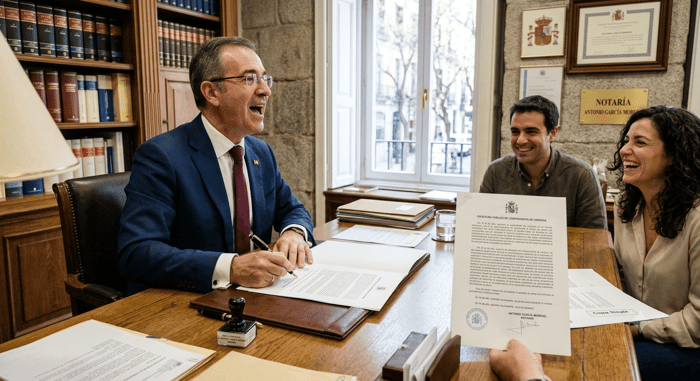
On the day of signing, the notary verifies the identity and legal capacity of everyone present, confirming that each party is who they claim to be and has the legal authority to sign. Where a seller is represented by a lawyer or agent under Power of Attorney, the notary checks that the document is valid and covers the specific transaction.
The notary also pulls a Nota Simple from the Land Registry immediately before signing, which confirms who is legally recorded as the owner and shows any charges registered against the property, such as an outstanding mortgage. They read the Escritura Pública, the public deed of sale, aloud in full before both parties sign it, and they certify that the deed has been executed correctly. Once signed, the notary is responsible for submitting the deed to the Registro de la Propiedad for inscription, which is the step that formally records the change of ownership.
What the Notary Doesn't Check
This is where the expectation gap tends to cause real problems. The notary does not carry out title due diligence beyond what the Land Registry shows on the day. They do not check whether the property has any planning irregularities, whether it holds a valid occupation licence (cédula de habitabilidad), or whether it complies with the categories we've covered before on this blog, such as fuera de ordenación status. They do not check for outstanding community fee arrears with the comunidad de propietarios, nor do they investigate whether a plusvalía municipal dispute is pending on the property.
Perhaps most importantly for anyone negotiating a purchase, the notary does not advise you on the terms of the deal itself. They are not there to tell you the price is fair, to flag a clause that disadvantages you, or to renegotiate anything on your behalf once you're at the table. By the time you're sitting in front of a notary, the substance of the deal should already be settled.
Why an Independent Lawyer Still Matters
Because the notary's role is deliberately narrow, the protective work that a French or British buyer might expect from their notary or conveyancer falls, in Spain, to an independent abogado working only for the buyer. A good lawyer reviews the Nota Simple in advance rather than on signing day, checks the property's status at the Catastro, confirms IBI and community fees are paid up to date, reviews any occupation licence or planning file, and negotiates the arras (deposit) contract before you ever reach the notary's office.
The practical summary we give clients is simple: the notary makes the sale legal. Your lawyer makes it safe. Both matter, but they are not interchangeable, and treating the notary as a substitute for independent legal advice is one of the more expensive misunderstandings a foreign buyer can make in Mallorca.
Buying by Power of Attorney
Many of our international clients cannot be on the island for the signing itself. Spanish law allows a notarised Power of Attorney to be granted to a lawyer or representative, who can then attend the notary appointment and sign on the buyer's behalf. This is common practice for Mallorca purchases involving buyers based in the UK, Germany, Scandinavia and further afield, and it doesn't weaken the legal standing of the transaction provided the POA is properly drafted and covers the specific sale.
If you're planning a summer completion, it's worth booking your notary appointment well in advance. July and August are the busiest months for signings on the island, and availability tightens considerably.
What a Notary Costs
Notary fees in Spain are set by a regulated tariff under Real Decreto 1426/1989 and adjusted periodically. This means fees are not negotiable and don't vary meaningfully between one notary's office and another; they scale according to the value of the transaction rather than being agreed case by case. In most Mallorca purchases the buyer pays this cost, although in principle the parties could agree otherwise. Compared with the overall cost of buying, notary fees are a modest line item, but the deed cannot be registered without one.
Understanding exactly what a notary will and won't do for you is one of the clearer ways to walk into a Mallorca purchase properly prepared, and it's a conversation worth having with your legal representative long before signing day arrives.