Table of Contents
Usufruct in Spain: How Lifetime Rights of Use Work in Mallorca Estate Planning
Every so often a listing in Mallorca will note that a property is sold "en nuda propiedad" or that the seller "se reserva el usufructo". For buyers unfamiliar with Spanish property law, this can look like an unusual complication. In practice it is a well-established legal structure, used constantly by Mallorcan families and increasingly by foreign owners planning how to pass property to the next generation without losing the right to live in it themselves.
Understanding usufruct properly matters whether you are the one setting up this kind of arrangement for your own estate, or a buyer being offered a property where someone else already holds this right.
What Usufruct Actually Is
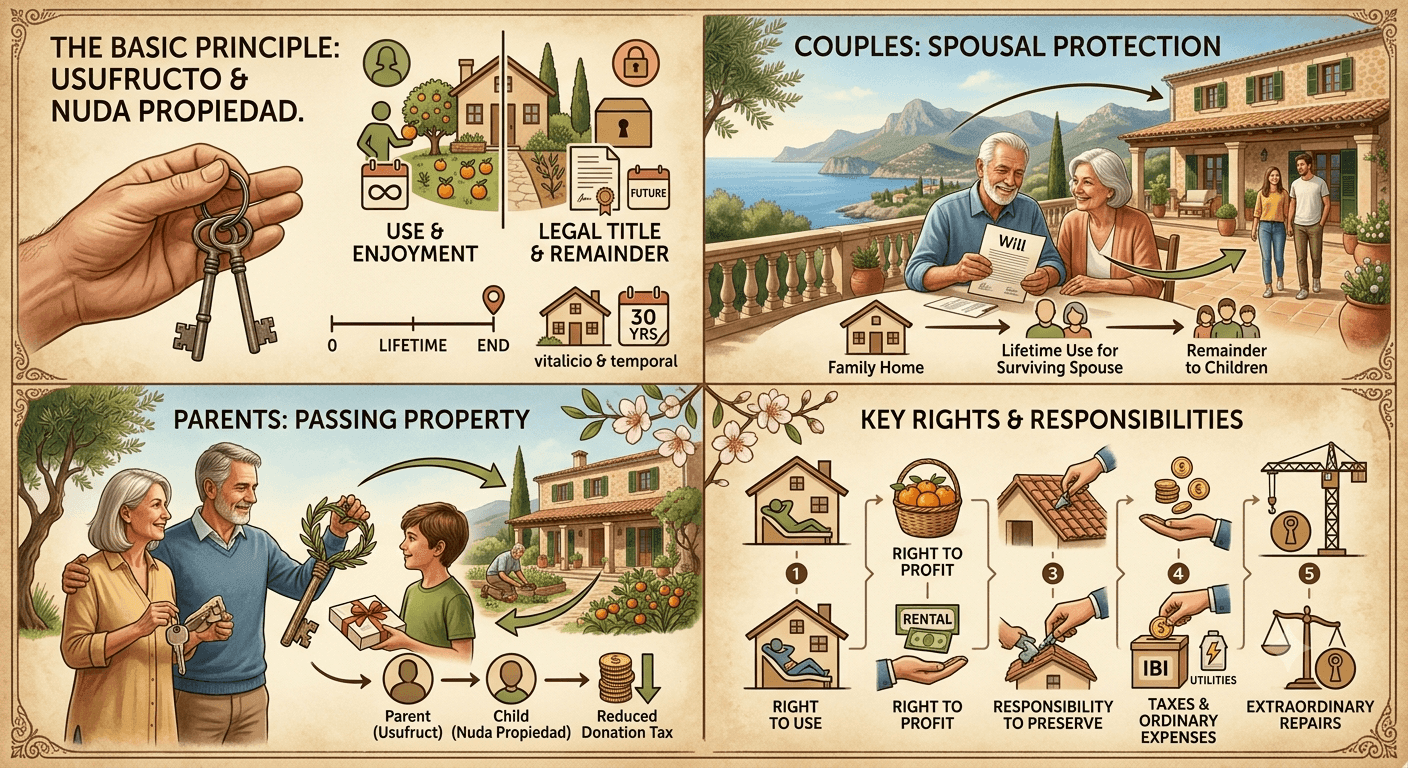
Usufruct, or usufructo in Spanish, is the legal right to use a property and enjoy its benefits, including living in it or renting it out and keeping the income, without owning it outright. Full ownership of a property, pleno dominio, splits into two separate rights: the usufruct, held by the usufructuary, and the bare ownership, nuda propiedad, held by the bare owner. The usufructuary can use and profit from the property; the bare owner holds the underlying title but cannot occupy or dispose of the property freely while the usufruct is in force.
Usufruct can be constituted for life, known as usufructo vitalicio, or for a fixed period, usufructo temporal. In the estate planning context relevant to most Mallorca owners, it is almost always the lifetime version: a parent donates the bare ownership of a property to their children while reserving the usufruct for themselves, meaning they retain the right to live in the property, or to rent it and keep the income, for as long as they live.
Why Families Use This Structure
The appeal is straightforward. Parents transfer the underlying property title to their children now, while retaining full practical use of it until death, at which point the usufruct extinguishes automatically and the children's bare ownership converts into full ownership without any further transfer being needed. This is a common way to plan for succession gradually, and it can also reduce the value of the parent's estate for inheritance tax purposes at the point of eventual death, since the usufruct itself typically has no residual value to transmit once its holder dies.
Thinking about buying or selling in Mallorca?
It is also used outside family succession planning. Some Mallorca properties are sold on the open market with the seller reserving a lifetime usufruct, effectively selling the bare ownership to a buyer while continuing to live in the property until death. This can suit an elderly owner who wants to release capital from their home without moving out, and it can suit a buyer prepared to wait for full possession in exchange for a lower purchase price today.
How Usufruct Is Valued for Tax Purposes
Spanish tax law values a lifetime usufruct using a fixed formula tied to the usufructuary's age: the percentage of the property's total value attributed to the usufruct is 89 minus the usufructuary's age, with a floor of 10% and a ceiling of 70%. A 60-year-old usufructuary therefore holds a right valued at 29% of the property, and the bare ownership is valued at the remaining 71%. The younger the usufructuary, the more valuable the usufruct, since it is expected to run for longer.
This formula, set out in Spain's inheritance and gift tax law, governs how much tax the bare owner pays on receiving their share when the usufruct is constituted by donation, and it is also the basis for valuing the usufruct itself if it is sold, exchanged, or extinguished before the usufructuary's death. A temporary usufruct, by contrast, is valued at 2% of the property's value per year of duration, up to the same 70% ceiling.
What This Means for a Buyer
A buyer offered a property in nuda propiedad is buying the underlying title while someone else, typically an elderly relative of the seller, retains the right to live there or collect rent from it. The purchase price reflects this: it is priced against the bare ownership percentage from the valuation formula above, not against the property's full market value. The buyer does not get possession until the usufruct extinguishes, usually on the usufructuary's death, unless the usufructuary agrees separately to give it up earlier.
This is not a purchase for a buyer who wants to move in immediately. It suits an investor, or a family member, prepared to hold the bare ownership for a period of uncertain length in exchange for a meaningfully lower entry price. Anyone considering this route should have their lawyer review the specific terms of the usufruct, since the deed can include conditions on maintenance costs, community fees, and what happens if the usufructuary wants to rent the property to a third party rather than live in it themselves.
Practical Considerations for Existing Owners
For an owner in Mallorca considering donating bare ownership to their children while keeping the usufruct, the practical steps involve a notary, since the donation must be formalised in a public deed and registered at the Land Registry. The donation itself is subject to gift tax, calculated on the value of the bare ownership transferred, and the applicable allowances and rates depend on the region and the relationship between donor and recipient.
It is worth noting that a usufructuary generally remains responsible for ordinary running costs of the property, including IBI and community fees, while structural repairs to the building's core fabric typically fall to the bare owner, though the precise split can be defined differently in the deed itself. Because this structure affects tax now and inheritance later, and because Balearic civil and tax rules interact with the general Spanish framework in ways that vary by individual circumstance, this is not a decision to make without a notary and a tax advisor familiar with property in the Balearics.