Table of Contents
Spain's Second World Cup: What the Research Says About the Economic Effect
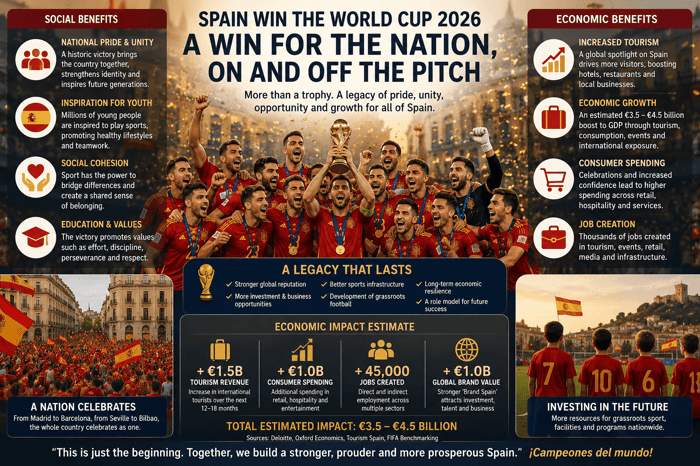
Spain beat Argentina 1-0 in extra time on 19 July 2026 to win its second FIFA World Cup, and the celebrations that followed — from Madrid's Plaza de Cibeles to Palma's Plaça de les Tortugues — were about far more than economics. But Spain's 2010 World Cup win has actually been studied in some detail by economists, and the findings are more specific, and more interesting, than the usual assumption that a big win simply makes everyone spend more.
What Happened After Spain's 2010 Win
The most direct evidence comes from a 2012 study by tourism economist Juan Luis Nicolau, who examined stock market reaction in the days after Spain's 2010 final victory. He found a significant, measurable increase in the market value of Spain's leading tourism-sector companies in the 18 days following the win — evidence, in his reading, that a World Cup victory can genuinely enhance a country's standing as a travel destination in the eyes of investors, not just tourists.
A follow-up study by Nicolau and Sharma in 2018 tested this across four World Cup winners — France in 1998, Italy in 2006, Spain in 2010 and Germany in 2014 — by tracking 19 listed hotel and airline companies after each final. Spain was the only one of the four to show a statistically significant gain: tourism shares produced an abnormal return of over 4% on the first trading day after the final. France, Italy and Germany showed no comparable effect. Spain's tourism-dependent economy appears to have made it a genuine outlier.
Thinking about buying or selling in Mallorca?
The Broader GDP Picture
Beyond Spain specifically, a 2024 study by economist Marco Mello in the Oxford Bulletin of Economics and Statistics analysed OECD data going back to 1961 to test the popular claim that winning the World Cup boosts a country's economy. Using both an event-study design and a synthetic difference-in-difference approach, Mello found that winning the tournament increased year-on-year GDP growth by an average of roughly 0.48 percentage points across the two quarters following the final, an effect that was statistically significant, if modest. Interestingly, the study attributes most of this bump to stronger export growth rather than domestic spending — consistent with the idea that international buyers respond to the prestige and visibility a winning nation gains, more than domestic consumers changing their own habits.
Why This Time Is Different for Spain
One important distinction: unlike in 2010, Spain isn't hosting this tournament — the 2026 World Cup was staged jointly by the United States, Mexico and Canada. That matters economically, because the academic literature is far more sceptical about the financial returns of hosting a World Cup than of simply winning one. Studies of past host nations have repeatedly found that the costs of stadiums and infrastructure often exceed the tourism revenue generated. Spain, in 2026, gets the winner's tourism and export effect identified by Nicolau, Sharma and Mello, without any of the hosting-related costs that usually offset it.
The tourism effect documented after 2010 also wasn't instant — most research on major sporting wins finds the measurable tourism benefit builds over the one to two years following the tournament, as destination awareness and travel bookings catch up with the moment of victory itself.
The Relevance for a Tourism Economy Like the Balearics
None of this is a guarantee of a repeat effect in 2026 — every tournament and every economic backdrop differs, and the research is clear that the size of the bump is modest rather than transformative. But for a region as tourism-dependent as the Balearic Islands, the 2010 precedent is a genuinely relevant data point: Spain's tourism sector was the one part of its economy the market reacted to directly and measurably after that win, more than any other World Cup-winning nation's tourism sector before or since.
Whatever the numbers ultimately show, Mallorca's summer season carries on regardless. If you're following the market here for reasons closer to home, browse our current listings across Mallorca or get in touch.