Table of Contents
- PV System Options for Mallorcan Homes
- The Installation Process
- Current Subsidies and Tax Incentives (Checked July 2026)
- Typical Prices and Payback Periods
- Battery Options: Do You Need One?
- Compensation Rates for Surplus Power
- Permissions and Permits
- Community and Shared Installations
- What This Means for Property Owners
Solar Power for Residential Properties in Mallorca: The Complete 2026 Guide
Mallorca gets over 300 days of sunshine a year, which makes solar one of the more straightforward home upgrades available to owners here — but the details around subsidies, permits, feed-in rates and batteries change often enough that most owners end up with an outdated picture. Here's where things actually stand in 2026.
PV System Options for Mallorcan Homes
Most residential installations on the island fall into one of three self-consumption categories under Spanish law: without surplus (autoconsumo sin excedentes, where an anti-injection device stops any excess reaching the grid), with surplus under simplified compensation (autoconsumo con excedentes acogido a compensación, where unused generation is credited against your bill), and with surplus not under compensation, which usually only makes sense for larger installations selling power directly at market rates. The overwhelming majority of homeowners choose the compensation route, since it's the only one that turns unused daytime generation into a real saving without the paperwork of operating as a small generator.
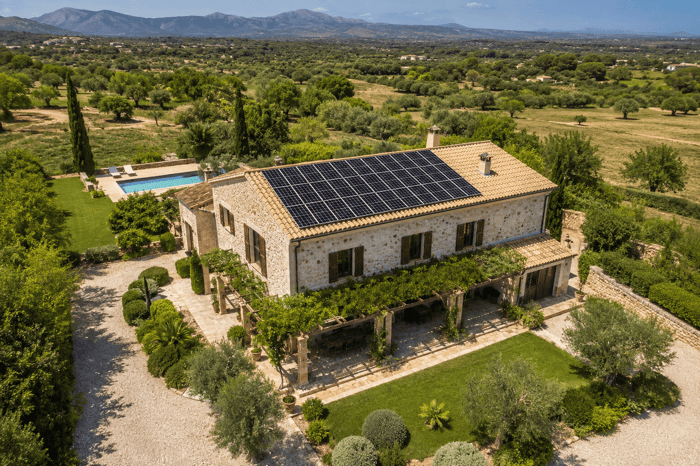
A typical Mallorcan home installs between 3kWp and 7kWp of rooftop panels, sized against annual consumption, roof orientation and shading rather than a fixed rule of thumb. South-facing, unshaded tile roofs — common across the southwest's villas — are close to ideal; flat roofs on apartment buildings work too, with tilted mounting frames, but shared roof space raises the ownership and permission questions covered further down.
Thinking about buying or selling in Mallorca?
The Installation Process
A qualified installer typically starts with a site visit to assess roof condition, orientation, shading and your annual consumption profile, then submits a technical project or memoria técnica alongside the permit application (more on that below). Physical installation on a standard villa usually takes one to two days; larger arrays, added battery storage, or unusual roof work can extend that to three or four days. Once panels are up, the installation needs a bidirectional meter, formal connection approval from the local distributor (Endesa Distribución across most of Mallorca), and registration with the Govern Balear's Dirección General de Energia i Canvi Climàtic before it can legally start generating and qualify for compensation or any grant. Total time from first site visit to switch-on varies enormously by municipality — some straightforward cases clear in a couple of weeks, others take a few months if permitting is slow or documentation needs revising.
Current Subsidies and Tax Incentives (Checked July 2026)
The headline regional grant, FOTOPAR2026, is run by the Govern de les Illes Balears and co-financed by the European Regional Development Fund. It pays €600 per kWp of solar installed and €420 per kWh of battery storage added as part of a new installation, up to a cap of 5kWp and 30kWh, funded on a first-come-first-served basis. Its 2026 application window closed on 30 April, so as things stand today it is not open for new applications — but Balearic authorities have historically followed one call with another, and a further round is expected in due course. It's worth checking directly with the Govern Balear or an installer before assuming it's unavailable, since these dates can move.
Two other incentives run independently of that grant cycle and are worth checking regardless of timing. Most Mallorcan town halls offer a multi-year IBI (property tax) reduction for installing solar — typically 25% to 50% off your annual bill for three to six years, with the exact percentage and duration set by each ayuntamiento — plus an ICIO (construction tax) reduction of up to 95% on the works themselves. Both are claimed directly through your local council rather than the regional government. Separately, a state-level IRPF income tax deduction of 20%, 40% or 60% of the cost of energy-efficiency works has applied since October 2021, though its original deadline was set for works completed by the end of 2025; whether and how it's been extended into 2026 varies by source at the time of writing, so it's worth confirming current eligibility with a gestoría before counting on it in your budget.
Typical Prices and Payback Periods
All-in installed cost across Spain currently runs around €1,100 to €1,500 per kWp, which puts a typical 5kWp system without battery storage at roughly €4,500 to €6,500, and the same system with a 5kWh battery closer to €7,000 to €9,500. On top of the equipment and installation, budget separately for legalisation and paperwork: rough 2026 figures for Mallorca put this at €400–800 for a standard single-family installation, €700–1,200 once batteries are involved, and €1,000–2,000 for a shared installation across a community of owners, with Palma and Calvià generally sitting at the higher end of that range and smaller inland towns at the lower end.
Payback on a well-sized system without a battery typically runs five to eight years; adding a battery extends that to seven to twelve years, since the extra cost of storage is only justified by the gap between what you're paid for exported energy and what you'd otherwise pay to import it at night. Panels themselves carry a working life of 25 to 30 years, so even a battery-inclusive system pays for itself with well over a decade of essentially free generation left afterward.
Battery Options: Do You Need One?
A battery makes the most financial sense when the gap between what you're paid for exported power and what you pay to import it at night is largest — and in 2026 that gap is substantial, since compensation rates sit far below evening tariff rates. Grant-funded batteries must be new lithium-ion units installed as part of a new PV system; retrofitting a battery onto an existing installation isn't eligible for the FOTOPAR grant, only new combined installations. A typical 5kWh residential battery adds roughly €3,000–4,000 to a system's cost, and can lift the share of your own generation you actually use directly from around 35–40% up to 60–70%, which matters more the higher your evening consumption is relative to daytime.
Compensation Rates for Surplus Power
Under Spain's simplified compensation scheme (Real Decreto 244/2019), your electricity retailer credits you for surplus energy exported to the grid — this shows up as a discount line on your bill, not a bank transfer, and it can never exceed the value of the energy you draw from the grid in the same billing period. Rates in 2026 typically run between €0.04 and €0.12 per kWh depending on retailer and whether you're on the regulated (PVPC) or free market tariff, with most offers clustering around €0.05–0.10/kWh. Unused surplus doesn't roll over to the next month under the standard simplified scheme, though some retailers now offer a "virtual battery" product that banks the euro value of surplus for use in future bills — worth comparing if your generation regularly outpaces your own consumption.
Permissions and Permits
Under the Balearic Islands' 2017 planning law, rooftop solar on buildings generally falls under the simplified comunicación previa regime rather than requiring a full municipal building licence — you notify the town hall with the technical documentation rather than waiting for prior approval. There are three specific exceptions that do require a full licencia urbanística: buildings formally declared as bienes de interés cultural or otherwise catalogued as heritage-protected, installations that affect the building's structure or foundations, and any project requiring formal environmental impact assessment. This matters in particular for older townhouses in Palma's old town or catalogued village properties, where a rooftop array may need full planning sign-off rather than the faster notification route available almost everywhere else.
Fees, documentation requirements and processing speed vary noticeably by municipality — Palma and Calvià tend to apply more thorough scrutiny and higher fees than smaller inland towns, simply because of volume and staffing. Whatever the route, the installation still needs to be registered with the Govern Balear once complete, since that registration is what unlocks compensation billing and grant eligibility.
Community and Shared Installations
For apartment buildings and shared communities of owners, autoconsumo colectivo lets a single rooftop installation supply multiple individual meters, with generation split between participating owners according to agreed coefficients. This route requires a bidirectional meter and a specific CAU (access and connection point) communication to the distributor listing every participating CUPS, but it meaningfully improves the economics for everyone involved: installation and legalisation costs are shared across the community rather than borne by one owner, which is why community solar consistently shows some of the fastest payback periods of any residential configuration on the island. For a shared installation to work smoothly, the community needs to agree the cost-sharing and consumption-sharing coefficients upfront, ideally with professional support drafting the agreement.
What This Means for Property Owners
For anyone buying or already owning in Mallorca, solar has moved from a niche add-on to a mainstream consideration in property running costs, particularly for villas with large roof areas and high summer air-conditioning loads. A well-specified system with a battery can meaningfully offset one of the largest recurring costs of owning here, and buildings with an installation already in place — properly registered and compensation-active — are increasingly seen as a genuine selling point rather than a curiosity.
If you're weighing up a property here and want to understand how an existing or potential solar installation fits into the wider running costs of ownership, browse our current listings across Mallorca or get in touch — we're happy to talk through what's realistic for a specific property.