Table of Contents
The GR221: Mallorca's Dry-Stone Route Through the Tramuntana
Most visitors experience the Serra de Tramuntana from a car window or a cycling saddle. The GR221 — officially recognised as a long-distance hiking trail only in October 2024, after roughly a quarter of a century in planning — is the way to experience it on foot, one mountain village and one dry-stone terrace at a time.
What the GR221 Actually Is
Also known as the Ruta de Pedra en Sec — the Dry Stone Route — the GR221 runs the length of the Serra de Tramuntana, the UNESCO-listed mountain range that forms Mallorca's northwest spine. The main route covers roughly 140km between Port d'Andratx in the southwest and Pollença in the northeast, though the Consell de Mallorca's own figures put the full signposted network, including variants, at over 260km. Most hikers walk it in 8 to 10 daily stages, though a longer 13-stage version exists for those who prefer shorter days.
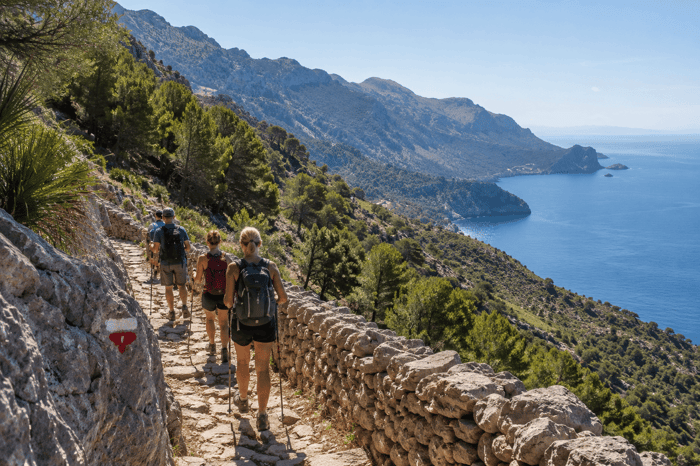
The trail takes its name from the dry-stone walls, terraces and huts that line much of the route — agricultural infrastructure built over centuries to make the steep Tramuntana slopes farmable, and now recognised by UNESCO as part of the cultural landscape that earned the range its World Heritage status in 2011.
Thinking about buying or selling in Mallorca?
The Route, Village by Village
Starting from Port d'Andratx, the trail climbs gently through wooded hills toward Sant Elm before turning north into the mountains proper. From there it threads through Estellencs, Banyalbufar, Esporles and Valldemossa — the villages most associated with the range's literary and artistic history — before reaching Deià and dropping to Port de Sóller. The northern stages continue through the Sóller valley toward the Tossals Verds refuge, the Santuari de Lluc, and finally down to Pollença and the coast.
Each stage links one mountain refuge to the next, and the refuges — Coma d'en Vidal, Muleta, Tossals Verds, Son Amer and others — are bookable in advance through the Consell de Mallorca, with dormitory-style rooms, meals and hot showers. This isn't wild camping; it's a structured, supported long-distance trail with infrastructure built specifically for it.
What to Expect on the Ground
The GR221 is considered a demanding trail, not a casual stroll. Stages run long — the section from Tossals Verds climbing toward Puig d'Ofre is one of the longest at around 28km — and much of the route crosses genuinely alpine terrain far from any road. Good boots, layered clothing and enough water for stretches without a reliable spring are non-negotiable, and the loose, rocky ground on some descents (notably around Muleta) has caught out hikers expecting an easier path.
What it rewards in return is a version of Mallorca that's very hard to see any other way: valleys and ridgelines with no roads in sight, terraced hillsides that have been worked the same way for centuries, and mountain villages that function as waypoints rather than tourist stops.
Living Near the Trailhead
For residents of the southwest, Port d'Andratx isn't just the trail's starting point — it's a reminder of how close genuinely wild walking country sits to some of the island's most established coastal addresses. Property in and around Andratx and the southern Tramuntana foothills increasingly appeals to buyers who want exactly that combination: a five-minute drive to the marina, and a mountain range that starts almost at the back gate.
If living within reach of the Tramuntana interests you, browse current listings in Port d'Andratx and Andratx, or get in touch to talk through what's available closer to the trail.