Table of Contents
- Why Mallorca Is Europe's Number One Destination for Luxury Villa Buyers in 2026
- Best Areas to Buy a Luxury Villa in Mallorca
- Types of Luxury Villas for Sale in Mallorca
- Luxury Villa Price Ranges in Mallorca: A 2026 Breakdown
- How to Buy a Luxury Villa in Mallorca as a Foreign Buyer: Step-by-Step
- Costs & Taxes When Buying a Luxury Villa in Mallorca
- Mortgages for Non-Residents: What You Need to Know
- Maximising Your Investment: Touristic Rental Licences & Rental Yield in Mallorca
- How to Choose the Right Luxury Villa Estate Agent in Mallorca
- Start Your Luxury Villa Search in Mallorca Today
Luxury Villas for Sale in Mallorca: 2026 Buyer's Guide
Buying a luxury villa in Mallorca involves more moving parts than most buyers expect going in — area, property type, budget tier, financing, tax, and licensing all interact with each other. This guide walks through each of those pieces in order, so you can work out where you sit before you start viewing properties.
Why Mallorca Is Europe's Number One Destination for Luxury Villa Buyers in 2026
Mallorca offers something few Mediterranean destinations combine at once: a direct flight time of two to three hours from most major European cities, over 300 days of sunshine a year, and a level of infrastructure — private healthcare, international schools, marinas, golf courses — built up over decades of serving both residents and visitors. That combination is why the island has held its position as a first-choice second-home and relocation market rather than a passing trend.
Buyer demand has stayed resilient even as prices have risen. Notarial transaction data for the island consistently shows steady, if less dramatic, annual price growth in recent years compared to the sharper jumps seen earlier in the decade — a market that is maturing rather than overheating.
Thinking about buying or selling in Mallorca?
Mallorca Property Market Trends: What's Driving Demand in 2026?
Limited buildable land, especially along the southwest coast, keeps new supply well below demand. Remote and hybrid work has extended the buyer pool beyond retirees to working professionals who can base themselves on the island for large parts of the year. International buyers continue to account for the majority of transactions in the island's most established coastal postcodes, with German and British buyers the two largest groups by a clear margin.
Why International Buyers Choose Mallorca Over Other Mediterranean Destinations
Compared with Ibiza, the island offers a broader range of family-oriented infrastructure — schools, year-round healthcare, established residential communities — alongside a similarly high-end lifestyle offering, without leaning as heavily on a single nightlife-driven season. Compared with the Costa del Sol, Mallorca's geography compresses beach, mountain and old-town living into a much smaller radius. Compared with the French Riviera, entry prices for an equivalent villa remain considerably lower, even at the ultra-prime end of the market.
Best Areas to Buy a Luxury Villa in Mallorca
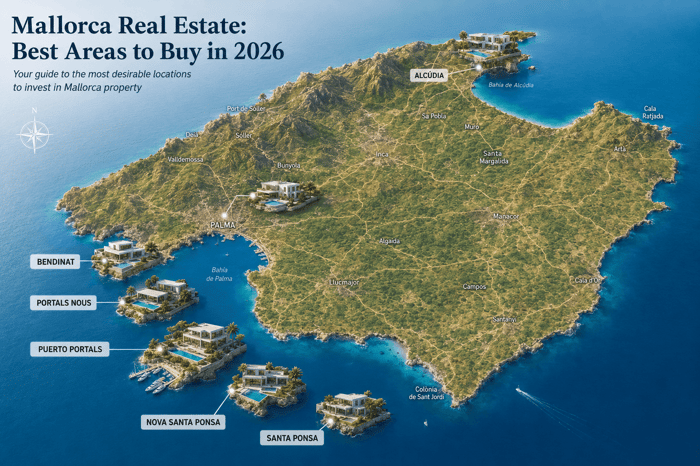
Mallorca's luxury villa market isn't one market — it's several, each with a distinct character, price level and buyer profile. The right area depends less on budget alone than on the kind of life you want around the villa: marina and nightlife, family and golf, historic old-town, or quiet natural surroundings.
South West Mallorca: Port Andratx, Andratx & Costa d'en Blanes
This corner of the island holds some of Mallorca's most prestigious addresses. Port d'Andratx combines a working marina with a steep, pine-covered hillside of villas that command sweeping bay views; Andratx town itself offers a quieter, more traditional base a short drive inland; Costa d'en Blanes sits closer to Palma with a mix of frontline and elevated villas. Prices across this stretch typically start in the premium segment and extend well into the ultra-luxury range for frontline and view properties. Browse villas in Port d'Andratx, Andratx and Costa d'en Blanes.
Santa Ponsa, Bendinat & Portals Nous
This is the southwest's most established family-luxury corridor. Santa Ponsa combines beach access with international schools and a large expatriate community; Bendinat sits between two golf courses with some of the island's most consistent capital appreciation; Portals Nous adds direct proximity to Puerto Portals marina, with its restaurants, boutiques and superyacht berths on the doorstep. Browse villas in Santa Ponsa, Bendinat and Portals Nous.
Palma de Mallorca & Illetas
Palma itself offers a different kind of luxury villa living: historic townhouses and hillside properties within minutes of the old town's restaurants, galleries and cathedral, alongside penthouse options overlooking the bay. Illetas, just west of the city, adds a run of pine-shaded, largely frontline villas with private access to some of the calmest water on the island. This area also takes in Son Vida, Palma's principal golf-villa enclave, set in the hills immediately above the city. Browse villas in Palma and Illetas.
North Mallorca: Puerto Pollensa, Alcudia & Pollensa Town
The north of the island trades the southwest's density for a quieter, more natural setting. Puerto Pollensa's long bay and low-rise skyline have long attracted buyers who want beach living without the built-up feel of the southwest coast; Alcúdia pairs a walled medieval old town with an extensive bay and nearby nature reserve; Pollensa town itself, set slightly inland at the foot of the Tramuntana mountains, is known for restored fincas and a strong year-round community rather than a purely seasonal one. Browse villas in Puerto Pollensa, Alcúdia and Pollensa town.
Golf Areas: Calvia, Nova Santa Ponsa & Son Vida
Golf-adjacent living forms its own distinct segment of the luxury market. Calvià and Nova Santa Ponsa sit around the southwest's cluster of championship courses, with villas built specifically around fairway and green-side plots. Son Vida, covered above alongside Palma, adds the island's oldest and most established golf-villa community, close to the city rather than the coast. Browse golf-area villas in Calvià and Nova Santa Ponsa.
Types of Luxury Villas for Sale in Mallorca
Beyond location, luxury villas in Mallorca split into a handful of recognisable categories, each suited to a different way of using the property.
Villas for Sale in Mallorca with Private Pools
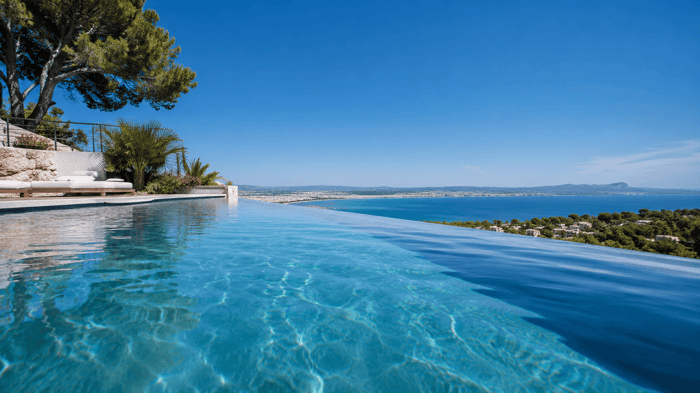
A private pool is close to a baseline expectation at the upper end of the Mallorca market rather than an upgrade. Infinity-edge pools that appear to merge with the sea or the surrounding landscape command a particular premium, and well-specified pool areas — heating, covered terracing, outdoor kitchens — meaningfully affect both rental appeal and resale value.
Beachfront & Frontline Luxury Villas in Mallorca
True frontline villas — with direct, uninterrupted access to the sea and no public road or path between the property and the water — are genuinely scarce, concentrated in pockets of Illetas, Port d'Andratx, Costa d'en Blanes and a handful of other stretches. Because so little frontline land remains available, these properties trade at a significant premium over otherwise comparable villas set back from the coast.
Sea View Villas for Sale in Mallorca
Elevation matters as much as proximity to the coast when it comes to views. Villas set into hillsides above Port d'Andratx, Bendinat or Puerto Pollensa often command sea-view premiums comparable to frontline properties, at a fraction of the price, precisely because the elevation delivers the view without requiring direct beach access.
Modern New Build Villas vs. Traditional Mallorcan Fincas
New-build villas typically offer lower ongoing maintenance, modern energy efficiency, and a fully customisable specification, at the cost of the character and mature gardens that come with an established property. Traditional fincas — often converted farmhouses set on larger rural plots — offer that character and privacy, generally require more ongoing upkeep, and sit predominantly inland rather than on the coast.
Golf Villas for Sale in Mallorca
Golf villas cluster around the island's established courses in Santa Ponsa, Bendinat, Son Vida and the Calvià–Nova Santa Ponsa corridor. Beyond the obvious lifestyle appeal, fairway and green-side plots tend to hold rental demand well outside peak summer, since golf tourism runs a longer season than beach tourism on the island.
Luxury Villa Price Ranges in Mallorca: A 2026 Breakdown
Luxury villa pricing on the island spans a wide range, and what counts as "luxury" varies considerably between the entry point and the very top of the market. The three tiers below give a working sense of what to expect at each level.
Entry-Level Luxury: €1M–€3M Villas
At this level, buyers typically find well-specified modern villas or renovated fincas in strong but not ultra-prime locations — set back from the coast, or in up-and-coming pockets of the established areas — with private pools and good but not necessarily uninterrupted views. Browse villas from €1M to €3M.
Premium Segment: €3M–€7M Villas
This bracket is where most of the southwest's established prime addresses sit: elevated sea-view villas in Bendinat or Port d'Andratx, well-located properties in Santa Ponsa or Portals Nous, and larger new-builds with fuller specifications. Browse villas from €3M to €7M.
Ultra-Luxury: €7M+ Villas & Estates
Above €7M, the market shifts toward frontline and beachfront villas, large estates with substantial land, and architecturally significant properties, generally bought by ultra-high-net-worth individuals for whom Mallorca is one of several international residences. Browse villas above €7M.
How to Buy a Luxury Villa in Mallorca as a Foreign Buyer: Step-by-Step
Non-residents can buy property in Spain freely, with no restrictions tied to nationality. The process follows a fairly consistent sequence, and with the right local support in place, most purchases complete within a few months of an accepted offer.
Step 1: Obtain Your NIE Number
The NIE (Número de Identificación de Extranjero) is a tax identification number required for any property purchase, utility contract or bank account in Spain. Non-residents can apply at a Spanish consulate in their home country or in person at a designated police station or foreigners' office in Spain; either route typically takes a few weeks, so it is worth starting this early in the process.
Step 2: Open a Spanish Bank Account
A Spanish account simplifies paying the deposit, completion funds, notary fees and ongoing costs such as utilities and community fees. Most major Spanish banks, along with several international banks with a Spanish presence, offer non-resident accounts; the NIE, passport and proof of address abroad are the standard documents required to open one.
Step 3: Engage a Local Lawyer (Abogado)
Independent legal representation — separate from the seller's lawyer or notary — is standard practice for a Mallorca property purchase. A local abogado checks the property's legal status at the Land Registry, confirms there are no outstanding debts or charges, reviews the contract, and can act under power of attorney if a buyer cannot be on the island for every stage of the process.
Step 4: Make an Offer & Sign the Reservation Contract
Once an offer is accepted, a reservation contract (contrato de reserva) is typically signed alongside a holding deposit, taking the property off the market while due diligence is completed. This is usually followed, once checks are satisfactory, by a private purchase contract (contrato de arras) with a larger deposit — commonly around 10% of the price — which legally commits both parties, with financial penalties if either side withdraws without cause.
Step 5: Due Diligence, Mortgage & Notary Completion
Due diligence covers the property's registry status, any urban planning irregularities, outstanding community or utility debts, and confirmation of a valid habitation certificate. If a mortgage is involved, the bank's valuation and formal approval typically run in parallel with this stage. Completion (the escritura pública) takes place in front of a notary, where the balance of funds is paid, keys are handed over, and the notary registers the sale.
Costs & Taxes When Buying a Luxury Villa in Mallorca
Beyond the purchase price, buyers should budget for a further 10–13% in taxes and fees, varying mainly by whether the property is new-build or resale.
Transfer Tax (ITP) & VAT on New Builds
Resale properties in the Balearic Islands are subject to Impuesto de Transmisiones Patrimoniales (ITP), applied on a progressive scale: 8% up to €400,000, 9% from €400,000 to €600,000, 10% from €600,000 to €1,000,000, 12% from €1,000,000 to €2,000,000, and 13% above €2,000,000, calculated bracket by bracket rather than as a single flat rate on the full price. New-build properties, bought directly from a developer, are instead subject to 10% VAT (IVA) plus 1.5% Actos Jurídicos Documentados (AJD) stamp duty, and are exempt from ITP.
Notary, Registry & Legal Fees
Notary and Land Registry fees are set on official scales and typically run to roughly 1–1.5% of the purchase price combined, reducing as a percentage on higher-value properties. Independent legal fees for the buyer's lawyer generally add a further 1–1.5%, agreed directly with the lawyer rather than set by a fixed scale.
Ongoing Ownership Costs: IBI, Wealth Tax & Community Fees
IBI (Impuesto sobre Bienes Inmuebles) is the annual municipal property tax, paid to the local town hall and based on the property's cadastral value. Spain's wealth tax applies to non-residents on Spanish-situated assets only, with a state-level exemption of €700,000; EU and EEA nationals can elect to apply Balearic regional rules instead, which set a considerably higher regional exemption of €3,000,000 — a distinction worth discussing with a tax adviser, since it can materially change the outcome for larger portfolios. Villas within a shared urbanisation or gated community also carry annual community fees, covering shared gardens, security and communal facilities.
Mortgages for Non-Residents: What You Need to Know
Spanish banks lend actively to non-resident buyers, though on less generous terms than for residents. Typical financing for non-residents runs to 60–70% loan-to-value, against up to 80% for Spanish tax residents, sometimes falling to around 50% for more complex income profiles or unusual properties. Terms are generally capped at 20–25 years for non-residents, against up to 30 years for residents, and most lenders expect the loan to be repaid before the borrower turns 70–75. Buyers should budget for a deposit of 30–40% of the purchase price on top of the taxes and fees above, and expect the full process, from application to signing at the notary, to take from a few weeks up to two to three months depending on how quickly documentation and translations are provided.
Maximising Your Investment: Touristic Rental Licences & Rental Yield in Mallorca
A villa in one of Mallorca's established areas can generate meaningful rental income outside the weeks the owner uses it personally, but only if the property is let entirely within the law — short-term touristic rentals without a valid licence carry serious fines.
What Is a Touristic Rental Licence in Mallorca?
Short-term lets of under 30 days require an ETV licence (Estancia Turística en Vivienda). Since 2022, the Balearic government has maintained a moratorium on issuing new ETV licences across the islands, which remains in effect in 2026. In practice, this means the only route into legal short-term letting today is buying a property that already holds a valid, transferable licence, rather than applying for a new one. We've covered the licence system itself, including the different licence types and how transfers work, in a dedicated guide: read our full ETV licence guide.
Rental Income Potential from Mallorca Luxury Villas
Peak-season weekly rates for a well-specified licensed villa in an established southwest location generally sit well above equivalent properties without sea views or pool areas, with July and August commanding the strongest rates of the year. Occupancy and achievable rates outside the core summer months depend heavily on proximity to golf courses, marinas and year-round amenities, which is part of why golf-area and marina-adjacent villas tend to hold rental income better across the shoulder seasons than purely beach-driven locations.
How to Choose the Right Luxury Villa Estate Agent in Mallorca
The right agent matters more in a market like Mallorca's than in most, given the mix of language, legal process and local nuance a foreign buyer has to navigate.
What to Look for in a Licensed Mallorca Estate Agent
Check that any agency you work with is a member of a recognised professional body — API (Agente de la Propiedad Inmobiliaria) and ABINI (Asociación Balear de Agentes Inmobiliarios) are the main ones on the island — rather than operating without formal registration. Beyond credentials, look for genuine multilingual support, transparency about a property's legal status and licence position from the first conversation, and a track record specific to the area you're interested in rather than the island as a whole.
Why a Boutique, Family-Owned Agency Can Outperform Corporate Rivals
A smaller, established local agency typically knows individual streets, buildings and even specific villas in a way a larger, more corporate operation covering the whole island cannot easily replicate. That local depth tends to translate into more accurate guidance on pricing, faster answers on planning or licensing questions specific to a particular municipality, and a more personal, less transactional buying experience overall.
Start Your Luxury Villa Search in Mallorca Today
Imperial Properties has been part of the Mallorca market since 1985, based in Santa Ponsa and specialising in the southwest coast alongside island-wide coverage. Whether you're just starting to explore the market or ready to view specific properties, browse our current listings or get in touch on +34 971 692 434 or WhatsApp — we're happy to talk through what fits your budget and the kind of life you want around the villa.