Table of Contents
How to Read a Spanish Escritura: What the Title Deed Actually Tells You About a Property
When you buy a property in Spain, the escritura de compraventa is the document that transfers ownership from seller to buyer. It is signed before a notary, registered in the Land Registry, and becomes the foundational legal record of your ownership. Most buyers receive a copy, file it away, and never look at it again.
That is a missed opportunity. The escritura contains a significant amount of information about the property you have bought — and reading it properly, or having it explained by your lawyer before you sign, can reveal things that the sales process does not always make clear. For buyers doing due diligence before an offer, understanding how to read the nota simple — the Land Registry extract that precedes the escritura — is equally important.
This guide explains what the main documents contain, what to look for, and what the red flags are.
Thinking about buying or selling in Mallorca?
The Nota Simple: Your First Read
Before you buy, the most important document to obtain is the nota simple informativa — a short extract issued by the Registro de la Propiedad (Land Registry). In Spain, anyone can request a nota simple for any registered property. Your lawyer will obtain this as part of standard due diligence, but you can also request one directly from the Land Registry using the property's registry reference number.
The nota simple contains four key sections. The first identifies the property — its registry number, address, description (apartment, villa, plot) and cadastral reference. The second section records the ownership (titularidad) — who currently owns the property and how they acquired it (purchase, inheritance, donation). The third records charges and encumbrances (cargas) — any mortgages, liens, easements or other rights that affect the property. The fourth records any annotations (anotaciones) that may limit the ability to sell or transfer the property.
The cargas section is the most important for a buyer. A mortgage registered against the property must be cancelled at or before completion — typically from the proceeds of the sale. An easement (servidumbre) may be permanent and must be understood before purchase. A right of first refusal (derecho de tanteo) held by a third party could give them the right to match your offer. Your lawyer should explain every entry in this section before you proceed.
The Surface Area Problem
One of the most common sources of confusion in Spanish property transactions is the discrepancy between the surface area recorded in the escritura and the actual measured area of the property. In Spain, properties can be registered in three different ways: the area including structural walls (superficie construida), the usable internal area (superficie útil), and the area including a proportional share of common areas in apartment blocks (superficie construida con elementos comunes).
The area recorded in the Land Registry escritura may differ from the area shown in the catastro (the fiscal property register), which may differ again from the actual measured floor area. It may also differ from what the developer or seller has marketed as the property's size. None of these differences are necessarily fraudulent — they reflect different measurement methodologies — but buyers should establish which measurement is being used and verify it against a professional floor plan before exchanging.
If the registered area is significantly smaller than the marketed area, this can affect the property's assessed value for IBI (local property tax) and in some cases the ITP (transfer tax) assessment. Your lawyer should flag any material discrepancy.
Reading the Escritura de Compraventa
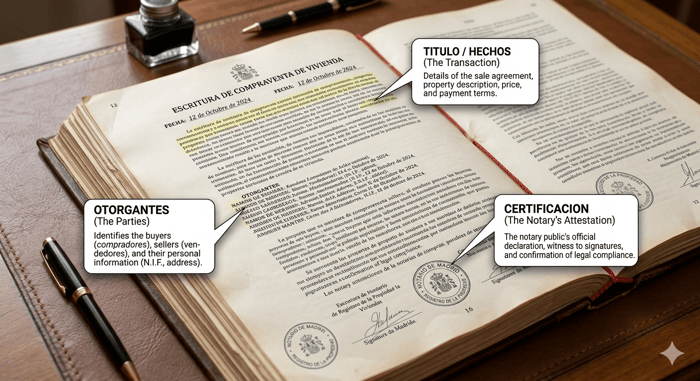
The escritura de compraventa is a longer and more formal document than the nota simple. It is drafted by the notary, reviewed and signed by both parties at completion, and contains the following main sections.
Identification of the parties. The full legal names, passport or DNI/NIE numbers, and addresses of buyer and seller. If either party is a company rather than an individual, the company's details and the representative's authority to sign must be stated. Non-residents should confirm their NIE number appears correctly, as errors here can cause complications at the Land Registry.
Description of the property. The property's registered description — address, registry reference, cadastral reference, surface area, boundaries. Check that this matches the nota simple and that the cadastral reference matches the catastro record. Any discrepancy should be raised with the notary before signing.
Charges and encumbrances. The escritura will state whether the property is being transferred free of charges (libre de cargas) or whether any registered mortgage or charge is being cancelled simultaneously. If a seller's mortgage is being cancelled from the sale proceeds, this should be clearly stated and the cancellation process (subrogación or cancelación) confirmed with your lawyer.
The price and payment method. The declared purchase price and how it is being paid — typically by bank transfer or banker's draft at the notary table. In Spain, the declared price in the escritura must reflect the actual price paid. Under-declaring the price (declaring a lower figure than actually paid) is illegal, carries significant penalties and creates problems when you come to sell. Do not agree to any arrangement that involves an element of the price paid in cash outside the escritura.
Tax declarations. The escritura will contain declarations relating to ITP (if a resale) or IVA and AJD (if a new build), plus plusvalía responsibilities. These should be reviewed with your lawyer before signing.
Community of owners and IBI. A declaration that the seller has no outstanding community fees and that the IBI (local property tax) is paid up to date. Request the certificates to support these declarations rather than accepting them on trust.
After Signing: Registration
Signing the escritura before the notary does not complete the transfer of ownership for all legal purposes. The escritura must be registered in the Registro de la Propiedad (Land Registry). Until registration is complete, the transfer has occurred legally between the parties but the buyer's ownership is not fully protected against third-party claims.
The notary sends the escritura electronically to the Land Registry immediately after signing. The registration process typically takes between one and four weeks. Your lawyer should confirm when registration is complete and obtain a copy of the registered escritura showing the new owner's details. This registered copy is the document to keep.
The Catastro: Making Sure the Records Match
The Land Registry (Registro de la Propiedad) and the catastro are two separate systems in Spain with different purposes. The Land Registry records legal ownership and charges; the catastro records physical and fiscal data for tax purposes. A fully sound property transaction requires alignment between both.
After completion, your lawyer should ensure the catastro record is updated to reflect the new ownership. This is important for IBI billing, for any future planning applications, and for any subsequent sale. Misalignments between the two systems are common in older properties and can take time to resolve — it is better to deal with them immediately after purchase than when you come to sell.
Getting It Right from the Start
The escritura and nota simple are the foundation of your Spanish property ownership. Reading them properly — or having them read properly on your behalf — protects you before, during and after the purchase. The cost of good legal advice at this stage is small relative to the value of the transaction and the peace of mind it provides.
Imperial Properties has been helping buyers through the purchasing process in Santa Ponsa and across the Calvià municipality since 1985. If you are at the due diligence stage on a property you are considering, the team can recommend trusted local lawyers who specialise in the southwest Mallorca market. Contact us on +34 971 692 434, via WhatsApp at wa.me/34971692434, or browse current listings at imperial-properties.com.