Table of Contents
Buying Property Jointly in Mallorca: How Ownership Shares Actually Work
More couples, friends and family members are buying together in Mallorca than the property statistics tend to suggest, and Spanish law treats a joint purchase quite differently from what many international buyers assume, particularly anyone used to how joint ownership works in the UK. Understanding the default rules before you sign the escritura, rather than after, is what protects everyone involved if circumstances change later.
We've covered gananciales, the marital property regime that applies to many married couples, in a separate post. This one focuses on the more general picture, since it applies just as much to unmarried partners, friends and family buying together.
The Default: Pro Indiviso Ownership
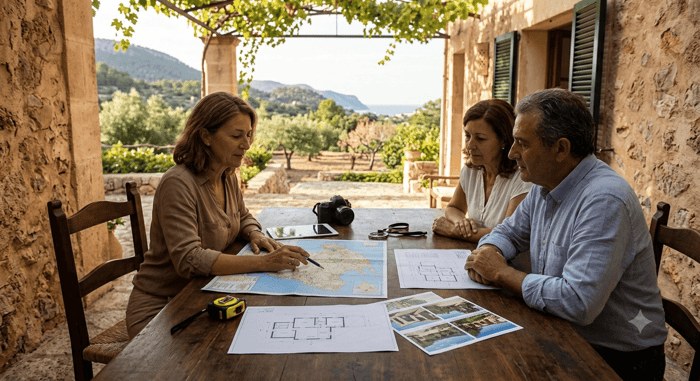
When two or more people buy a property together in Spain, the standard structure is pro indiviso, broadly equivalent to tenancy in common in English law. Each owner holds a defined percentage share of the whole property rather than a specific physical part of it, and there's no requirement for the shares to be equal. A 50/50 split is common, but 60/40, 70/30 or any other division is equally valid, and the percentages are stated explicitly in the Escritura Pública.
Thinking about buying or selling in Mallorca?
Why Your Ownership Share Should Match What You Actually Paid
The percentages recorded on the deed should genuinely reflect each buyer's financial contribution to the purchase. If one buyer pays 70 percent of the price but the deed records a 50/50 split, the Spanish tax authorities can treat the difference as a gift from one buyer to the other, potentially triggering gift tax. This is one of the more common oversights among international buyers who default to an equal split simply because it feels fair, without realising it can create an unintended tax exposure.
Why There's No Automatic Right of Survivorship
This is the single biggest difference from UK joint ownership that catches buyers off guard. Spain does not recognise joint tenancy with automatic right of survivorship. Under pro indiviso, if one co-owner dies, their share doesn't pass automatically to the surviving co-owner. It forms part of the deceased's estate and passes according to their will, or, if there's no will, under Spanish or their home country's intestacy rules, depending on their circumstances. For unmarried partners in particular, this means you could end up co-owning your home with your late partner's children, parents or siblings rather than inheriting their share outright. A Spanish will that addresses this directly, potentially granting a surviving partner a usufructo, the right to live in and use the property for their lifetime, is worth discussing with a lawyer before you buy, not after something happens.
What Happens If One Owner Wants to Sell
Any co-owner in a pro indiviso arrangement can, at any time, bring what's known as an acción de división, a legal action asking the courts to divide the jointly owned property. For an indivisible asset like a house or apartment, this typically results in a court-ordered sale, often at auction, with the proceeds split according to each owner's registered percentage. This route is slow, costly and rarely gives anyone their preferred outcome, which is precisely why a well-drafted private co-ownership agreement between the buyers, alongside the deed itself, is worth having in place from the outset, setting out how a future sale, buyout or disagreement over the property's use would actually be handled.
Dissolving Joint Ownership Later
If co-owners later want to formally separate their interests, whether following a relationship breakdown or simply a change of plans, Spanish law provides a specific mechanism called extinción de condominio, where one owner buys out the others and takes sole ownership. Handled this way, the transaction is taxed at a considerably lower rate than a standard property transfer, since it's treated as a dissolution of joint ownership rather than a new sale. This makes it a far more tax-efficient route than the departing owner formally selling their share to the remaining owner through a conventional purchase.
Getting the Structure Right From Day One
A joint purchase in Mallorca works well for a great many buyers, but it works best when the ownership shares reflect real contributions, when everyone understands there's no automatic inheritance right between co-owners, and when a private agreement sits alongside the deed to cover what happens if circumstances change. None of this is complicated to arrange before you sign, and all of it is considerably harder to sort out after the fact.