Table of Contents
How Real Estate Agent Fees Work When Selling in Mallorca: Who Pays What
Sellers often assume estate agent fees work the same way everywhere, and buyers often assume they're the ones who'll be charged. Neither assumption reliably holds in Spain. There's no national law setting agent commission or dictating who pays it, which means the arrangement is a matter of market custom and, ultimately, whatever you agree with your agent in writing before you sign anything.
Understanding how this actually works avoids an unpleasant surprise for either side at the notary.
Who Pays the Commission
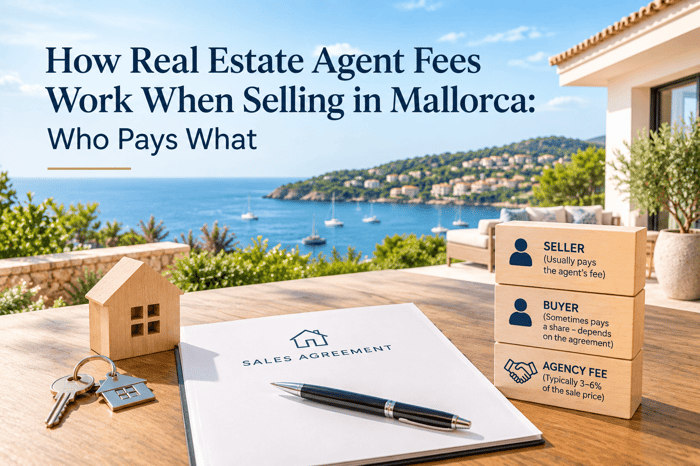
By long-standing market custom rather than legal requirement, the seller pays the estate agent's commission in the great majority of residential sales in Spain, Mallorca included. Buyers typically pay their own purchase taxes and legal costs but not the selling agent's fee. There are exceptions: some agencies also charge a separate fee to the buyer, particularly where the buyer has engaged a search agent under their own mandate to find and negotiate a property on their behalf, rather than working with the seller's listing agent. If a buyer's agent is involved, it's worth clarifying upfront which side, or both, is expected to pay them.
Thinking about buying or selling in Mallorca?
How Much Agents Typically Charge
Commission isn't set by any regulatory body in Spain, so it's genuinely negotiated between seller and agent rather than fixed by law. Across the market, fees commonly fall somewhere between 3 and 6 percent of the final sale price, plus 21 percent IVA on top of the fee itself. Where more than one agency is involved in bringing a buyer to the table, an inter-agency arrangement typically splits this commission between the listing agent and the introducing agent, which doesn't change what the seller pays overall.
What the Fee Actually Covers
A commission isn't simply a fee for finding a buyer. It typically covers listing and marketing the property, organising and conducting viewings, vetting and negotiating with potential buyers, and handling much of the paperwork through to completion. Some agencies also assist with practical after-sale steps, such as helping transfer utility accounts and community registration into the new owner's name. It's worth asking exactly what's included before signing a listing agreement, since the scope of service varies more between agencies than the headline percentage does.
When Commission Is Actually Paid
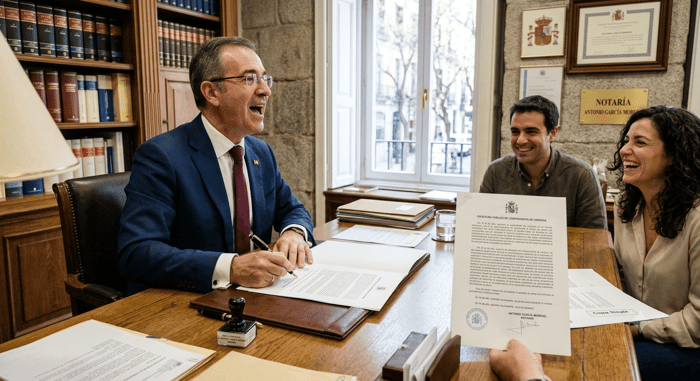
Standard practice in Spain is for the commission to be paid at the signing of the Escritura Pública before the notary, once the buyer has delivered the full price and the sale is legally complete. This is generally the safest point for both sides: the seller has certainty the sale has gone through, and the agent is paid from cleared funds rather than a deposit that could still fall through. Some agencies ask for a portion of their fee earlier, at the signing of the arras, which isn't unusual but is worth negotiating down or securing with a refund clause if the sale doesn't proceed for reasons outside the seller's control.
Exclusive Listings and Multi-Agency Arrangements
Sellers can list with a single agency on an exclusive basis or with several agencies simultaneously. An exclusive arrangement often comes with a more committed marketing effort from the agency, since they aren't competing with other agents for the same commission, while a multi-agency listing casts a wider net at the cost of a less coordinated sales effort. Whichever route you choose, get the commission percentage, what it covers, and the payment terms confirmed in writing before the property goes to market, not after an offer arrives.
The Practical Takeaway
There's no fixed rulebook governing agent fees in Spain, which means the details are genuinely yours to negotiate. Confirming who pays, how much, what's included, and when it's due, in writing and before you list, is the clearest way to avoid a conversation you'd rather not be having at the notary's table.