Table of Contents
- The Tramuntana — What It Is and Why It Matters
- Sa Calobra — The One Everyone Knows About
- The Professional Connection — Who Actually Trains Here
- The Classic Routes for Residents
- The Cycling Infrastructure — What the Island Actually Provides
- When to Ride — The Mallorca Cycling Calendar
- What It Actually Means to Live Here
- FAQs
Cycling in Mallorca: The Tramuntana, the Grand Tour Stars and Why This Island Is Europe's Best Place to Ride
Every February and March, before the professional cycling season begins in earnest, roughly a third of the world's best cyclists are in Mallorca. They are here for the same reason that tens of thousands of amateur cyclists arrive every spring and autumn: the roads are empty, the weather is good, the climbs are serious enough to hurt and beautiful enough to make you forget that they are hurting you, and there is nowhere else in Europe where you can combine all of these things with a good hotel, a coffee worth drinking and a flight home that takes two hours. Mallorca has been Europe's premier cycling destination for long enough that the island's cycling infrastructure — the hotels built specifically for cyclists, the bike shops stocking every conceivable component, the cafes with proper cycle parking and staff who know what a chain drop is — has evolved to match the demand in a way that still surprises people arriving for the first time.
For residents of the island, the situation is even better. The professional peloton descends for a few weeks each winter and leaves. The roads, the climbs, the routes — they stay. Living in Mallorca with a bike is one of those situations where the gap between what most people think is possible on a Tuesday morning and what you can actually do is genuinely large.
The Tramuntana — What It Is and Why It Matters
The Serra de Tramuntana is the mountain range that runs along the northwest coast of Mallorca for roughly 90 kilometres, from Andratx in the southwest to Cap Formentor in the north. It is a UNESCO World Heritage site, designated in 2011 for both its natural landscape and its cultural significance as a shaped agricultural environment going back 1,000 years. From a cycling perspective, what matters is that the Tramuntana presents a sustained series of serious road climbs on high-quality tarmac, in a landscape of limestone peaks, olive terraces and sea views that is consistently spectacular across the entire route, with the Mediterranean appearing through the passes and descents in a way that makes even a very hard day in the mountains feel worthwhile.
The roads through the Tramuntana were not built for cycling — they were built for olive oil carts, and later for the occasional motor car, and they show it. The gradients are honest (Sa Calobra averages 7 percent over 9.5 kilometres; Coll de Sa Batalla reaches gradients of 12 to 14 percent; the Coll de Sóller is deceptive in its consistent 5 to 6 percent grind from the Palma side). The road surfaces on the main routes are good. Traffic in February and March is essentially absent. In June the roads are busier, but the Tramuntana is still, by the standards of any comparable mountain road in France, Italy or Spain, mercifully quiet.
Sa Calobra — The One Everyone Knows About
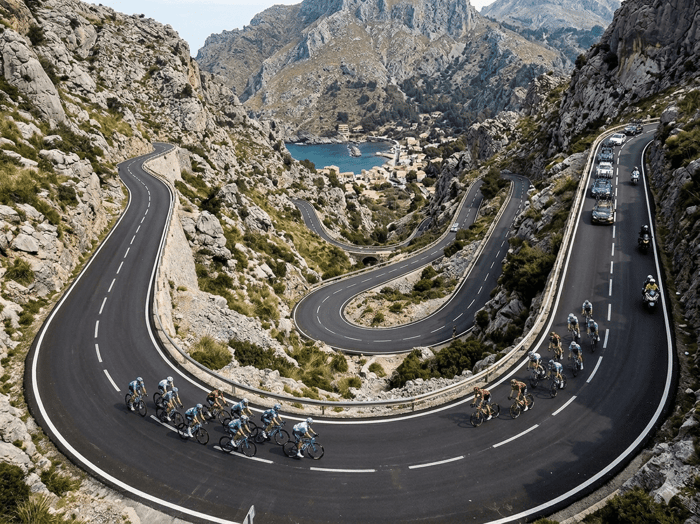
Sa Calobra is the climb that appears in every conversation about Mallorcan cycling, and it deserves its reputation, though not quite for the reasons usually cited. The climb is 9.5 kilometres at an average gradient of 7 percent, with the road descending from the Coll dels Reis pass at 682 metres to the small port of Sa Calobra at sea level. The road was designed by the Mallorcan engineer Antoni Parietti in the 1930s and is one of the more audacious pieces of road engineering in Europe — it includes a 270-degree corkscrew turn that passes under itself, a feature that has no practical necessity whatsoever and exists purely because Parietti wanted to build something extraordinary. Which he did.
The climb, going upward from the port, is harder than the statistics suggest because it is relentless — there is no flat section to recover on, no hairpin so tight that you can sit up and breathe. The views from the higher sections, looking south along the Tramuntana ridge and out over the northwest coast toward the open sea, are what the climb is actually about. Dozens of professional cyclists have described the descent as one of the finest in the world, and it is. Pogacar, who has used Mallorca for winter training, has been photographed descending Sa Calobra in conditions that suggest he finds the whole thing considerably more relaxing than the rest of us do.
The Professional Connection — Who Actually Trains Here
The list of professional cyclists who use Mallorca for pre-season training reads like a who's who of Grand Tour winners, and it has done for more than two decades. Chris Froome — four-time Tour de France winner — trained extensively on the Tramuntana roads during his years at Team Sky and has spoken publicly about the island's roads as among the best training terrain in the world. Tadej Pogacar, the current dominant force in professional road racing, trains in Mallorca before the spring classics and has been a regular presence on the Sa Calobra road in February and March. Mark Cavendish, the most prolific stage winner in Tour de France history, spent significant portions of his career's final chapter training on Mallorca's flatter coastal roads, using the island's generous weather to stay on the bike when the rest of northern Europe was frozen.
Beyond the individual names, the majority of WorldTour teams — the highest division of professional cycling — use Mallorca for at least one training camp each year, typically in January or February. UAE Team Emirates, Visma-Lease a Bike, Ineos Grenadiers, Lidl-Trek and Jumbo have all been present in recent seasons. The effect of this professional presence on the island's cycling infrastructure has been straightforwardly positive — when 20 WorldTour riders descend on a small island hotel for two weeks and need mechanics, physiotherapists, specific nutrition and a fleet of training bikes serviced daily, the service providers who emerge to meet that demand end up being very good at their jobs.
The Classic Routes for Residents
For residents of the southwest — Santa Ponsa, Portals Nous, Palmanova and the surrounding communities — the cycling that is directly accessible from home covers a wider range than most people realise. The flat coastal roads through Peguera and Camp de Mar to Andratx are a natural warm-up and recovery loop, manageable on any fitness level and genuinely pleasant on a calm morning. From Andratx the road climbs into the Tramuntana proper, and the next 40 kilometres toward Sóller — through Estellencs, Banyalbufar and Valldemossa — is one of the most consistently beautiful road cycling routes in the Mediterranean. The Coll de Sa Batalla above Banyalbufar gives views that, on a clear winter morning with snow occasionally visible on the highest Tramuntana peaks, are as good as this island produces.
The Sóller-Sa Calobra-Sóller loop is the standard Grand Tour training circuit — starting in Sóller, climbing over the Coll de Sóller from the Palma side, turning northeast toward Caimari, then descending to the coast and up to the Coll dels Reis before dropping to Sa Calobra, climbing back, and returning to Sóller. It is approximately 85 kilometres with 2,200 metres of climbing and takes most serious amateur cyclists between four and six hours. It is the kind of ride that would be a significant expedition in most parts of Europe and is a regular Tuesday for people who live here and ride regularly.
For riders based in the southwest who prefer not to drive to the Tramuntana start points, the Cap de Andritxol road and the climbs above Andratx offer a shorter but still demanding option that can be reached from Santa Ponsa in 45 minutes on the bike. The loop through Calvià village and over the small ridge toward Galilea — a climb of about 300 metres over 8 kilometres from Palmanova — is the standard local training climb for southwest residents and good enough to build fitness on through the winter months.
The Cycling Infrastructure — What the Island Actually Provides
The hotels and rental accommodation built specifically for cyclists in Mallorca — with secure bike storage, early breakfast service, drying rooms, group shuttle services to the climb start points and in-house mechanics — are concentrated mainly in Alcúdia, Port de Pollença and Sóller in the north, and around Palma and El Arenal in the south. For southwest residents, the practical infrastructure that matters is the quality and density of bike shops. Palma has several excellent independent bike shops stocking both mainstream and premium brands and carrying the component and workshop capacity to sort out most problems without ordering from the mainland. The road network itself is in good condition on the main cycling routes — the Tramuntana roads in particular are maintained to a standard that reflects the economic importance of cycling tourism to the island.
When to Ride — The Mallorca Cycling Calendar
February and March are the months when the island is at its most cyclist-friendly — cool enough for hard efforts, dry in most years, and with road traffic at its annual minimum. The professionals are here in volume, the hotels that cater for cyclists are full, and there is a particular atmosphere on the Tramuntana roads in these months that is unlike anything in the summer. October and November offer similar conditions and are increasingly popular with cyclists who prefer the autumn light and the slightly lower hotel prices to the February peak.
June is a perfectly good time to ride in Mallorca but requires different planning. The heat in the middle of the day on the exposed Tramuntana climbs can be serious — 32 degrees on the Sa Calobra road at noon in June is a different experience from 15 degrees at the same gradient in February, and not in a good way. The practical answer is what the professionals do year-round: ride in the early morning, be off the big climbs by 11am, and accept that the afternoons in summer are for the pool or the sea rather than the bike. The light on the Tramuntana roads at 7am in June, before anyone else is on them, is genuinely beautiful.
What It Actually Means to Live Here
The cycling case for living in Mallorca is easy to state but takes time to fully appreciate. Most people who move to the island with a bike expect to ride more than they did at home. Most of them do. What fewer of them anticipate is the extent to which the quality of the riding changes their relationship with it — the difference between training on roads you know are good and riding on roads that are genuinely among the best in Europe is not trivial. The Tramuntana is not a convenience. It is a serious mountain range, properly difficult, properly beautiful, properly rewarding in the way that things are rewarding when they require effort and then deliver something that justifies it.
For residents of the southwest, that mountain range is an hour from the front door. The professional peloton works it out every winter. The rest of us get to live here.
See all our properties for sale in Mallorca
Browse properties in Santa Ponsa and Nova Santa Ponsa