Table of Contents
- Land Classification — The Foundation of Everything
- Habitable vs Uninhabitable — Understanding the Classification That Determines Your Purchase Strategy
- What You Can and Cannot Build on Rustic Land in Mallorca
- The Military Certificate Requirement for Non-EU Buyers
- Water Rights — One of the Most Complex Elements of Rural Property Ownership in Mallorca
- Renovation Rules and the Licensed Architect Requirement
- Tourist Rental Licences on Rural Fincas
- Finca Prices in Mallorca in 2026 — What to Budget
- FAQs
Buyers Guide to Fincas and Country Properties in Mallorca: Everything You Need to Know Before You Buy
A buyers guide to fincas in Mallorca is one of the most requested but least well-written pieces of practical content in the entire Mallorcan property market — and the gap between what buyers think they know and what they actually need to understand before committing to a rural property purchase is consistently wider than in any other segment of the market. The Mallorcan finca — a rural farmhouse set within agricultural land, typically with olive, almond or citrus groves, stone walls and the particular silence of the island's interior — represents a property proposition that is genuinely different from anything available in the coastal and urban markets. The planning rules are different. The legal process carries additional requirements for certain buyers. The water rights are more complex. The renovation possibilities are more restricted. And the rewards — in terms of privacy, authenticity, landscape and the particular quality of a life lived at pace with the Mallorcan interior — are correspondingly richer. This guide covers every essential element: land classification, what you can and cannot build, the military certificate requirement for non-EU buyers, water rights, the difference between habitable and uninhabitable status, renovation rules and what rural properties in Mallorca actually cost to buy and restore.
Land Classification — The Foundation of Everything
The single most important thing to understand about any rural property in Mallorca is its land classification — and this is determined not by what the property looks like but by the planning status of the land it sits on. Spanish planning law divides land into two fundamental categories: suelo urbano (urban land) and suelo rustico (rustic or rural land). Within suelo rustico, Mallorca applies a further subdivision into different zones that carry different permitted uses and construction rights.
The classification of suelo rustico in Mallorca operates under the Balearic Islands' own planning legislation, principally the Plan Territorial Insular de Mallorca (PTI) and the municipal planning instruments (PGOU) of each municipality. Within suelo rustico, the key sub-categories that affect finca buyers are suelo rustico comun (general rural land, with the most permissive rural planning rules), suelo rustico protegido (protected rural land, carrying significant restrictions on construction and use), and the various environmental and landscape protection categories that restrict intervention to varying degrees. Before making any offer on a rural property, your Spanish lawyer should obtain the full planning classification from the municipal planning department and confirm exactly which category the land falls into — this takes a few days and costs very little but is the most important piece of due diligence in any rural purchase.
Habitable vs Uninhabitable — Understanding the Classification That Determines Your Purchase Strategy
In Mallorca's rural planning system, existing buildings on rustic land are classified as either habitable (with a valid first occupancy licence or habitation certificate) or uninhabitable (lacking this licence, typically because the building pre-dates the planning system or because it has never obtained the relevant certification). This distinction is crucial for buyers because it determines what can be done with the property after purchase.
A habitable finca — one with a valid cédula de habitabilidad or first occupancy licence — can be used immediately as a residence, rented legally as tourist accommodation (subject to obtaining an ETV licence) and renovated or extended within the limits permitted by planning law. An uninhabitable finca is a more complex proposition. The building cannot legally be used as a residence until it obtains the relevant licence, which requires demonstrating that the building meets current habitability standards. In practice, many buyers of uninhabitable fincas undertake a comprehensive renovation as part of the purchase plan, with the habitability licence obtained as part of the project completion.
The distinction between the two categories also affects mortgage availability — most Spanish banks will not advance a mortgage on an uninhabitable property, which means uninhabitable finca purchases are typically cash transactions or require the buyer to finance the renovation separately from the purchase price. Understanding this from the outset is essential to structuring a realistic purchase and renovation budget.
What You Can and Cannot Build on Rustic Land in Mallorca
The planning rules governing construction on rustic land in Mallorca are materially more restrictive than those that apply to urban plots, and buyers who approach a rural purchase with the assumption that they can build freely on their plot quickly discover otherwise. The following is a general guide to what is and is not permitted — specific rules vary by municipality and by the sub-classification of the rustic land, so all planning questions must be verified with the relevant municipal planning department before any commitment is made.
What is generally permitted on rustic land: Renovation and restoration of existing habitable buildings, within limits that typically restrict any increase in the existing constructed surface area or volume. Construction of agricultural buildings (sheds, barns, storage structures) ancillary to genuine agricultural use of the land. New residential construction is permitted in very limited circumstances — generally only on plots above a minimum surface area (which varies by municipality but is typically 14,000 to 50,000 square metres) and subject to strict design and scale requirements. Swimming pools are generally permitted on rustic land subject to obtaining a building licence, with size restrictions applying. Access roads and service infrastructure ancillary to the residence are generally permitted.
What is generally not permitted on rustic land: New residential construction on plots below the minimum surface area threshold. Any increase in the volume of an existing building beyond what is permitted by the specific classification. Division of rustic land plots into smaller units (parcelación). Construction of multiple independent dwellings on the same rural plot. Commercial development not related to the agricultural or tourism use of the land.
The most important practical consequence of these rules is that the volume of an existing finca building is frequently the most valuable element of the property — particularly if it is large. A finca with 500 square metres of existing construction on a 10,000 square metre plot cannot legally be extended beyond what the planning classification permits, which means the existing constructed space must be designed and fitted out to the highest possible standard to realise the full value of what is there.
The Military Certificate Requirement for Non-EU Buyers
One of the most significant additional requirements for non-EU buyers purchasing rustic land in Mallorca is the military authorisation — a formal permit from the Spanish Ministry of Defence that must be obtained before the purchase can complete. This requirement, established by Law 8/1975 and Royal Decree 689/1978, applies to all nationals of countries outside the European Union who wish to purchase rural land in the Balearic Islands. It does not apply to EU nationals, Swiss nationals or Norwegian nationals, and it does not apply to purchases of urban property — only to rustic land.
British nationals have been subject to this requirement since 1 January 2021, when Brexit removed their EU exemption. American, Canadian, Australian, Gulf and other non-EU buyers are similarly affected. The processing time varies significantly depending on the plot size: rural plots under 2,000 square metres are processed by the Ministry of Defence regional office in Barcelona in approximately four weeks, while plots of 2,000 square metres or above are processed by the central Ministry in Madrid and typically take five to nine months. For buyers of larger rural plots, this timeline must be incorporated into the purchase contract through a military authorisation condition clause that protects the deposit if the authorisation is delayed or refused. No notary will complete a rural purchase for a non-EU buyer without the written military authorisation document. Read our complete guide to the military certificate for non-EU buyers.
Water Rights — One of the Most Complex Elements of Rural Property Ownership in Mallorca
Water supply is one of the most practically important and most frequently underestimated aspects of rural property ownership in Mallorca, and buyers who do not investigate the water situation thoroughly before purchase can discover post-completion that their supply is less secure or more expensive to maintain than they assumed. Rural properties in Mallorca typically rely on one or more of the following water sources, each with its own legal status and practical implications.
Mains water supply: Many rural properties within reasonable distance of a town or village are connected to the municipal mains water network. This is the simplest and most straightforward supply situation, but connection fees can be significant for properties that require new connection, and mains pressure in rural areas can be lower than in urban zones. Always verify whether a claimed mains connection is genuine by checking with the relevant municipal water company before purchase.
Private well (pozo): Many rural properties draw water from a private well on the plot. Wells in Mallorca are subject to the Balearic Islands Water Law and require registration with the Confederación Hidrográfica. Unregistered wells are technically illegal and can be ordered closed by the water authority. Extraction limits apply — the volume of water that can be legally drawn from a registered well is regulated, and in areas of the island where aquifer pressure is a concern (which includes parts of the Calvià and Llucmajor municipalities), extraction limits have been tightened in recent years. The legal status, registration and extraction allowance of any well on a rural property being considered for purchase should be confirmed through the Confederación Hidrográfica before any commitment is made.
Shared water rights (aguas turnadas): Some rural properties in the Mallorcan interior have access to traditional irrigation water through a system of shared water rights administered by local irrigation communities (comunidades de regantes). These rights are typically associated with the historic agricultural use of the land and are attached to the property rather than to the owner — they transfer with the sale. The existence and validity of any shared water rights should be confirmed as part of due diligence.
Renovation Rules and the Licensed Architect Requirement
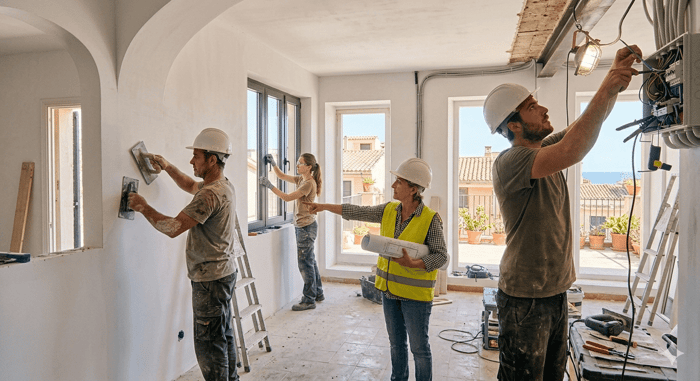
Any renovation of a finca in Mallorca beyond the most minor maintenance works requires a building licence (licencia de obras) from the relevant municipality and must be designed and certified by a licensed Spanish architect (arquitecto). The distinction between works requiring a major building licence and those that can proceed with a minor licence (licencia de obras menor) is determined by the scope of the works — structural works, changes to the building envelope, extension of the building footprint, new pools and similar significant interventions require a major licence, while internal decoration, replacement of finishes and non-structural works typically require only a minor licence or notification.
The licensed architect's role in a rural renovation in Mallorca goes beyond design. The architect certifies compliance with planning conditions, submits the licence application to the municipality, signs off the works at key stages and issues the completion certificate (certificado de fin de obra) that is required to obtain or renew the habitability licence. The architect's fee for a full renovation project typically runs between 6 and 12 percent of the construction budget, depending on the scope and complexity of the project. This fee is in addition to the builder's contract and the various administrative costs associated with licence applications and certifications.
Unauthorised building works on rural properties in Mallorca — works carried out without the required building licence — expose the owner to significant legal and financial risk. The Balearic Islands' planning enforcement regime has become progressively more active in recent years, with increased inspections of rural properties and enforcement notices requiring the removal of unauthorised structures or the restoration of properties to their pre-works condition. Buyers considering a property where previous owners have carried out renovation or construction works should instruct their lawyer to verify that all works have been properly licensed and that there are no outstanding enforcement notices against the property.
Tourist Rental Licences on Rural Fincas
The moratorium on new ETV (Estancias Turísticas en Viviendas) tourist rental licences that has applied across the Balearic Islands since February 2022 means that obtaining a new tourist rental licence for a rural property in Mallorca is currently not possible in most circumstances. Rural fincas that already hold an ETV licence therefore carry a significant additional premium — their ability to generate lawful short-term rental income at the nightly rates that premium rural properties command makes them materially more valuable than equivalent properties without a licence.
Buyers considering a rural property as an investment that will generate rental income should verify the ETV licence status of any property before purchase, and should confirm directly with the Consell Insular de Mallorca whether the licence is current, valid and transferable to a new owner. Licences are property-specific and transfer with the property on sale, but the transfer must be properly documented and registered.
Finca Prices in Mallorca in 2026 — What to Budget
Finca prices in Mallorca in 2026 span an enormous range, from approximately 400,000 euros for a modest rural property requiring significant restoration on a smaller plot, to well above 10 million euros for a fully modernised estate with exceptional land, situation, pool and ETV licence. The most active transaction bracket for quality habitable fincas sits between 800,000 euros and 3 million euros, reflecting properties in reasonable condition with mature gardens, pools and reliable water supply on plots of 5,000 to 30,000 square metres.
In terms of renovation costs, a comprehensive full renovation of a Mallorcan finca to a high residential standard typically runs between 1,800 and 3,500 euros per square metre of construction, depending on specification and the condition of the existing structure. A 300-square-metre finca requiring a full renovation to a quality finish would therefore typically cost between 540,000 and 1.05 million euros in construction costs alone — before purchase price, architect fees, building licence costs, landscaping, pool installation and furnishing. Buyers who approach rural purchases with a renovation plan need to model these costs carefully before committing to a purchase price, because the gap between realistic total cost and perceived value is wider in the finca market than in any other segment.
Read our guide to the military certificate requirement for non-EU buyers
Read our guide to the Contrato de Arras
See all our properties for sale in Mallorca