Table of Contents
- The Three Renovation Tiers — Defining What You Are Actually Doing
- Cost Per Square Metre — The 2026 Mallorca Construction Market
- Specific Element Costs — What Individual Works Cost in Mallorca in 2026
- The Licensed Architect — What They Do and What They Cost
- Building Licences — Process, Timeline and Cost
- The Most Common Budget Overrun Causes
- FAQs
Mallorca Renovation Costs 2026: A Verified Guide to What It Actually Costs to Renovate a Property on the Island
Mallorca renovation costs in 2026 are among the most frequently searched and least accurately reported figures in the island's property market — and the gap between what buyers budget and what projects actually cost is one of the most consistent sources of financial surprise in the entire Mallorcan buying process. Whether you are purchasing a finca that requires comprehensive restoration, a Santa Ponsa villa that needs a full kitchen and bathroom refresh, or an Old Town Palma apartment that you want to take to a contemporary specification, the renovation budget needs to be modelled accurately before the purchase price is agreed rather than worked out afterwards. This guide provides verified current cost ranges for every category of renovation work relevant to the Mallorcan property market in 2026, alongside the framework of rules, processes and professional requirements that govern renovation on the island.
The Three Renovation Tiers — Defining What You Are Actually Doing
Before any cost analysis is meaningful, the scope of the renovation must be defined clearly. In Mallorca's construction market, renovation projects fall into three practical categories that have materially different cost profiles, planning requirements and project timelines.
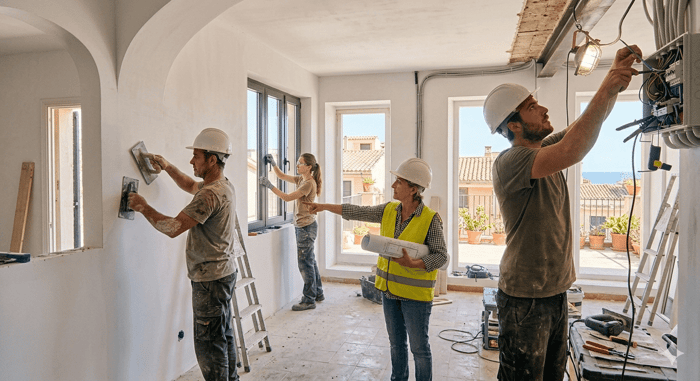
Cosmetic renovation covers works that do not touch the structure of the building or its mechanical, electrical or plumbing systems — new floor finishes, painting, replacement of kitchen and bathroom fittings without moving services, new windows and external doors within existing apertures, landscaping and soft furnishing. Cosmetic renovation does not require a major building licence in most cases (though a minor licence or works notification is typically required even for relatively modest works) and does not require the involvement of a licensed architect beyond initial advice. This is the renovation that buyers use to update a property that is structurally sound and well-serviced but dated in its finish.
Full renovation covers comprehensive works that include structural elements, complete replacement of mechanical, electrical and plumbing systems, new pool installation or major pool refurbishment, new kitchens and bathrooms with service relocation, window and door replacement with potential aperture modifications, and external works including terrace construction and garden remodelling. Full renovation requires a major building licence (licencia de obras mayor), a licensed Spanish architect to design and certify the works, and typically involves building out of the property for the duration of the project. This is the renovation that buyers undertake when purchasing a property that has been unloved for a decade or more, or when taking a structurally sound property to a significantly higher specification than it currently presents.
Luxury renovation encompasses everything in the full renovation category plus the highest-specification finishes, bespoke joinery, premium natural stone and tile throughout, smart home automation, premium audio-visual installation, heated pools, outdoor kitchen and entertaining infrastructure, full landscaping design and planting, and the level of detail and finishing care that characterises the finest properties in the premium Mallorcan market. Luxury renovation requires the same planning and professional framework as full renovation but at a significantly higher cost per square metre and with a longer project timeline.
Cost Per Square Metre — The 2026 Mallorca Construction Market
The following cost ranges are based on current pricing in the Mallorcan construction market in 2026, drawn from verified project data and contractor pricing across the southwest and northwest of the island. All figures are inclusive of labour and materials but exclude VAT (which is applied at 10 percent for residential renovation works on principal residences, or 21 percent for other properties), architect fees, building licence costs and furniture/soft furnishing.
| Renovation Category | Cost per sqm (euros) | Typical project timeline | Licence required | Architect required |
|---|---|---|---|---|
| Cosmetic renovation | 400 to 900 | 4 to 12 weeks | Minor licence or notification | Not mandatory but advisable |
| Full renovation | 1,800 to 2,800 | 6 to 18 months | Major building licence | Mandatory |
| Luxury renovation | 2,800 to 5,000+ | 12 to 30 months | Major building licence | Mandatory |
| New pool (standard) | 25,000 to 45,000 total | 8 to 16 weeks | Building licence | Project drawings required |
| New pool (infinity/overflow) | 45,000 to 120,000 total | 12 to 24 weeks | Building licence | Mandatory |
Specific Element Costs — What Individual Works Cost in Mallorca in 2026
Breaking the overall renovation cost down to individual elements helps buyers understand where the budget goes and where the most meaningful specification decisions lie.
Kitchens: A quality kitchen supply and installation in Mallorca in 2026 runs from approximately 15,000 euros for a well-specified standard kitchen with quality appliances (AEG, Bosch, Siemens level), through 30,000 to 60,000 euros for a premium kitchen with stone worktops, high-end appliances (Miele, Gaggenau, Sub-Zero level) and custom storage, to above 100,000 euros for a fully bespoke kitchen with integrated appliances, stone island, wine cellar and the kind of specification that characterises the premium end of the Mallorcan market. Kitchen costs in Mallorca are generally 20 to 35 percent higher than mainland Spain equivalent specifications, reflecting the logistics cost of island supply chains and the premium charged by the relatively small number of high-quality kitchen specialists operating on the island.
Bathrooms: A quality principal bathroom supply and installation — freestanding bath, walk-in shower, quality vanity and fixtures, heated towel rail, underfloor heating, quality tiles — runs from 8,000 to 20,000 euros for a standard quality finish and 20,000 to 50,000 euros for a luxury finish with premium natural stone, Duravit or equivalent sanitaryware and bespoke shower and bath fittings. Guest bathrooms at a quality but not luxury specification typically run 4,000 to 10,000 euros each.
Flooring: Natural stone flooring — the standard choice for quality Mallorcan renovation — costs 80 to 180 euros per square metre for materials plus 25 to 50 euros per square metre for installation, giving a total installed cost of 105 to 230 euros per square metre depending on stone type and format. Authentic Mallorcan hydraulic tiles (rajoles) for terraces and traditional interior spaces cost 60 to 120 euros per square metre for materials with similar installation costs. Engineered wood flooring in bedrooms and living areas runs 60 to 120 euros per square metre installed.
Windows and external doors: Replacement of all windows and external doors in a 200-square-metre villa typically costs between 25,000 and 60,000 euros depending on the number of apertures and the specification chosen — aluminium with thermal break and double glazing at the standard end, timber or premium aluminium with triple glazing and solar control glass at the premium end. Window quality is one of the most important efficiency investments in a Mallorcan renovation because the climate demands both effective solar control in summer and reasonable insulation in winter.
Electrical and plumbing systems: Complete rewiring of a 200-square-metre property typically runs 12,000 to 25,000 euros depending on the number of circuits, smart home infrastructure and the complexity of the installation. Complete replumbing runs 8,000 to 18,000 euros for a similar property. HVAC installation (ducted air conditioning with heat pump heating) runs 15,000 to 40,000 euros depending on the number of zones and the specification of the outdoor units.
Smart home automation: A comprehensive smart home installation covering lighting control, heating and cooling automation, audio-visual distribution, security cameras, alarm system and smart lock entry runs between 15,000 and 80,000 euros depending on the number of rooms, the integration complexity and the specification of the control systems. KNX-based whole-home automation at the premium level accounts for the upper end of this range.
The Licensed Architect — What They Do and What They Cost
The involvement of a licensed Spanish architect (arquitecto) is mandatory for all major building works in Mallorca and is the most important professional engagement in any renovation project. The architect's role encompasses the project design, the building licence application, the structural calculations where relevant, the supervision of works at key stages, the coordination with the aparejador (building technical architect, who oversees day-to-day site supervision), and the final completion certificate that enables the habitability licence to be renewed and the property to be re-registered at the Land Registry with its updated details.
Architect fees in Mallorca for renovation projects are typically calculated as a percentage of the total construction budget, ranging from 6 to 12 percent depending on the project scope and complexity. For a full renovation with a 500,000 euro construction budget, an architect fee of 8 percent represents 40,000 euros — a material cost that must be included in the total project budget from the outset. The aparejador's fee adds a further 3 to 6 percent. Some firms charge a fixed fee for smaller or clearly scoped projects rather than a percentage, which can be more cost-predictable for buyers with well-defined project briefs.
Building Licences — Process, Timeline and Cost
The building licence (licencia de obras mayor) is issued by the relevant municipal planning department — in Santa Ponsa and the southwest, this is the Calvià Ajuntament. The application is submitted by the architect and must include the full architectural project, structural drawings, energy efficiency study, site photographs, a responsible declaration from the contractor and the required fees. In the Calvià municipality, the processing time for a major building licence application is currently running at approximately three to five months from submission of a complete application to licence issuance — a timeline that has improved from the six to nine months that were common in 2022-2023 but remains a meaningful factor in project planning. The licence fee is calculated as a percentage of the declared construction budget, typically 3 to 6 percent depending on the municipality and the type of works.
The Most Common Budget Overrun Causes
The most consistent causes of budget overrun in Mallorcan renovation projects, based on contractor and project manager experience across the island, are: hidden structural issues discovered during demolition (particularly in older finca buildings where original construction quality was variable and may have been partially obscured by previous remedial works); soil conditions affecting foundation work for pools or extensions; delays in the supply of specified materials from the mainland or abroad (Mallorca's island logistics add lead times that mainland projects do not face); variations introduced by the client during construction (the most controllable cause of overrun but the most common); and contractor capacity constraints in the peak summer season when the best Mallorcan contractors are frequently committed across multiple projects simultaneously.
The practical advice from experienced project managers in Mallorca is to build a contingency of 15 to 20 percent of the construction budget into any renovation financial model. For rural fincas and older buildings where the construction history is less certain, a 20 percent contingency is the minimum prudent provision. Buyers who model their total investment cost — purchase price, renovation budget, professional fees, licence costs, furniture and landscaping — with a realistic contingency from the outset are consistently better positioned than those who treat the renovation budget as a fixed figure that subsequent discovery cannot exceed.
Read our complete finca buyer's guide
Read our guide to the military certificate for non-EU buyers
See all our properties for sale in Mallorca