Table of Contents
- The Balearic EV Subsidy Programme — What Is Available in 2026
- The Charging Network in Mallorca 2026 — Coverage and Speed
- Home Charging — The Foundation of EV Ownership in Mallorca
- The Best EV Options for Mallorca Residents in 2026
- The Practical Realities of Driving Electric in Mallorca Day to Day
- Importing an EV to Mallorca — What Residents Need to Know
- FAQs
Electric Vehicles Mallorca 2026: Charging Infrastructure, Subsidies and Driving the Island EV
Electric vehicles in Mallorca in 2026 have moved from novelty to genuine practicality for a significant and growing proportion of the island's permanent resident community — and the combination of Balearic government subsidies, a rapidly expanding charging network and the particular logic of island driving makes Mallorca one of the more compelling places in Spain to make the switch. The Balearic Islands have set themselves a target of becoming one of the greenest island destinations in Europe by 2030, and the transition to electric mobility is central to that ambition. For residents of the southwest — whose daily driving patterns typically involve commutes to Palma, school runs, marina visits, restaurant evenings and the occasional weekend trip to the Tramuntana or the north — the case for an EV is stronger in Mallorca than in many mainland contexts, and it is getting stronger every quarter as the charging infrastructure continues to expand. This guide covers the current state of the EV network, the subsidies available to Mallorcan residents, the practical realities of day-to-day electric driving on the island and what to know before making the switch.
The Balearic EV Subsidy Programme — What Is Available in 2026
The Balearic Islands government has operated one of the most generous electric vehicle subsidy programmes in Spain for several years, funded through a combination of regional budget allocations and EU recovery funds. The current subsidy structure in 2026 provides the following support for residents who purchase or lease a new electric vehicle and are registered in the Balearic Islands.
For private individuals purchasing a battery electric vehicle (BEV), the Balearic government subsidy of up to 40 percent of the purchase price applies on top of the national MOVES III programme grants, which provide a further 7,000 euros for a BEV purchase when accompanied by scrapping an old vehicle or 4,500 euros without scrapping. The combined maximum support available to a Balearic resident purchasing a BEV in 2026 — combining regional and national programmes — can reach between 8,000 and 12,000 euros depending on the vehicle price and whether an old vehicle is being scrapped. For businesses registered in the Balearics, including property management companies, holiday rental operations and professional services firms, the combined subsidy programmes can reach up to 15,000 euros per vehicle for commercial EVs.
The Balearic Islands also apply a significant vehicle registration tax (IVTM) exemption for zero-emission vehicles — electric vehicles registered in the Balearics pay zero IVTM, producing an annual saving of 150 to 400 euros per year depending on the vehicle's power rating. Additionally, electric vehicles in Mallorca benefit from free or discounted parking in an increasing number of municipal car parks, including several in central Palma and in the Calvià municipality, and from access to bus lanes in Palma on certain routes. The combination of purchase subsidy, annual tax exemption and parking benefits produces a total cost of ownership comparison with equivalent combustion engine vehicles that has become increasingly favourable over the four-year ownership horizon that most buyers use for planning purposes.
The Charging Network in Mallorca 2026 — Coverage and Speed
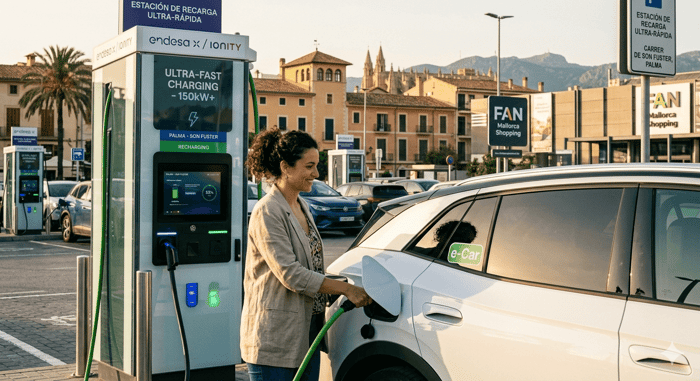
The charging infrastructure in Mallorca has expanded significantly over the past three years, driven by both public investment through the Govern Balear's FCEV charging network programme and by commercial installation from operators including Repsol, Iberdrola, Endesa X and the IONITY network. The island now has more than 400 public charging points, with the distribution weighted toward Palma and the southwest but with meaningful coverage extending to the north and east of the island.
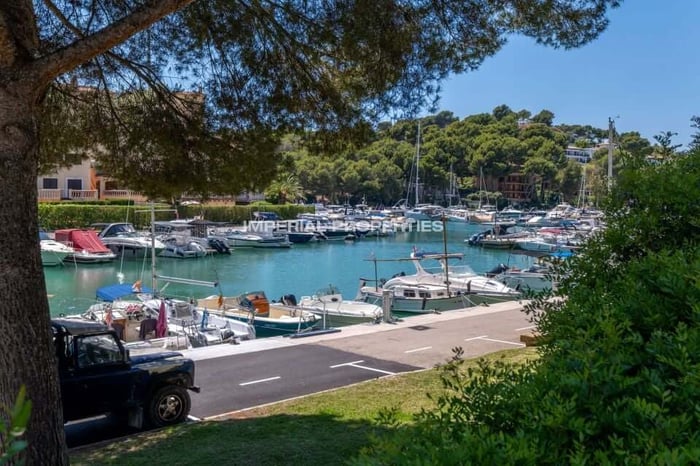
For residents of Santa Ponsa, Portals Nous and the surrounding southwest communities, the most practically relevant charging locations include the following confirmed installations in 2026. Puerto Portals has two 150kW DC fast chargers in the main marina car park, capable of delivering 100 kilometres of range in approximately 15 minutes for compatible vehicles — the kind of charge that fits naturally into a lunch or dinner at the marina without requiring any special planning. The Palma Airport car parks have 22kW AC chargers on both the short-stay and long-stay levels, serving residents who drive to the airport and return to find their vehicle partially charged. The Corte Inglés car park in Palma city centre has 22kW chargers on three levels. The Alcampo hypermarket in Son Espases, Palma, has a 150kW fast charger bay accessible during store hours. The Mallorca Country Club in Santa Ponsa, venue for the ATP Mallorca Championships, has installed 22kW chargers in the main car park available to non-members during non-event periods.
Along the principal southwest-to-Palma commute routes, charging points have been installed at the petrol station complexes at Palma Nova and at the Calvià municipality's own public car park in Santa Ponsa town. The expansion of the network along the Ma-1 motorway corridor between Calvià and Palma is one of the Govern Balear's infrastructure priorities for 2026-2027, with additional fast chargers planned at service area locations along the principal commuter routes.
Home Charging — The Foundation of EV Ownership in Mallorca
For property owners in Mallorca — whether in a villa with private parking or in an urbanisation with communal garage facilities — home charging is the foundation of practical EV ownership that makes public infrastructure a supplement rather than a necessity. A standard 7kW home wall charger installed in a private garage delivers approximately 35 to 50 kilometres of range per hour of charging, which means a typical EV with a 60kWh battery pack is fully charged from near-empty in eight to ten hours of overnight charging. For the daily driving patterns of most southwest Mallorca residents — a return trip to Palma of 40 to 60 kilometres, school runs of 15 to 25 kilometres, marina and shopping trips of similar distances — an overnight home charge provides more than sufficient range for the following day's use without any reference to the public network.
The installation of a 7kW home wall charger in a private property in Mallorca costs between 600 and 1,200 euros depending on the distance from the electrical panel and the quality of the installation. A 22kW three-phase charger, which charges approximately three times faster, costs between 1,200 and 2,500 euros installed. Both installations qualify for the MOVES III subsidy programme, which covers up to 70 percent of the installation cost for residential charging equipment. For communal garage installations in urbanisations, the situation is more complex — the installation requires a decision by the community of owners (junta de propietarios) under the Spanish Horizontal Property Law, but the legal requirement for communities to permit EV charger installation has been strengthened by amendments to the law in 2022, making it significantly more difficult for communities to refuse reasonable charging installation requests from individual owners.
The Best EV Options for Mallorca Residents in 2026
The Spanish EV market in 2026 is significantly more developed than it was three years ago, with a range of vehicles at different price points that suit the typical driving requirements of Mallorca residents. The following categories represent the most appropriate choices for different resident profiles.
For daily commuters and family use: The Tesla Model 3 Long Range remains one of the most efficient and reliable EVs available in Spain, with a WLTP range of 629 kilometres that eliminates any range anxiety for island use and a comprehensive Supercharger network that complements the public infrastructure. The VW ID.4 and the BMW iX1 are strong alternatives at similar price points with larger boot space suited to family use. All three qualify for the combined Balearic and national subsidy programmes. The Renault Megane E-Tech and the Peugeot e-2008 offer compelling value in the mid-range segment for buyers seeking strong subsidy support and lower purchase prices.
For the premium segment: The BMW iX and the Mercedes EQS represent the peak of EV luxury available in Spain, with both offering the kind of refinement, range and technology specification that matches the premium end of the Mallorca resident's expectations of a quality vehicle. The Porsche Taycan, which has developed a strong presence in the Mallorca market since its introduction, combines sports car character with genuine EV practicality in a combination that suits the driving roads of the southwest and the Tramuntana.
The Practical Realities of Driving Electric in Mallorca Day to Day
The experience of long-term EV owners in Mallorca consistently identifies the same advantages and the same residual challenges. The advantages are real and significant: the elimination of petrol costs (the average Mallorcan resident saves between 1,500 and 3,000 euros annually on fuel costs by switching from a petrol or diesel vehicle to an EV charged primarily at home), the absence of oil changes and the reduced brake maintenance that regenerative braking produces, and the particular satisfaction of driving a vehicle that is genuinely quiet in a context — the streets of old Palma, the narrow lanes of the Tramuntana villages, the evening approaches to the port of Andratx — where engine noise is intrusive.
The residual challenges are manageable but real. Long-distance day trips to the north or east of the island require awareness of the charging network rather than simple reliance on home charging, though the network coverage makes this a planning exercise rather than a genuine barrier. In the peak summer months of July and August, the most convenient public charging points at Puerto Portals and the Palma Airport are busier than in the shoulder and off-peak months, which requires a degree of flexibility in planning. And for residents in apartments without private parking, home charging is not available — which means reliance on the public network is complete rather than supplementary, a more demanding proposition that currently suits a smaller range of EV models and usage patterns.
Importing an EV to Mallorca — What Residents Need to Know
Residents moving to Mallorca from the UK, Germany, Scandinavia or other European countries who wish to import their existing EV face the standard vehicle importation process that applies to all imported vehicles: registration with the Jefatura Provincial de Tráfico, a Spanish ITV technical inspection (equivalent to the UK MOT), payment of the vehicle registration tax at the Balearic rate and updating the vehicle documentation to Spanish standards. EU vehicles registered in an EU member state can be imported without customs duty. Post-Brexit British-registered vehicles are subject to customs and VAT on import from the UK, though the calculation depends on the vehicle's value and the import circumstances. The specific subsidy programmes described above apply to new vehicles purchased and registered in Spain — imported second-hand vehicles do not qualify for the MOVES III or Balearic purchase subsidies.
See all our properties for sale in Mallorca
Browse properties in Santa Ponsa and Nova Santa Ponsa