Table of Contents
Euribor and Your Mallorca Mortgage: What the Official July 2026 Rate Actually Means
Our real estate guides have covered the basics of getting a mortgage in Spain as a non-resident, but the number that actually determines what a variable-rate mortgage costs month to month deserves its own explanation — and the official figure just published tells a more specific story than most headlines suggest.
The Official Number
The Banco de España confirmed the official 12-month Euribor rate for June 2026 at 2.798%, published via resolution in the Boletín Oficial del Estado on 1 July 2026. This is the figure banks are required to use for variable-rate mortgage reviews falling in July 2026 that reference June as the base month — not a media estimate, but the legally binding reference rate. Alongside it, the Banco de España also published the 5-year Interest Rate Swap at 2.823% and the €STR-based 12-month reference at 1.956%, the two other indices some Spanish mortgages use instead of Euribor.
Provisional tracking for July 2026 itself has shown the daily rate drifting somewhat higher, but that figure won't become official until the Banco de España publishes its own resolution in early August — worth remembering if you see a different July figure quoted elsewhere before then.
Thinking about buying or selling in Mallorca?
How This Compares Historically
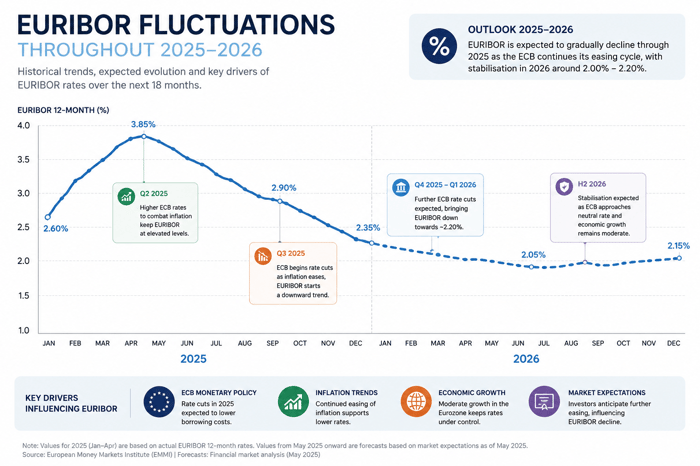
Context matters more than the raw number here. Euribor hit its all-time high of 5.393% in July 2008, at the start of the global financial crisis, and its all-time low of -0.505% in January 2021, during the era of negative interest rates that made variable mortgages briefly almost free to service. The rate has climbed well off those 2021 lows since the European Central Bank began raising rates in 2022, peaking closer to 4.2% at various points in 2023. Against that backdrop, June 2026's 2.798% sits roughly in the middle of the post-2022 range — higher than the ultra-cheap borrowing of the pandemic years, but well below the 2023 peak.
What It Means for a Real Mortgage
For a variable-rate mortgage, the interest you actually pay is Euribor plus whatever margin your bank agreed in the contract — commonly written as "Euribor + 1%" or similar. On June 2026's official 2.798% rate, a margin of 1% produces an effective rate of 3.798%; a more competitive margin of 0.5%, which well-qualified borrowers can sometimes negotiate, brings that down to 3.298%. The gap between a good margin and an average one compounds meaningfully over a 20 to 25-year mortgage term, which is why shopping the margin matters as much as watching Euribor itself.
Current market offers illustrate the spread: some fixed-rate mortgages in July 2026 were being offered from around 2.55% TIN for well-qualified borrowers willing to take on linked products, while variable-rate margins ranged from roughly Euribor + 0.35% up to Euribor + 0.69% depending on the lender and the borrower's profile.
Fixed vs Variable in 2026
With Euribor still meaningfully above its pandemic-era lows but showing signs of stabilising rather than climbing sharply, the fixed-versus-variable decision comes down to risk tolerance more than a clearly "correct" answer either way. A fixed rate locks in certainty for the life of the loan regardless of where Euribor goes next; a variable rate carries the possibility of paying less if rates continue easing, but with the same downside risk if they don't. For non-resident buyers specifically, who typically secure lower loan-to-value ratios than residents in the first place, the absolute euro amounts at stake with each percentage point of difference are often larger in cash terms, which is worth factoring into that decision alongside the headline rate.
What This Means for Mallorca Buyers
None of this changes the practical mechanics of getting a mortgage here as a foreign buyer — the NIE, the Spanish bank account, the 60–70% loan-to-value typical for non-residents — but it does mean the monthly cost of financing a purchase today is meaningfully different from what it would have been at 2023's peak, or during the near-zero years before 2022. If you're weighing up financing alongside a specific property, browse our current listings across Mallorca or get in touch — we can talk through how the numbers apply to a particular purchase.