Padel Fever: Why Southwest Mallorca Can't Get Enough of It
Ten years ago, most people in Mallorca had never heard of padel. Now it's hard to drive through Calvià without passing a glass-walled court, and the clubs keep coming. Spain has become the sport's undisputed global centre, with more than 17,000 courts and over six million players nationwide, and the southwest of Mallorca has embraced it as enthusiastically as anywhere on the island.
How Padel Took Over
The Spanish Padel Federation issued a record 109,040 player licenses in 2024, up 8% on the year before and 175% since 2012, when the federation first began tracking the figure. That's licensed, competitive players. The wider participation number is bigger still: surveys put the share of the Spanish population who play at around 12.7%, more than six million people, across all ages and skill levels.
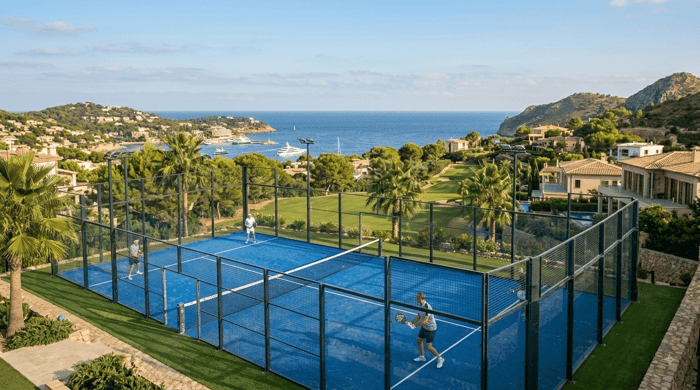
Mallorca has followed the mainland trend closely. Calvià alone now has multiple dedicated padel clubs, including Calvià Padel in Magaluf, alongside courts built into existing tennis facilities like Mallorca Country Club in Santa Ponsa and clubs in Bendinat and around Andratx. Padel's appeal is straightforward: it's easier to pick up than tennis, matches are shorter, and doubles is built into the format, which makes it a naturally social game.
Thinking about buying or selling in Mallorca?
Who's Actually Playing
Padel skews younger and more mixed than golf or tennis traditionally have. National data shows a roughly 60/40 split between male and female players, and the biggest single age bracket is the 24 to 39 group, though players in their forties and beyond make up close to half of all federated members. In Calvià specifically, that translates into a genuinely broad club membership: residents in their thirties and forties playing evening matches after work, retirees fitting in a morning game, and increasingly, families introducing children to the sport at a much younger age than they might have picked up tennis.
The court itself, at roughly 20 by 10 metres and enclosed by glass and fencing, takes up a fraction of the space a tennis court needs, which has made it easier for clubs and even some residential developments to add courts without a major footprint. That's part of why the sport has spread so quickly through areas like Santa Ponsa, Bendinat and Portals Nous, where space has always come at a premium.
The Lifestyle Draw for Residents
For a lot of people who've moved to the southwest in the last few years, padel has become part of how they meet people. Clubs run mixed social sessions and informal leagues that don't require the commitment of a golf membership or the solo discipline of running or cycling. It fits neatly into an evening after work or a weekend morning, and courts book up fast in the cooler months of spring and autumn, when temperatures are ideal for an hour on court.
It's also becoming a factor buyers mention when they're weighing up a neighbourhood, alongside the more established questions about schools, beaches and golf access. A development or area with a padel club nearby, or space to add a private court, has started to matter to a segment of buyers who wouldn't have thought to ask about it five years ago. Whether that becomes as significant a factor as golf access has for the southwest's older, established market remains to be seen, but the trajectory of the sport in Spain suggests it isn't going away.