Table of Contents
Calvia Poble: The Inland Village Hiding Behind the Coastal Name
Say "Calvia" to most people and they picture beaches: Santa Ponsa, Portals Nous, Palmanova, the whole sun-drenched string of resorts along fifty kilometres of southwest coastline. Fewer people picture what actually gave the municipality its name, a small inland village fourteen kilometres from Palma, tucked into the foothills of the Serra de Tramuntana, with about 2,500 residents and none of the beachfront crowds.
Calvia Poble, or Vila de Calvia as locals call it, is the administrative heart of the municipality and its oldest settlement. It is also the version of Calvia that most visitors, and quite a few long-term residents of the coastal areas, have simply never seen.
A Different Kind of Calvia
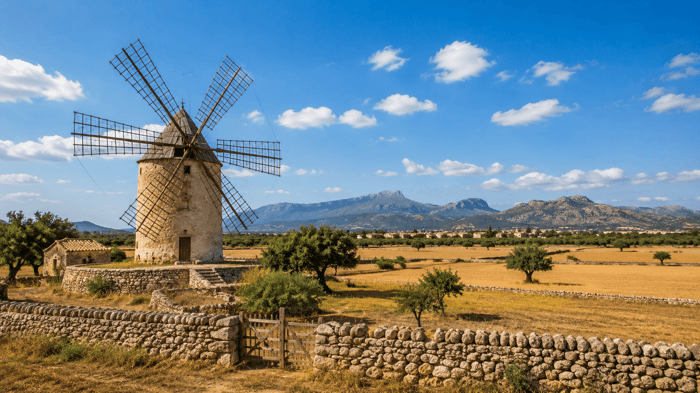
Driving up from the coast, the change is immediate. The roundabouts and beach bars give way to olive groves, dry-stone walls and a landscape that looks more like the island's rural interior than its tourist belt. The village itself keeps a modest scale: ochre-coloured houses, a handful of shops and bars, chickens wandering between the trees in places. It is, in a real sense, what Mallorcan village life looked like before the tourism boom reshaped the coast a few kilometres away.
That is not to say Calvia Poble is frozen in time. The town hall and adjoining civic buildings are modern and well resourced, a reminder that this quiet village governs one of the wealthiest municipalities in Spain. But the centre itself, its narrow streets and stone facades, has resisted the kind of redevelopment that transformed the coast.
Thinking about buying or selling in Mallorca?
A Name With Thirteenth-Century Roots
The parish behind the village's name, Sante Ihoannes Caviano, dates back to 1248, not long after Jaume I's conquest of Mallorca. The most widely accepted theory traces the place name to the Latin personal name Calvius, though an alternative theory links it to the Latin caluus, meaning "to burn" or "to be hot," a nod to the arid inland terrain. Either way, the settlement's roots run deeper than almost anywhere on this stretch of coast, and the archaeological record backs that up: Talaiotic sites within the wider municipality, including Naveta Alemany and Puig de Sa Morisca, show the area was inhabited roughly 2,000 years ago.
The Church at the Centre of Everything
Sant Joan Baptista, the parish church, dominates the village both physically and historically. The current neo-Gothic structure was built at the end of the nineteenth century, but it was raised around the remains of a thirteenth-century original, so the walls carry more layers of the village's history than a first glance suggests. A fountain and a ceramic mural nearby fill in some of the detail for anyone curious about how the village grew up around this one building.
A short walk from the church takes you past several of the manor houses, or cases senyorials, that once belonged to the landowning families of the district. Can Verger and Can Ros are among the best known, solid stone buildings that speak to a farming economy that predates the resort economy by centuries.
What Everyday Life Looks Like
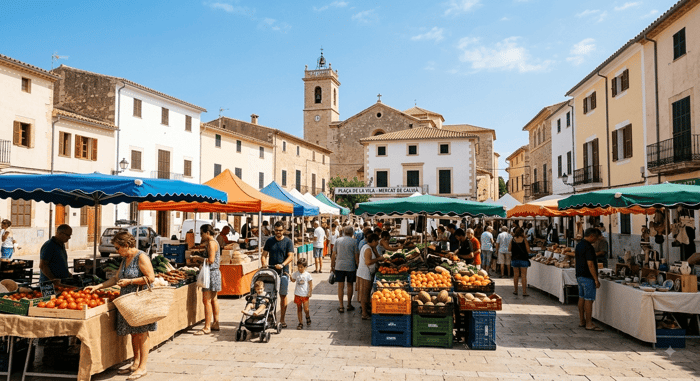
Calvia Poble's Monday market, held on Calle Major right by the parish church, is the clearest weekly reminder that this is a working village rather than a museum piece. Stalls sell fresh produce, clothing and local crafts, and the crowd is noticeably more local than the markets closer to the resorts. For residents of Nova Santa Ponsa, Bendinat or Son Font who want a genuinely Mallorcan morning out without a long drive, this is about as close as it gets.
The village's position also makes it a natural base for exploring the Tramuntana foothills. Hiking routes into the hills around Puigpunyent and the wider Serra begin within easy reach, offering a very different kind of Mallorca to the beach clubs a fifteen-minute drive away.
Why It Matters for Buyers in the Area
For anyone considering a home in the Calvia municipality, the existence of Calvia Poble is a useful reminder that "Calvia" covers a lot more than sea view apartments. Properties in and around the village tend to be traditional townhouses and converted period buildings rather than new-build coastal apartments, appealing to buyers who want proximity to international schools and the coastal amenities of Santa Ponsa or Bendinat without living directly on the seafront strip.
It is also a reminder of something easy to forget in a region defined by its coastline: Calvia's identity was never really about the beach. It was, and in the village itself still is, about a small farming community in the hills that happened to give its name to one of the busiest tourist destinations in the Mediterranean.