Table of Contents
The Windmills of Mallorca: Why the Island Has More Than Any Other Place in the Mediterranean
Fly into Palma and, weather permitting, you will see them before you see anything else: hundreds of windmills scattered across the plain south of the airport, blades catching the light as the plane banks in. It is the kind of first impression that makes people ask the obvious question. Why does one Mediterranean island have so many of these things?
The answer starts with the wind itself, and ends with one of the more surprising facts about Mallorca's built landscape: outside of Crete, no other place in the Mediterranean has anywhere near the number of windmills found here.
The Wind That Built an Industry
The Tramontana, the cold, forceful wind that sweeps down from the north, gives its name to the mountain range that shelters the island's northwest coast and can reach speeds strong enough to make wind power genuinely practical rather than merely occasional. That reliable, powerful airflow is the reason windmills spread across Mallorca in numbers that dwarf almost every other Mediterranean island.
Estimates of the total vary depending on how you count, and no single current inventory covers every structure, but figures commonly cited by heritage researchers and windmill associations put the historic total in the low thousands, with only Crete recorded as having more windmills than Mallorca anywhere in the Mediterranean.
Thinking about buying or selling in Mallorca?
Two Very Different Kinds of Mill
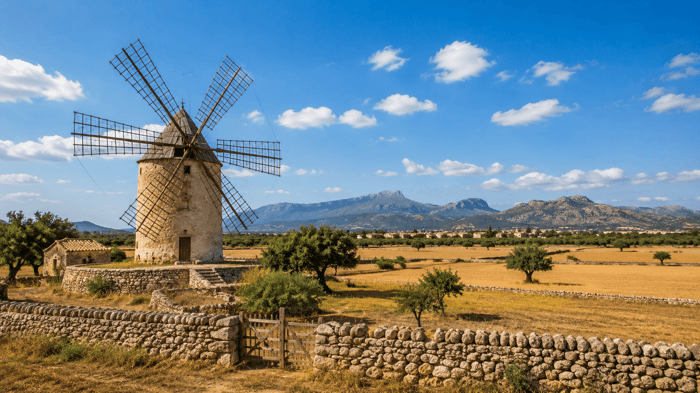
Not all of Mallorca's windmills did the same job, and the distinction matters for anyone trying to make sense of what they are looking at. Flour windmills, the older and more iconic type, are the cylindrical stone towers with six sail-blades that ground cereal into flour, historically including the wheat that went into ensaimadas. Documented references to flour-grinding windmills on the island predate the Christian conquest of 1229, making them a genuinely ancient feature of the landscape, with clusters still visible in Palma's Es Jonquet and Es Molinar neighbourhoods.
Water-extraction windmills are the younger, more numerous type, recognisable by their metal-bladed fans rather than cloth sails. These were built to pump groundwater for irrigation, and their story has a precise starting point: in 1845, the Dutch engineer Paul Bouvij began using wind-powered mills to help drain the marshland that is now the Pla de Sant Jordi, just south of Palma. The mills that followed his lead spread rapidly across the plain and beyond, eventually becoming the dominant type on the island by sheer number.
Where to See Them Today
Es Jonquet, the old fishing quarter on Palma's western edge, is the easiest starting point. Three of its mills have been restored, including Moli d'en Garleta, now a small interpretation centre dedicated to the history and typology of Balearic windmills. The narrow, whitewashed streets around them are worth the walk on their own.
For water-extraction mills in their working context, the Pla de Sant Jordi remains the definitive location, with a concentration of mills unmatched anywhere else on the island. Further inland, villages such as Algaida, Montuiri and Sineu retain windmills that sit within a genuinely rural, agricultural landscape rather than a restored heritage trail, offering a different and quieter way to encounter them.
A Slow Restoration Effort
Most of Mallorca's windmills, particularly the water-extraction type, are in poor condition, and heritage organisations have flagged the scale of the problem for years. The Consell de Mallorca, through its Historical Industrial Heritage unit, has led restoration and research work since the 1990s, and funding has periodically been directed specifically toward mills on the Pla de Sant Jordi as part of wider efforts to protect the island's molinological heritage.
Progress is gradual by necessity. There are simply too many structures, many on private land, for a comprehensive restoration programme to move quickly. But the mills that have been saved, from the roundabout specimen at Es Molina to the restored examples within Es Jonquet, show what is possible when restoration funding and heritage expertise come together.
A Landscape Worth Understanding
For residents and buyers in southwest Mallorca, windmills tend to register as scenery rather than history, glimpsed from a car window on the way somewhere else. Knowing what they actually are, flour mills grinding grain since before the Reconquista, water mills solving a nineteenth-century drainage problem, adds a layer of context to a landscape most people only half notice. Few islands anywhere in the Mediterranean can claim a comparable density of them, and fewer still wear that history as visibly as Mallorca does on the approach to Palma.