Table of Contents
The Sineu Wednesday Market: 700 Years of Trading in the Heart of the Island
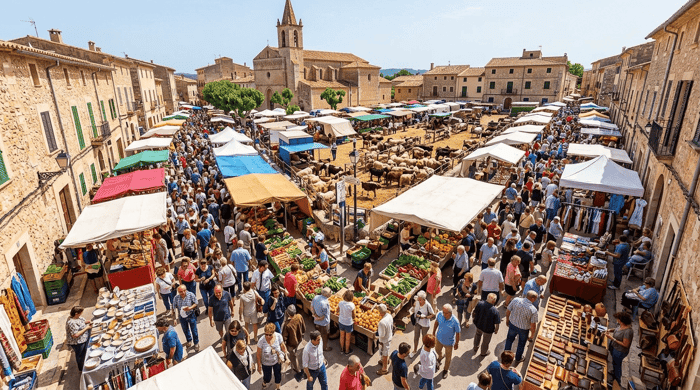
Every Wednesday morning, the quiet hilltop town of Sineu fills with noise. Farmers set out crates of tomatoes and capers, stallholders lay out leather goods and ceramics, and somewhere near the church square a pen of live chickens and goats still changes hands, exactly as it has for centuries. Sineu sits almost dead centre on the island, about 30 kilometres from Palma, and its market is the oldest continuously running one in Mallorca.
A Royal Privilege That's Never Lapsed
The market's roots go back to 1306, when King Jaume II of Mallorca granted Sineu the privilege of the Mercadal, formally establishing and protecting its weekly trading rights. King Peter the Ceremonious reconfirmed the privilege sixty years later, in 1366. That makes it more than 700 years old, and unlike most medieval institutions, it never stopped. Sineu itself briefly served as the island's capital in the 13th century, when King Jaume II built a palace there, a detail that still surprises people used to thinking of Palma as the only historic centre of power on the island.
Today the stalls spread across the church square, Plaça Es Fossar and the streets running off them, roughly from 8am to 1pm. It remains, uniquely among Mallorca's markets, a place where farm animals are still bought and sold alongside the fruit, vegetables, cheese, wickerwork and clothing, a detail that marks it out from every other market on the island and ties it directly back to its original purpose serving the agricultural communities of the Pla, the plain between Mallorca's two mountain ranges.
Thinking about buying or selling in Mallorca?
What Actually Happens on a Wednesday
The market isn't staged for visitors, which is part of what makes it worth the drive. Vendors know their regular customers by name, and the produce reflects what's actually being grown and reared in the surrounding countryside that week rather than a curated tourist selection. Alongside the fresh produce there are stalls for capers, olives, local cheeses, linens, baskets, and leather goods, and several of the bars around the square do a steady trade in frit mallorquí, a traditional dish of diced offal, potato and vegetables, as an early breakfast for people who've been at the market since it opened.
Once a year, on the first Wednesday after the first Sunday in May, the regular market gives way to the much larger Sa Fira de Sineu, a fair established under a separate royal privilege in 1318 that spills well beyond the market's usual footprint and draws crowds from across the island.
Getting There Without the Hassle
The most straightforward way to reach Sineu on a Wednesday is the train. Serveis Ferroviaris de Mallorca runs a direct line from Palma with a stop at Sineu station, and the journey takes roughly 40 to 50 minutes, timed to get market-goers there for the 8:30am opening rush. It's worth checking the current SFM timetable before travelling, since departure times shift seasonally. Driving is also straightforward and gives more flexibility if you plan to continue on to other inland villages afterwards, but parking around the old town fills up quickly once the market is underway, and the surrounding streets get busy.
Why Sineu Still Matters
For residents of the southwest, Sineu is a genuinely different side of the island from the coast: no beach, no hotel season, just a working agricultural town that happens to host one of Europe's longer-running weekly markets. It's a reminder of how much of Mallorca's identity was built inland, long before tourism reshaped the coastline, and it's still very much alive rather than preserved behind glass. Anyone who's only ever seen the southwest's marinas and beach towns owes themselves a Wednesday morning in the middle of the island.