Table of Contents
What is a Cédula de Habitabilidad? The Essential Guide for Mallorca Property Owners and Buyers
If you are buying, selling or renting a property in Mallorca, there is a document you will encounter in almost every transaction that often causes confusion among international buyers: the cédula de habitabilidad. Sometimes translated as the habitability certificate or certificate of occupancy, this document is issued by the Consell de Mallorca and certifies that a property meets the minimum legal requirements to be used as a residential dwelling. Understanding what it is, why it matters, and what to do when it is missing or expired is essential for anyone dealing with Mallorcan property.
What the Cédula de Habitabilidad Actually Is
The cédula de habitabilidad is an official certificate issued by the Consell de Mallorca — the island's governing council — under authority granted by the Balearic housing law, Ley 5/2018 de la vivienda de las Illes Balears. Its purpose is to certify that a specific property meets the minimum standards required to be legally occupied as a home. Those standards include minimum floor areas for rooms, adequate sanitary facilities, safe technical installations including electricity and water, and appropriate ventilation and natural light.
The certificate is issued in the name of the property, not the owner. When an owner sells or the property changes hands, the cédula goes with the property. It has a validity of ten years, after which it must be renewed. The Consell de Mallorca has the authority to delegate the issuance of cédulas to local ayuntamientos in certain circumstances, but in practice the Consell handles most applications centrally.
What the cédula does not certify is that the property is legally built, compliant with planning permissions, or free of any building infringements. Those are separate matters covered by different documentation. A cédula simply confirms that whatever exists on the ground is fit for human habitation at the time of issue.
Why It Matters So Much in Practice
The cédula de habitabilidad sits at the intersection of several practical requirements that affect day-to-day property ownership and transaction in Mallorca.
Utility connections are the most immediate practical issue. Under Article 16.3 of Ley 5/2018, electricity, water, gas and telecommunications companies are required to demand a valid cédula before establishing new service contracts for a property. This means that without a valid cédula, a new owner cannot connect utilities in their name — a situation that can be surprisingly difficult and costly to resolve quickly after a purchase completes.
Tourist rental licences — ETV licences — also require a valid and current cédula as a fundamental prerequisite. There is no route to obtaining or maintaining an ETV without one. Given the significant premium that ETV-licensed properties command in the current Mallorcan market, any buyer looking at properties with existing tourist licences must confirm that the cédula underpinning that licence is current.
Mortgages represent a third area of practical importance. Spanish banks require a valid cédula as a condition of mortgage lending. A buyer hoping to finance a purchase with a Spanish mortgage who discovers that the property lacks a valid cédula will find that the mortgage application cannot proceed until the certificate is obtained or renewed.
The legal position on sales is more nuanced. Under Article 16.4 of Ley 5/2018, any sale, rental or transfer of use of a property should incorporate a copy of the valid cédula — but the law also provides that if the seller does not have one, it is sufficient to state that fact, without imposing an automatic legal consequence. In practice, however, most buyers and their lawyers will require that a valid cédula is provided before completion, and a notary is obliged to note its absence in the deed. In real terms, attempting to sell a Mallorca property without a valid cédula significantly limits the buyer pool and the financing options available to those buyers.
The Three Types of Cédula de Habitabilidad
There are three distinct types of cédula, each applicable to different circumstances.
The cédula de primera ocupación — first occupancy certificate — is issued for newly constructed buildings, and also for properties that have undergone significant renovation or change of use affecting more than 60 percent of the property's distribution, structure or surface area. For a new-build purchase, the developer is responsible for obtaining this certificate before handover. For a major renovation project, the owner's architect is responsible for obtaining it at the completion of works.
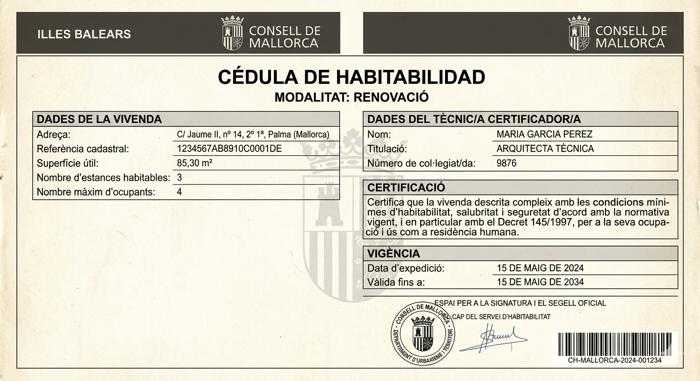
The cédula de renovación — renewal certificate — is what existing owners must apply for when their ten-year certificate expires. The renewal process requires an architect or technical architect to visit the property, certify its current condition as habitable, provide updated photographs, confirm that no structural changes have been made since the last certificate was issued, and submit a signed report with plans and cadastral data to the Consell de Mallorca. The Consell then reviews the submission and, if satisfied, issues the renewed certificate. Processing times vary but the Consell is legally required to resolve applications within one month of receipt.
The cédula por carencia — literally a certificate of lack — is a simplified certificate available for properties built before 1 March 1987 that have never had any cédula issued in their history. For these properties, a standard renewal process is not applicable because there is no previous certificate to renew. The carencia procedure requires a municipal certificate from the relevant ayuntamiento confirming that the property was completed before 1 March 1987, that no structural changes have been made since that date, and that no building infringement proceedings are outstanding against the property. The fee for the municipal certificate from Palma's urban planning service is currently 52.88 euros. An architect's report and property plans are also required. Because the process for a cédula por carencia is more involved than a standard renewal, it is important to allow adequate time when this certificate is needed for a transaction.
The Renewal Process in Detail
For a standard renewal, the process begins with instructing an architect or technical architect to visit the property. The architect inspects the property against the minimum habitability standards set out in Decreto 145/1997, which governs the technical requirements for habitability certificates in the Balearic Islands. The standards cover minimum room dimensions — a living room must be at least 14 square metres, a bedroom at least 6 square metres, a kitchen at least 5 square metres — and adequate bathroom facilities, ventilation, natural light and safe electrical and water installations.
If the property meets all the standards, the architect prepares a signed habitability report with current photographs, a floor plan showing the layout and dimensions, and cadastral data. This file is then submitted to the Consell de Mallorca — applications can be made electronically through the Consell's online office at seu.conselldemallorca.net. The application fee varies depending on the municipality and property type.
If the Consell identifies deficiencies during its review, it will issue a requirement notice setting out what must be corrected before the certificate can be issued. Common deficiencies identified in 2025 and 2026 include outdated electrical panels that do not comply with current low-voltage regulations, inadequate bathroom ventilation, and kitchen extraction that does not meet current standards. These deficiencies can usually be remedied without major works, but they add time and cost to the process.
Common Situations Buyers Encounter
In the due diligence process for a Mallorca property purchase, there are several cédula-related situations that come up regularly. The first and most straightforward is a valid, current certificate — the ten-year validity period has not expired and the certificate is presented without issue. The second common situation is an expired certificate — this is very frequently encountered, particularly in properties that have changed hands several times without the owners consistently renewing. The solution is the renewal process described above, which typically takes four to eight weeks once an architect has been instructed. The cost of obtaining a renewal, including the architect's fees and the Consell processing fees, varies depending on the property and the architect instructed, but specialist firms advertise renewal services from approximately 135 to 160 euros plus the Consell fees.
The third common situation is no certificate ever having been issued — the carencia scenario — typically in older rural properties and village houses built before the cédula system was introduced. This is the most time-consuming situation to resolve and requires careful handling. The fourth situation is a certificate that cannot be renewed because the property does not meet the minimum habitability standards and work is required before a certificate can be issued. This is rarer but does arise, particularly with older properties in need of renovation.
What Buyers Should Do
Before completing any purchase in Mallorca, buyers should ask for a copy of the current cédula de habitabilidad and verify its expiry date. If a cédula is not available, or if it has expired, this should be identified and addressed as part of the pre-completion process — either by requiring the seller to obtain or renew the certificate before completion, or by agreeing a reduction in the purchase price that reflects the cost and time required to resolve the situation, with the buyer undertaking to obtain the certificate after completion.
Imperial Properties works with trusted legal specialists and technical architects who handle cédula-related matters regularly and can assist buyers in verifying the certificate status of any property and resolving any issues identified. Visit www.imperial-properties.com or contact our team directly.