Table of Contents
- Why bring your own car to Mallorca
- The ferry crossing: ports and operators
- Driving to Mallorca from the UK
- Driving to Mallorca from mainland Europe
- What driving to Mallorca costs
- Rules once you are in Spain and Mallorca
- Mallorca's planned vehicle cap
- Planning tips for the journey
- What it means for property owners
Driving to Mallorca from the UK and Mainland Europe: Routes, Costs and Rules
Driving to Mallorca always ends with a ferry. Cars cross from Barcelona, Valencia or Dénia on the Spanish mainland, or from Toulon in France in season. From the UK, you either cross the Channel and drive through France, or sail the Bay of Biscay straight to northern Spain.
It is a longer journey than a two-hour flight, but plenty of owners and long-stay visitors make it every year, and for good reasons. Here is how the trip works in practice, what it costs, which rules apply in 2026, and what the island's planned vehicle cap means for people who own property here.
Why bring your own car to Mallorca
The obvious benefit is your own car, on your own terms. Hire prices in high season are steep, and anyone spending several months a year on the island quickly finds a familiar vehicle easier than a rotating fleet of rentals. You also arrive with everything you need: golf clubs, bikes, the dog, kitchen kit, paintings for the new house, wine from a stop in Burgundy or the Rioja.
For buyers moving over permanently, the drive is often the most practical way to bring the first load of belongings without paying for a full removal. And for many families the journey itself becomes part of the holiday, with a night in the Loire or the Pyrenees and a ferry breakfast as the island comes into view.
Thinking about buying or selling in Mallorca?
The trade-off is time and planning. A drive from London or Munich to the island takes two to three days door to door, the ferry needs booking well ahead in July and August, and there are more rules to get right than there were a few years ago.
The ferry crossing: ports and operators
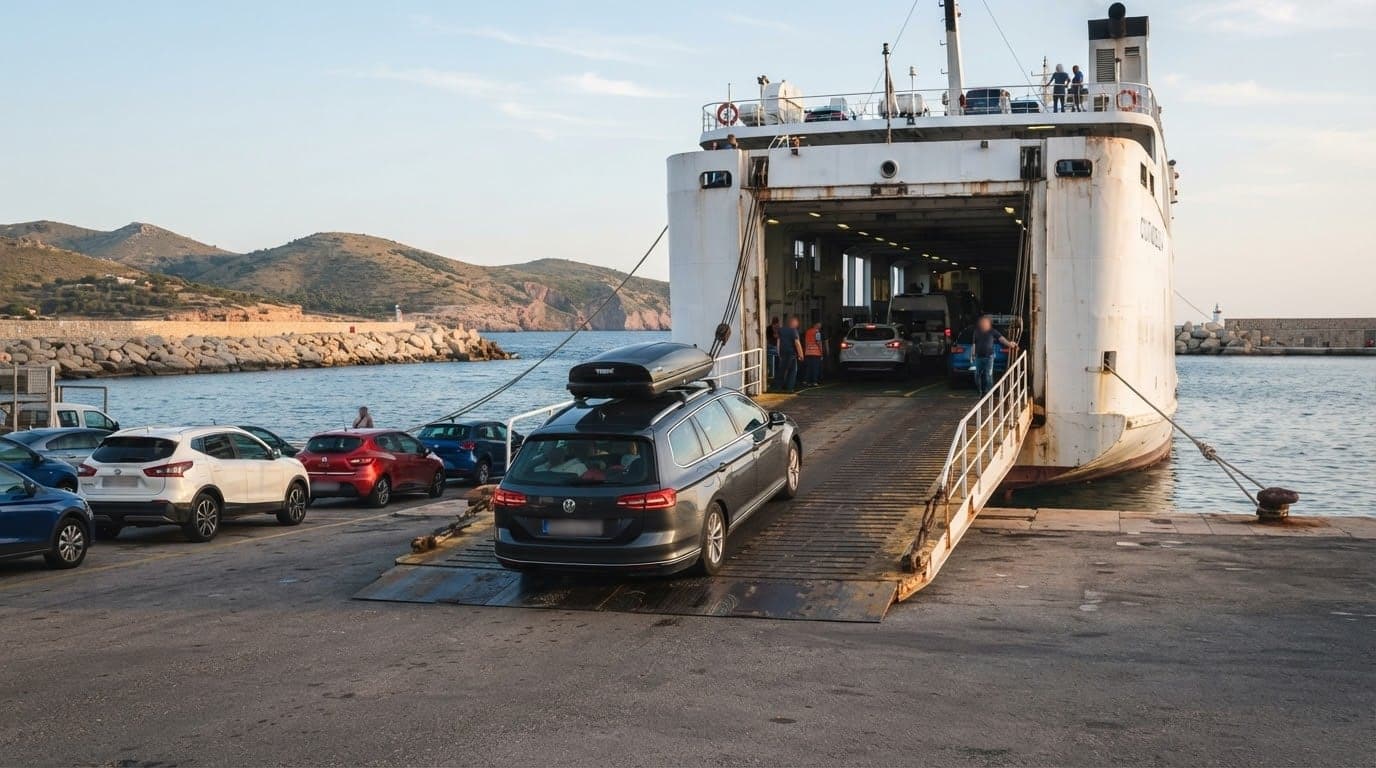
Three companies run the mainland Spain routes in 2026: Baleària, Trasmed and GNV. Barcelona has daily sailings to both Palma and Alcúdia. The Alcúdia run is the shorter crossing, while the Barcelona to Palma ferries take roughly seven to eight and a half hours. Valencia has daily ferries to Palma, and Baleària's fast ferry from Dénia reaches Palma in around five hours.
From France, Corsica Ferries operates a seasonal route from Toulon to Alcúdia, which suits drivers coming from Switzerland, southern Germany or Italy who would rather avoid the full length of the Spanish coast.
For anyone heading to Santa Ponsa, Port d'Andratx or anywhere in the southwest, Palma is the better arrival port. The Ma-1 motorway takes you from the port to Calvià without crossing the city centre. Alcúdia makes sense for the north and east of the island.
Driving to Mallorca from the UK
UK drivers have two options. The first is the Channel: Dover or the Eurotunnel to Calais, then roughly 1,350 kilometres through France to Barcelona. The second is Brittany Ferries, which sails from Portsmouth and Plymouth to Santander and Bilbao. Its Spanish timetable runs year round from Portsmouth, with up to 16 weekly Bay of Biscay crossings in peak season and the Plymouth to Santander route running from late March to early November. From Bilbao it is around 600 kilometres to Barcelona, or a longer run south to Valencia.
The documents are straightforward. According to GOV.UK, you need your UK driving licence, your V5C log book and your insurance certificate. A photocard licence is accepted in Spain without an International Driving Permit. Your car needs a UK sticker if the number plate does not already show the UK identifier, and headlamp converters or adjustment so you do not dazzle oncoming traffic.
At the border, the EU's Entry/Exit System has been fully operational since April 2026. British passport holders register fingerprints and a facial image on their first crossing, which at Dover and the Eurotunnel happens before boarding. The separate ETIAS travel authorisation is not yet in operation, and no application is required at present. Keep an eye on the 90 days in 180 rule if you are not a Spanish resident.
Driving to Mallorca from mainland Europe
For drivers from Germany, Austria, Switzerland, the Netherlands or Belgium, there are no border formalities inside the Schengen area, so the journey is simply a long drive. Most people head down the Rhône valley, cross into Spain at La Jonquera and continue to Barcelona or Valencia. The AP-7 motorway along the Catalan and Valencian coast has been toll-free since the concessions ended in 2020 and 2021.
France is where the paperwork sits. Low emission zones remain in force in cities such as Paris, Lyon, Marseille, Strasbourg and Grenoble after France's Constitutional Council struck down their abolition in May 2026. To drive into those zones you need a Crit'Air sticker, which must be ordered from the official site, certificat-air.gouv.fr, before you travel. Sticking to the autoroutes and ring roads avoids most of them.
What driving to Mallorca costs
Prices change by season, vehicle and how early you book, so it is better to think in terms of the main cost lines than one headline figure:
- The sea crossings: the Channel or Bay of Biscay ferry, plus the Balearic ferry. Both are priced by vehicle length and height, number of passengers and whether you take a cabin. Roof boxes and bike racks push you into a higher category.
- French autoroute tolls: most of the route through France is tolled. Spain's main coastal motorway from the border to Alicante is free.
- Fuel or charging: the largest variable. Electric drivers will find the fast-charging network along the French and Spanish motorways well established.
- Overnight stops and meals: one or two hotel nights on the mainland, depending on your route.
Booking the Balearic ferry early is the single biggest saving, particularly for July, August and the Easter holidays.
Rules once you are in Spain and Mallorca
Since 1 January 2026, Spanish-registered cars must carry a connected V16 warning beacon instead of triangles. Foreign-registered vehicles in international traffic are exempt under the 1968 Vienna Convention and can continue to use warning triangles, alongside reflective vests.
Palma's low emission zone, covering the old town inside the Avenidas and along the seafront, has carried fines since July 2025. Until 31 December 2026, cars with the Spanish B, C, ECO and 0 labels can enter. From 2027 the threshold rises to C, ECO and 0. Foreign-registered cars need to be entered in the city's authorisation register at least five days before they enter, using the form on Palma's mobility website.
How long a foreign-plated car can stay depends on your residency status. We cover this in detail in our guide to non-resident car ownership in Mallorca, and if you are moving here for good, our article on importing and registering a car walks through the matriculación process.
Mallorca's planned vehicle cap
The big change on the horizon is a law to limit the number of vehicles arriving on the island by sea, similar to the systems already running in Ibiza and Formentera. The Consell de Mallorca approved the bill on 5 June 2026, and on 9 September the Balearic Parliament voted to take it into consideration, with every group in favour except Vox, which abstained.
As drafted, the bill allows the Consell to set an annual or two-year ceiling on incoming vehicles, an entry charge and a separate cap on hire cars. Ferry companies would issue the entry permits and collect the charge, and breaches carry fines of between 300 and 30,000 euros. Mallorca residents are exempt. Importantly for our clients, non-residents who own a home on the island fall outside the limit for one vehicle.
The bill still needs final approval, and the number of vehicles allowed will only be set once a new capacity study is complete. The Consell has said it aims to apply the system from the 2027 summer season, so anyone planning to drive over next year should watch for the final rules before booking.
Planning tips for the journey
- Book the Balearic ferry first, then build the drive around it. Summer sailings fill up early.
- Night crossings save a hotel night and land you on the island in the morning.
- Check your breakdown cover and insurance extend to France and Spain, and carry your documents in the car, not in the boot.
- Most operators carry pets, but kennel and pet cabin space is limited, so reserve it with the ticket.
- Arrive at the port in good time. Vehicle check-in closes well before departure.
What it means for property owners
For many of our buyers, driving down is part of the rhythm of owning a home in Mallorca: the car comes over in spring and goes back in autumn, loaded both ways. The homeowner exemption in the planned vehicle cap is a practical reason to keep doing exactly that.
If you are thinking about buying in the southwest, you can browse our current properties in Santa Ponsa and Nova Santa Ponsa, or call or WhatsApp us on +34 971 692 434. Our team speaks English, German and Spanish, and we have been helping people settle on the island since 1985.