Table of Contents
Gananciales vs Separación de Bienes: What Spain's Marital Property Regimes Mean for Foreign Buyers in Mallorca
Every couple who buys property in Mallorca through a Spanish notary will, at some point during the signing, hear a question that rarely comes up in their home country: what is your matrimonial property regime? For couples married in Spain this is usually straightforward. For foreign couples, it can be the moment a purchase slows down — not because anything is wrong, but because nobody has explained what the notary actually needs to know.
This is not a tax question and it is not about who pays what. It is about how the property you buy will be legally owned between you as spouses, and it has real consequences later if you come to sell, remortgage, or if the marriage ends.
What Is a Matrimonial Property Regime?
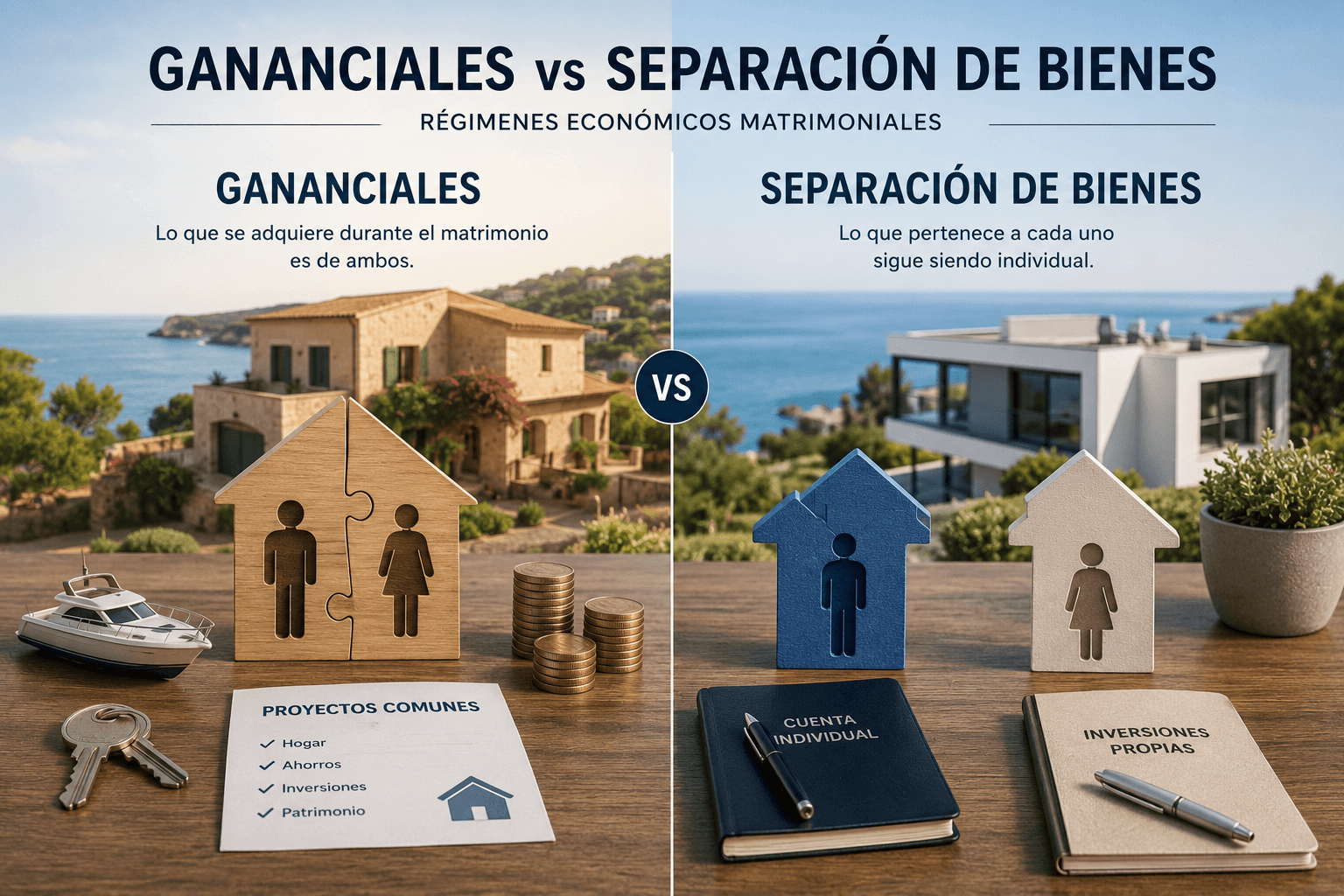
Under Spanish notarial law, the notary is required to record the matrimonial property regime governing the buyers whenever a purchase could affect the financial consequences of a marriage — and buying a home is the textbook example. Spanish law recognises two principal models. Sociedad de gananciales is a community property regime: broadly, assets acquired during the marriage belong to both spouses jointly and are split equally, regardless of whose income paid for them. Separación de bienes is the opposite: each spouse keeps and manages their own assets independently, whether acquired before or during the marriage.
Gananciales is the default regime for Spanish couples who marry without signing a prenuptial agreement (capitulaciones matrimoniales), unless they live in one of the regions, including the Balearic Islands, where separación de bienes is the historical default under regional civil law. For foreign buyers, though, the starting point is different again.
Thinking about buying or selling in Mallorca?
Which Regime Applies to a Foreign Couple?
For couples with an international element to their marriage, the applicable regime is generally determined by EU Regulation 2016/1103 on matrimonial property regimes, in force in participating member states since 29 January 2019. In broad terms, this looks first at whether the couple made a choice of law at the time of marriage, then at their first common habitual residence after marrying, then at shared nationality, and finally at the closest connection — in that order.
Couples from common law countries, including the United Kingdom, often assume this question does not apply to them because "matrimonial property regime" is not really a concept in English or Welsh law. In practice, Spanish notarial and registry practice treats this as broadly equivalent to separación de bienes, since marriage in a common law jurisdiction does not automatically create shared ownership of assets acquired before or during the marriage. This is a well-established position in Spanish notarial practice, but it still needs to be stated and recorded correctly in the escritura, the property title deed.
Why This Matters at the Signing
The regime that gets written into your escritura determines how the property is registered, and that in turn determines what happens later. If a couple buys under separación de bienes, ownership is typically recorded as a specific percentage share for each spouse, and each spouse can, in principle, deal with their own share independently. Under gananciales, both spouses generally need to consent to any future sale or mortgage of the property, because it belongs to the marital community rather than to either spouse individually.
This becomes particularly relevant if you decide to sell later, remortgage, or if one spouse needs to act alone — for example, in the event of illness, absence, or a change in personal circumstances. Getting the regime recorded correctly at the outset avoids a situation years later where a sale is delayed because the property registry needs proof of a foreign matrimonial regime that was never properly documented at the time of purchase.
Capitulaciones Matrimoniales and Translated Documents
If you have a prenuptial agreement or marriage contract from your home country that sets out a specific property regime, Spanish notarial practice generally requires a certified translation of that document, prepared by a sworn translator authorised by Spain's Ministry of Foreign Affairs, before the notary can rely on it. Some couples instead choose to formalise capitulaciones matrimoniales directly before a Spanish notary at the time of purchase, adopting Spanish law and a specific regime such as separación de bienes going forward, which can simplify matters considerably for future transactions in Spain.
Neither route is inherently better; the right choice depends on your existing marriage contract, your nationality, and how you intend to hold other assets. This is a conversation worth having with a Spanish notary or lawyer well before completion, not in the notary's office on signing day.
What Buyers Should Do Before Completion
Foreign couples buying in Mallorca should establish, ideally before making an offer, which matrimonial property regime applies to them under their home country's law, whether that regime needs to be evidenced with translated documentation, and whether they want to adopt a Spanish regime instead through capitulaciones. Bringing marriage certificates and any existing prenuptial agreements to early meetings with your notary or lawyer, rather than at signing, gives everyone time to prepare the correct paperwork.
This is one of several legal steps, alongside obtaining an NIE and understanding the escritura itself, that foreign buyers need to work through before completing a purchase in Mallorca. None of it is complicated once it is explained properly, but it is far easier to sort out in advance than to untangle at the notary's desk.