Table of Contents
IBI Explained: The Annual Property Tax Every Mallorca Owner Pays
Every property owner in Mallorca, resident or not, receives a bill each year for IBI, the Impuesto sobre Bienes Inmuebles. It is the closest equivalent to council tax in the UK or Grundsteuer in Germany, and unlike some of the more complicated taxes that come up around a Spanish property purchase, it is one that owners live with every single year for as long as they hold the property. Understanding how it is calculated and when it falls due avoids the most common mistake foreign owners make with it: missing the payment simply because the notice went to an address they were not checking.
What IBI Actually Is
IBI is a municipal tax, set and collected by the local town hall rather than the national tax authority, and it applies to every property owner in Spain regardless of residency status or whether the property is occupied, rented out, or standing empty. It is calculated as a percentage of the property's valor catastral, the cadastral value assigned by the Spanish land registry office, the Catastro, which is an administrative valuation and is typically well below the property's market price. Buying a luxury villa for several million euros does not mean the IBI bill is calculated on that figure; it is calculated on the valor catastral alone.
How the Tax Is Calculated
The general rate applied to the valor catastral in the Balearics falls between 0.4% and 1.1%, with the exact percentage, the tipo impositivo, set individually by each town hall. This means two similarly priced properties in different municipalities, or even in different parts of the same municipality, can carry noticeably different IBI bills. In the southwest, this typically works out to a few hundred euros a year for a standard apartment and can run into the low thousands for a large villa or a rural finca with substantial land and outbuildings, though the specific figure always depends on the property's individual cadastral valuation.
Thinking about buying or selling in Mallorca?
In Mallorca, IBI collection for most municipalities is administered by the Agència Tributària de les Illes Balears, the ATB, on behalf of the local town halls. The person liable to pay is whoever is registered as the owner on 1 January of that year, which is a detail worth clarifying explicitly in the purchase contract when buying or selling partway through the year, since the outgoing and incoming owner sometimes agree to split the bill proportionally even though only one of them is technically the registered payer.
When IBI Falls Due
Payment periods vary by municipality, but across most of Mallorca the voluntary payment window runs broadly through the autumn months, and in Calvià specifically, IBI and the separate rubbish collection charge, basura, are typically collected together around the summer. The exact dates are published annually by the ATB and by each town hall, and they can shift slightly from one year to the next, so it is worth checking the current calendar rather than assuming last year's dates will repeat exactly.
Missing the voluntary payment period triggers a surcharge, generally in the region of 20% of the amount owed, and the debt can ultimately attach to the property itself if it remains unpaid for long enough, which matters for anyone buying a resale property, since outstanding IBI debt from a previous owner can in some circumstances follow the property rather than the individual who incurred it.
Why Foreign Owners Often Miss the Payment
The most common reason non-resident owners fall behind on IBI is straightforward: the notice, the recibo, is sent to the address registered against the property, and owners who are not living there full time, or who have not kept their contact details updated with the town hall, often never see it. This is compounded when a Spanish postal address on file is not actively checked between visits.
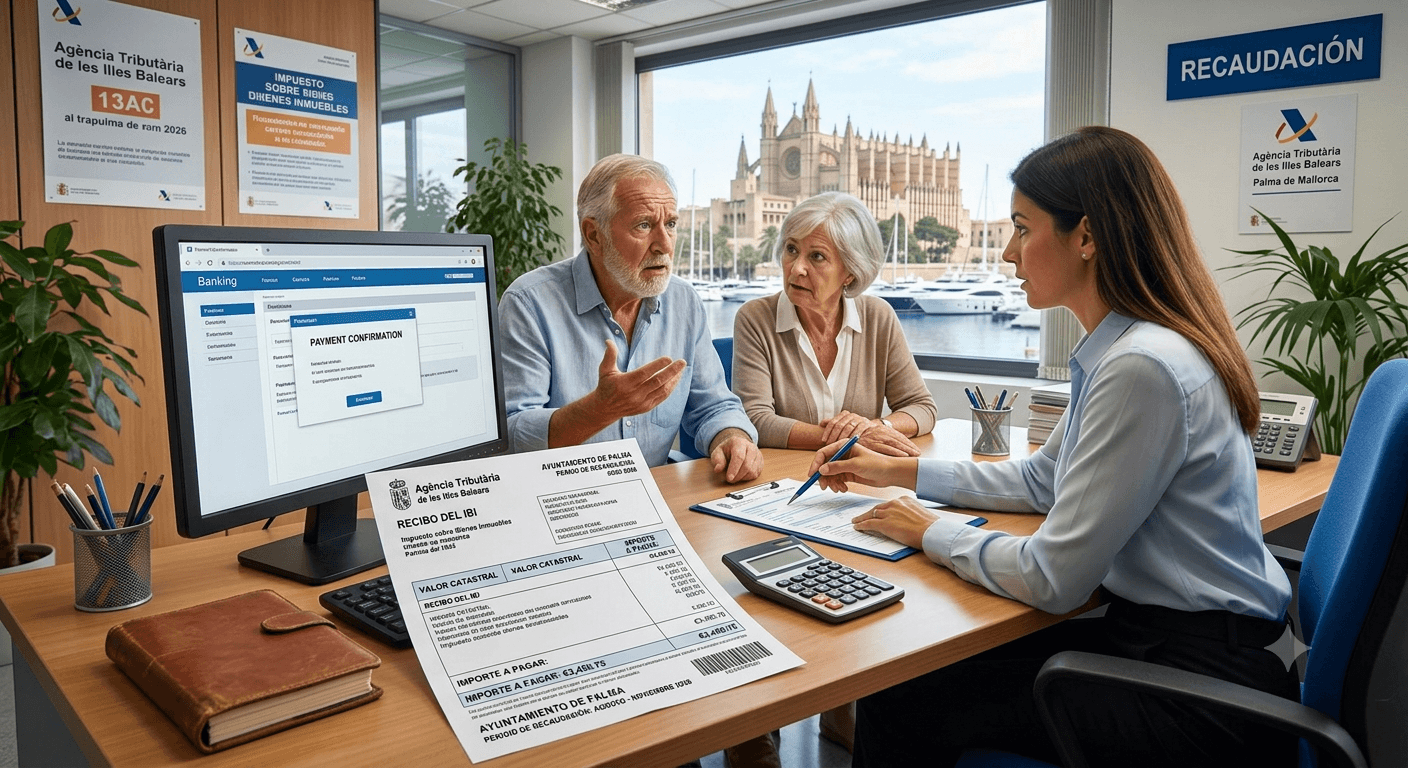
The most reliable solution is setting up direct debit, domiciliación bancaria, from a Spanish bank account, either through the ATB directly or through the relevant town hall. Once in place, the payment happens automatically each year within the collection period, regardless of whether the owner is on the island to receive a paper notice. Most Mallorcan municipalities also allow online payment through the ATB portal or the town hall's own website using the reference number from a previous IBI receipt, which is a useful fallback for the first year of ownership before direct debit is arranged.
What Buyers Should Check Before Completion
When buying a resale property, it is worth asking the seller for their most recent IBI receipt. This confirms the current annual amount, the payment schedule for that specific municipality, and, importantly, whether the tax has actually been paid up to date, since unpaid IBI is one of the debts a notary and land registry search should surface before completion. Most purchase contracts also address who is responsible for the year's IBI in proportion to how long each party owned the property during that calendar year, and this is worth confirming explicitly with your lawyer rather than assuming it will be handled automatically.