Table of Contents
Registering for Public Healthcare in Mallorca: How the IB-Salut System Works
One of the most common questions from people moving to Mallorca is also one of the most practical: how do I actually get seen by a doctor here? Spain's public healthcare is consistently ranked among the best in Europe, and on the Balearic Islands it is managed by IB-Salut, the Servei de Salut de les Illes Balears. But getting registered involves a specific sequence of steps, and doing them in the wrong order is the most common reason new residents get stuck.
This guide sets out that sequence clearly, along with what to expect once you are registered and where the public system's real limitations are.
Who Is Eligible for IB-Salut
Access to Spain's public healthcare system depends on your residency and employment status, not your nationality. If you are employed or self-employed in Spain and contributing to the Seguridad Social, you and your registered dependants are entitled to public healthcare. Pensioners receiving a state pension from another EU or EEA country can access IB-Salut using a form S1, which transfers their healthcare entitlement to Spain. Economically inactive residents, including many early retirees and remote workers who are not paying into the Spanish system, can access the public system through the convenio especial, a special agreement that allows affiliation to the SNS for a monthly fee, though many in this position choose private insurance instead, particularly non-EU nationals on visas that require it.
Thinking about buying or selling in Mallorca?
The Registration Sequence, Step by Step
The order matters, because each step depends on paperwork from the one before it. First, register at your local town hall to obtain your empadronamiento, the certificate confirming your address in the municipality. In Calvià and the wider southwest, this is done through the ayuntamiento serving your area. Second, if you do not already have one, obtain your NIE or TIE, your foreign identification number, since this is required at every later step. Third, if you are employed or self-employed, register with the Seguridad Social to obtain your social security number; if you are relying on an S1 or the convenio especial, gather that documentation instead.
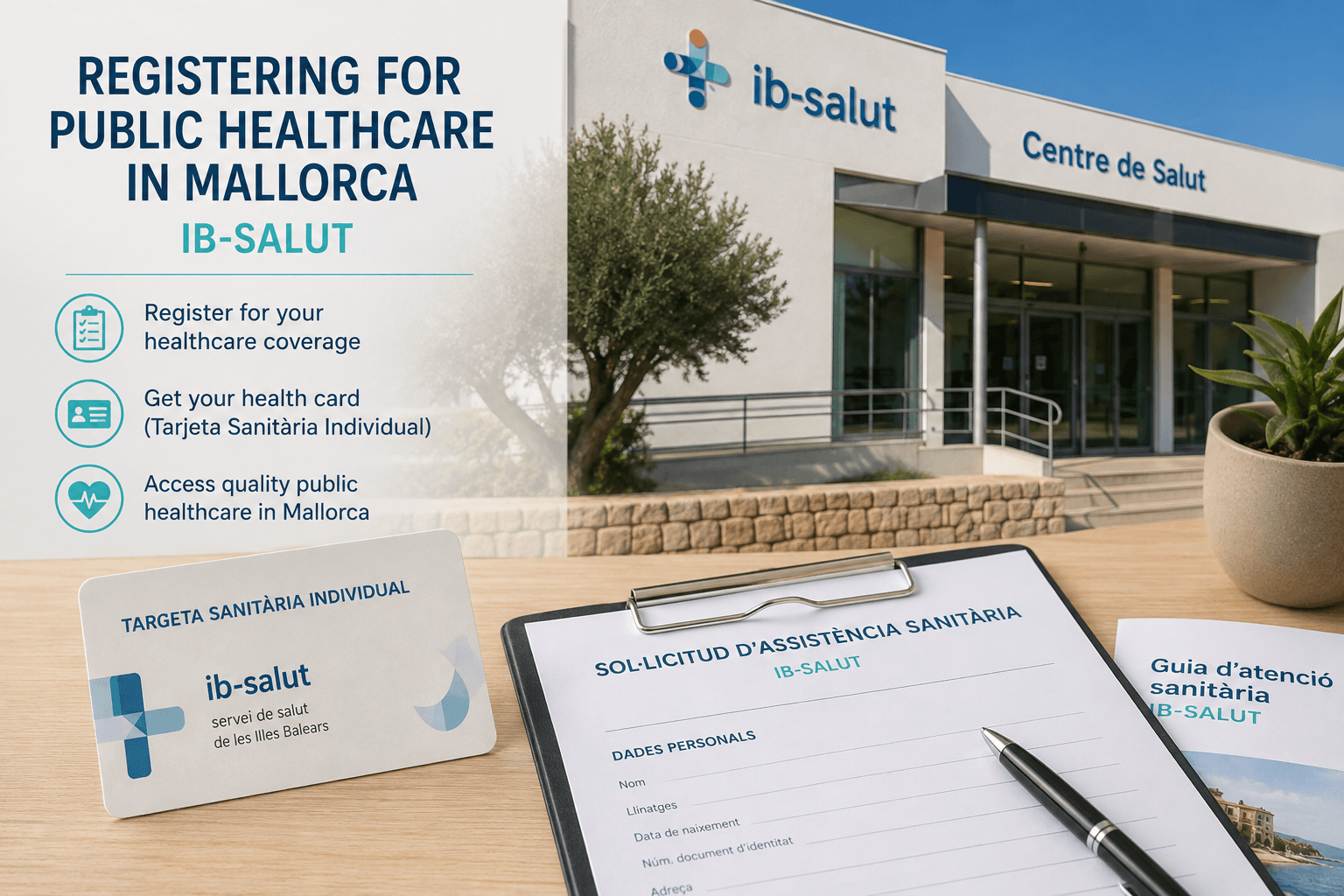
Only once these are in hand can you visit your nearest Centro de Salud, the local public health centre, to register formally with IB-Salut. Appointments can be arranged by phone through INFOSALUT CONNECTA on 971 220 000, or in person at the centre itself. Once registered, you receive a Tarjeta Sanitaria Individual, the personal health card that proves your entitlement and lets you collect prescribed medication from any pharmacy in Spain. It is valid for four years and needs to be renewed rather than reissued from scratch.
What the Tarjeta Sanitaria Covers
Registration with IB-Salut assigns you a primary care doctor at your local Centro de Salud, who becomes your first point of contact for almost everything, from routine illness to referrals for specialist care. Those covered by the system pay nothing for GP appointments, accident and emergency treatment, or inpatient hospital care, though some prescription medications carry a co-payment that varies by income and employment status.
For anyone in the southwest, the main hospitals in the network are Son Espases University Hospital in Palma, the principal hospital for the Balearic Islands, and Son Llàtzer Hospital, also in Palma, which handles specialist and emergency services. Your Centro de Salud refers you onward to these when needed; you cannot generally book directly with a hospital specialist without going through primary care first.
Where the Public System Has Limits
The quality of care within IB-Salut is genuinely high, but waiting times for non-urgent specialist appointments and elective procedures can be long, and this is the main reason many residents choose to combine public entitlement with private health insurance. Language is a lesser but real consideration too: most staff speak Spanish and Catalan, and English is common, particularly in Palma and areas with a high international population, but German and other languages are less consistently available, though interpreters are provided at the major hospitals when needed.
None of this makes IB-Salut a poor choice, and the great majority of residents, Spanish and foreign alike, rely on it as their primary healthcare. But it is worth understanding these trade-offs before deciding whether private insurance makes sense alongside your public entitlement, rather than after you are already waiting for an appointment.
Practical Next Steps for New Residents
If you are relocating to the southwest, the sequence to follow is straightforward once you know it: register your address at the ayuntamiento, secure your NIE or TIE, establish your entitlement route through employment, an S1, or the convenio especial, then register at your nearest Centro de Salud. Bringing your passport, proof of address and relevant entitlement documentation to that final appointment avoids a second visit.
Healthcare registration is one of several practical steps, alongside utilities, vehicle matters and school enrolment, that new residents in Mallorca need to work through in their first few months. Getting the sequence right the first time saves considerable back-and-forth later.