Table of Contents
Puig de sa Morisca: Santa Ponsa's 3,000-Year-Old Hilltop Archaeological Park
Puig de sa Morisca is a 45-hectare archaeological park on the hill above Santa Ponsa, with Talayotic ruins, Islamic-era remains, 8 kilometres of trails and views across Santa Ponsa, Son Ferrer and El Toro. It is open all year round and entry is free.
Plenty of people who live in Santa Ponsa have driven past the entrance a hundred times without going in. That is a shame, because this pine-covered hill holds more history per square metre than almost anywhere else in Calvià, and the views from the top are some of the best in the southwest.
What Is Puig de sa Morisca?
According to Calvià Town Council, the Archaeological Park of Puig de sa Morisca is the largest peri-urban park in the municipality. It brings together archaeological, ethnographic, natural and landscape heritage across 45 hectares on the eastern side of Santa Ponsa bay, on a hill of around 120 metres.
The park tells three big stories in one place: the Talayotic culture unique to the Balearic Islands, a later Islamic settlement from the Almohad period, and the site of the first battle of the Christian conquest of Mallorca in 1229. For a small hill surrounded by residential streets, that is quite a list.
Thinking about buying or selling in Mallorca?
The Talayotic Settlement
The heart of the park is the Puig de sa Morisca settlement, an Iron Age Talayotic village that played an important role in how the surrounding territory was organised and in trade between the Talayotic people and the Punic world, particularly from the fifth century BC onwards.
At the summit, a set of defensive structures turns the hilltop into a small fortress. Three towers built in the massive, cyclopean style typical of the period guard the north and south of the summit, giving a commanding view over the land and sea around them. In the middle stands the remains of a circular talayot around nine metres across, protected by stretches of wall at its most exposed points.
The settlement did not stand alone. Around it lie a series of related sites, including the Son Miralles talayot, the Es Fornets sanctuary and the Turó de ses Abelles. Together they make Puig de sa Morisca a textbook example of how Talayotic and post-Talayotic communities organised their territory in Mallorca.
The Islamic Chapter
The hill was occupied again much later. Archaeologists have documented a domestic hearth in Tower I dating from the Taifa period (1009 to 1115), the first sign of Islamic-era occupation. The more substantial Islamic remains are on the summit, where three rooms were built during the Almohad period (1202 to 1229), arranged around the old Tower III.
That date range ends in 1229 for a reason. In September of that year, the troops of King Jaume I of Aragon landed at Santa Ponsa and fought the first battle of the conquest of Mallorca nearby, a moment still celebrated every year in the town's Festes del Rei en Jaume.
Nature and Rural Heritage
You do not need to be an archaeology enthusiast to enjoy the park. The hill is covered in Aleppo pine and Mediterranean scrub, with wild olive, rosemary, lavender and mastic along the paths, and rarer species such as Ephedra fragilis and the orchid Orchis collina. The shade of the pines makes it a comfortable walk even on warm days.
The park also preserves traces of more recent rural life, including sitges, the circular platforms where charcoal was once made, and restored stone huts once used by the people who worked the woodland. They are a reminder that until well into the twentieth century these hills were a working landscape, not a holiday backdrop.
Walking the Trails and Viewpoints
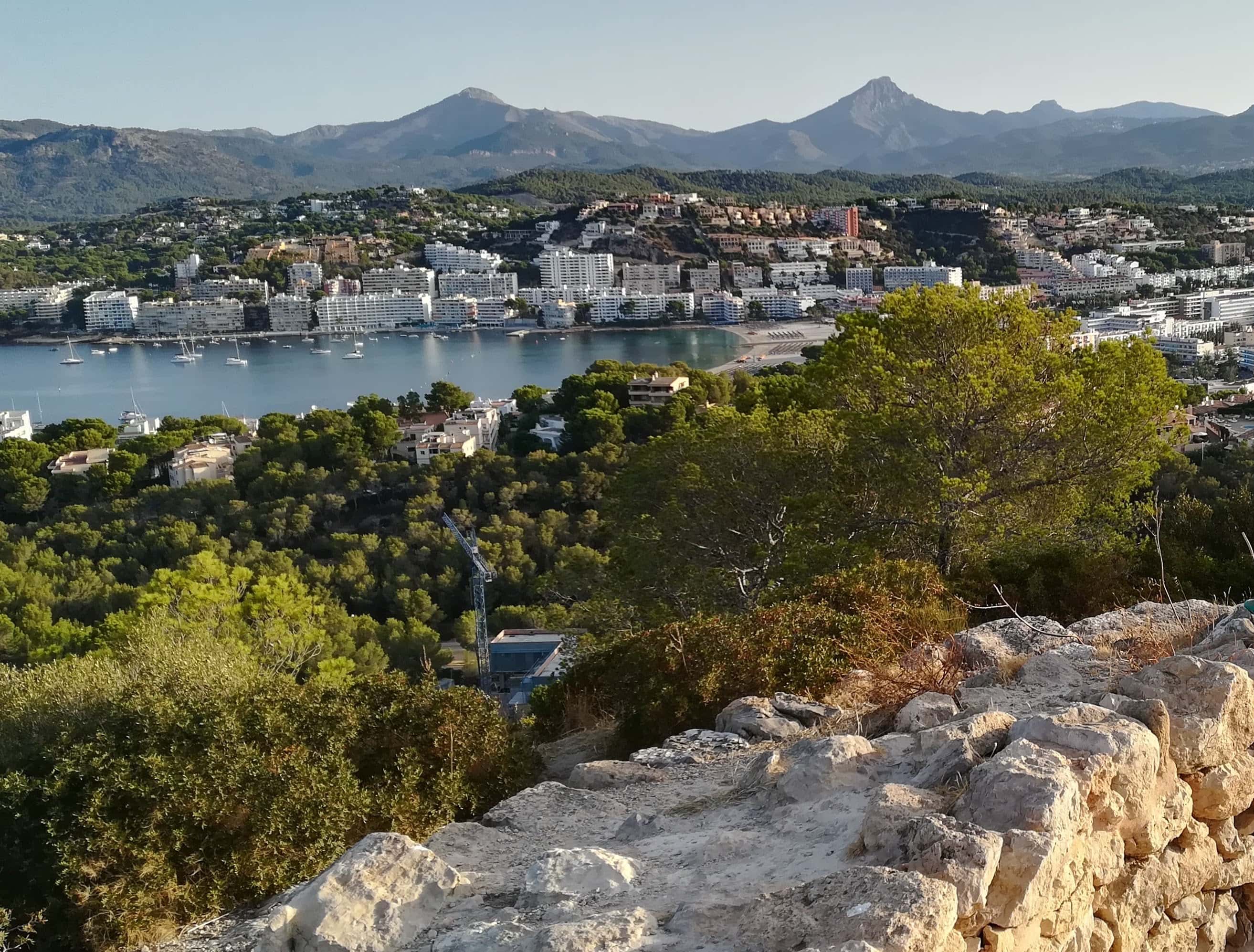
The park has around 8 kilometres of trails and five viewpoints, looking out over Santa Ponsa, Son Ferrer, El Toro and the open sea. Most visitors find the walking easy, with a few short, steeper sections and steps as you climb towards the summit. A typical loop taking in the settlement and the main viewpoints takes around an hour to an hour and a half at a relaxed pace.
The views are the reward. From the top you can follow the curve of Santa Ponsa bay and the coastline towards El Toro, with the pine-covered hills of Calvià inland. Late afternoon, when the light turns golden over the water, is a particularly good time to go.
Practical Information
- Location: the main entrance is on Carrer Puig de na Morisca in Santa Ponsa, with a car park beside the gate.
- Opening: open all year round.
- Price: free entry.
- What to bring: water, comfortable shoes and a hat in the warmer months. There are no cafés or shops inside the park.
Next to the entrance stands the park's main building, 1,700 square metres, set aside for archaeological collections from excavations carried out across Calvià over the past 60 years. A permanent exhibition, "Humans in Contact", is being developed there. Full details are on the Calvià Town Council heritage page.
Living Next to History
For residents, Puig de sa Morisca is more than a visitor attraction. It is a protected green space right on the edge of Santa Ponsa, a place for morning walks with the dog, a family picnic or a sunset stroll, all within a few minutes of home. Homes in the streets around the hill enjoy a rare combination: the beach and the marina on one side, and forest trails on the other.
It is one of the details that makes Santa Ponsa such a rounded place to live, with beaches, golf, a working marina and, just up the road, 3,000 years of island history.
Find Your Home in Santa Ponsa
Imperial Properties has been based in Santa Ponsa since 1985, and we know every street around the hill. If you would like to live close to Puig de sa Morisca, browse our latest properties for sale in Santa Ponsa and Nova Santa Ponsa.
Call us on +34 971 692 434, message us on WhatsApp, or email help@imperial-properties.com. If you are thinking of selling, you can request a free property valuation.