Table of Contents
Deià: Inside the Village Robert Graves Turned Into an Artists' Colony
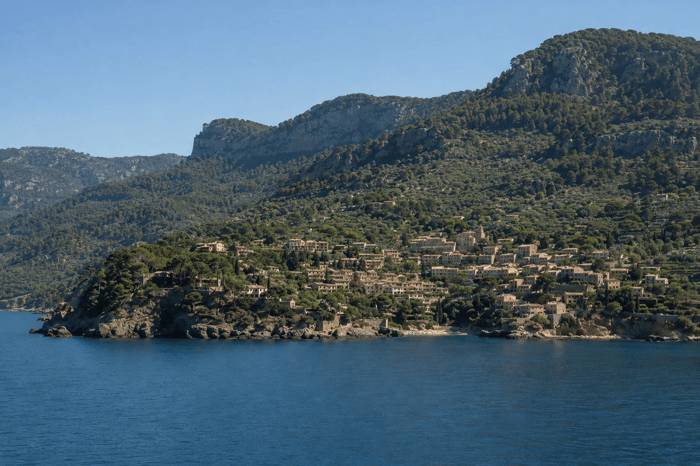
Deià sits wedged between the Tramuntana cliffs and the sea, a cluster of ochre stone houses stacked up a hillside about twenty minutes north of Sóller. It's a small place — a few hundred residents, one main street, a church at the top of the village — but its reputation runs far beyond its size. That reputation was largely built by one man: the English poet and novelist Robert Graves, who arrived in 1929 and stayed, on and off, for the rest of his life.
What Graves started, others carried on. By the second half of the twentieth century, Deià had become one of the Mediterranean's genuine creative enclaves, and the pull hasn't really faded. Walk the village today and the connection to that period is still visible, in the cemetery, in the house Graves built, and in the way the village still treats art as something ordinary rather than exceptional.
Why Robert Graves Chose Deià
Graves came to Mallorca on the recommendation of Gertrude Stein, who reportedly told him the island was a paradise — if he could stand living there. He arrived with the American poet Laura Riding in 1929, when Deià was still a remote farming and fishing village with no real tourist trade. Behind him was the trauma of the First World War, in which he had served and been seriously wounded, along with a fractured personal life and an academic career at Oxford he had little appetite to continue.
Deià offered something different: distance from England, a landscape he found suited to work, and a village largely indifferent to who he had been before he arrived. He and Riding bought land on the sunny eastern side of the valley in 1930 and had a house built by local masons, moving in two years later.
Thinking about buying or selling in Mallorca?
Ca n'Alluny: The House Robert Graves Built
The house is called Ca n'Alluny — "the distant house" — and it still stands about a kilometre outside the village on the road toward Sóller, looking out over olive terraces to the sea. Graves and Riding finished the garden not long before the Spanish Civil War broke out in 1936, forcing them to leave Mallorca. The Second World War followed almost immediately after, and it wasn't until 1946 that Graves returned, this time with his second wife Beryl and their children, to find the house had been quietly cared for by village friends throughout the intervening decade.
He lived there until his death in 1985, working through more than 140 books across poetry, historical fiction, mythology and translation — I, Claudius among the best known. The Robert Graves Foundation, established with backing from the Balearic government's Department of Culture, acquired the house and opened it to the public as a museum in 2006. The rooms are largely as he left them: his study with its desk and typewriter, the family's furniture, the garden he dug himself when he needed to think rather than write. Visits typically begin with a short film on his life before moving through the house itself. Graves is buried in the village cemetery at the top of Deià, beside the church, with a simple headstone facing the mountains.
The Artists Who Followed
Graves didn't set out to found a colony, but his presence changed how the village was perceived. Visitors and short-term residents followed through the decades that came after — Anaïs Nin, Gabriel García Márquez and Ava Gardner all spent time in Deià at various points, drawn partly by the landscape and partly, inevitably, by Graves' own circle. The pattern deepened in the 1970s, when musicians including Mike Oldfield and Kevin Ayers settled in or around the village, cementing its reputation as somewhere creative people came to work without being disturbed.
That reputation has held. Deià still has a disproportionate number of working artists, writers and musicians relative to its population, along with a small but active gallery scene and a village bookshop that has outlasted plenty of shops selling more obviously profitable things. It isn't a place that performs bohemianism for visitors — it's simply retained the conditions that made it attractive to Graves in the first place: quiet, light, proximity to the sea, and a mountain backdrop that keeps the pace slow.
Deià Today: Village Character and Life
The village itself is part of the Tramuntana mountain range, a UNESCO World Heritage cultural landscape recognised for its centuries of agricultural terracing and dry-stone construction. Deià sits within that landscape rather than beside it — the stepped olive groves that surround the village are the same terraces that have shaped this coastline for generations, and they're one of the reasons the village has changed comparatively little in outward appearance even as its profile has grown.
There's a small cove below the village, Cala Deià, reached by a steep path down through the terraces, and the walking routes around the village connect through pine forest and along the coast toward Sóller in one direction and Valldemossa in the other. Restaurants and cafés in the village lean toward small and seasonal rather than large and tourist-oriented, a pattern that's held for decades and that residents tend to guard carefully.
Property and Living in Deià
Deià's combination of scarcity, protected landscape status and cultural cachet has made it one of the more sought-after addresses in the whole of Mallorca, not just the northwest. Building within the village and the surrounding terraced land is tightly restricted by Tramuntana heritage rules, which keeps the housing stock small and largely historic — traditional stone fincas and village townhouses rather than new development. That scarcity is part of what continues to draw buyers who want the specific combination Graves himself found here: privacy, a working landscape rather than a manicured one, and a community that has never really organised itself around tourism.
For anyone exploring property options across the island with a similar profile in mind — protected setting, strong rental and resale history, proximity to both mountains and coast — it's worth browsing what's currently listed across Mallorca to get a sense of how villages like Deià compare with other parts of the island.